Speedy Sedan: Euro 1978 Mercedes 450SEL 6.9

The Mercedes 450SEL 6.9 was a high-performance version of the W116 platform.


W116 were the legendary flagship sedan produced by Mercedes from 1972 to 1979, making it the luxury car of the '70s, owned and driven by anyone who was anybody back then, such as heads of state, oil tycoons, athletes and movie stars.

They were great cars, perhaps the first real modern Mercedes sedan. They looked really good and were built even better.


This is a 1978 Mercedes 450SEL 6.9 being offered for sale.

You've got to love the numbering code used by Mercedes and the ease with which it is deciphered. The "450" typically designates a 4.5-litre 8-cylinder engine. "SEL" tells us it's the extended wheelbase, which is essentially a slightly stretched chassis for extra rear passenger leg room.

So this is already an exemplary vehicle.


But the "6.9" is what pushes it into the realm of greatness. These were produced in limited numbers from 1975-1979, totaling 7380 worldwide, probably about a third of which survive today. They have an even bigger 6.9-litre 8-cylinder engine that is capable of speeds up to 150mph.

Typically, when you think of 1970s European cars, you think of a costly mechanical and electrical nightmare, especially 30+ years after the fact, when maintenance history isn't always complete. Not true with the W116 platform cars and the 6.9. It actually seems like Mercedes purposely designed the 6.9 to minimize maintenance as much as possible, thanks to a dry sump oil system, where oil is circulated from storage to the engine, as opposed to a typical pan and pump found in most vehicles. Therefore since the system automatically circulated the oil, the car didn't need to have the oil changed as often as other cars. This meant more time on the road, less time in the shop.


To add a icing on the cake, this is apparently a grey-market European-specification car, meaning it was specially imported into the United States sometime in the past.

This is key. One of great travesties in U.S. automotive history was the power given to the federal government to regulate the auto industry, probably largely thanks to Ralph Nader and a bunch of slick lawyers. It created inane guidelines that were counter-intuitive and detrimental to design. This was especially true for imported vehicles, which had to meet U.S. specification guidelines. From the '60s to the late '80s this resulted in a myriad of superior European designs being downgraded and de-tuned in order to be able to legally sell their vehicles here. The results were most noticeable on headlights and bumpers, especially for Mercedes and BMW sold here. Since U.S. DOT mandated that cars sold here must have bumpers that withstand a slow-speed 5mph crash, European automakers were forced to add on larger and unsightly bumpers to all U.S.-bound vehicles, at their own expense as well. Headlights had to be single-unit sealed beam lamps, which resulted in both another cosmetic and technological step backwards.


This car has none of that.

Instead, you get a much better looking car, the way the manufacturer originally intended it to look, along with various other upgrades outlawed by the DOT like more horsepower and hydro-pneumatic self-leveling suspension, which raises and lowers the height of the vehicle via a knob on the dashboard.

This example looks terrific in white with the square Euro lamps and small, short slim chrome bumpers that flaunt the clean, muscular lines and now-classic shape. The color, car and location all go together great, as white keeps a car cooler in the Florida sun and looks good against the lush tropical landscape of Miami. The 4-doors and powerful engine guarantee it will be a cozy hauler to the beach, country club or weekends to and from the Florida Keys.

The seller states it has less thank 89,900 original miles. They do not state if the odometer is in kilometers, which would be European metrics, but I assume if it was they've converted it for the listing. The car has had at least two owners, the last being a little old lady since 1991, which is good.


The seller mentions this 6.9 was in storage and will need a tune-up. Cosmetically, they say it's had at least one repaint, which if kept the original white is not much to worry about as flat colors are much easier to replicate then metallic paint. They say it does have some bubbling on the bottom of the front driver's side door. If that's all the paint flaws there are it's not an issue. Most older Mercedes have much worse, so I personally would overlook it.

The Euro headlights, handsome as they are, look a little tired. They either just need a cleaning or may need to be replaced entirely, which is costly.

I also note some chips front grille slats, very typical of the older Mercedes. I'm not sure what the solution to that is, but rest assured it's been solved by somebody.

On the inside they say the leather is good but the dashboard is cracking, typical of older German cars exposed long-term to heat and sun. I imagine it's a hard fix as it would probably just require a whole new dash unit, so I would put a dash cover over it to hide the flaws and protect it from getting worse.

Mechanically they say it runs and shifts smoothly, but the brakes may need replacement.


Find it here on ebay for sale in Miami FL with 2 days left, 2 bids at $205, and reserve not met. I also found the dealer website with more photos and information here. They say they are asking $9,999 but say it's negotiable. That's a lot of money for a '70s sedan, but this car has so much going for it: a solid platform to start with, the very rare 6.9 model, Euro-spec right here in the U.S. and in excellent shape and relatively low miles to top it off. If you're going to get a 6.9, something like this should be the one, especially because it's a Euro-spec car. The U.S. cars are really ugly and take away from the experience. The CPI Value Guide estimates a '78 450SEL 6.9 at $4,000 fair condition, $7,700 good and $16,150 excellent. I would rate this as good, so a target price should be from $6,500k-$9,000k, making you and most reasonable sellers happy.

Lost Iacocca Platform: 16k-mi 1982 Dodge Mirada


When Lee Iacocca turned Chrysler around in the 1980s, he started by launching a series of platforms intended to revive the brand and push it out of bankruptcy. The most successful of which was the small-to-midsize K-platform, which were mostly sparse, frugal little cars that nevertheless delivered what '80s American brand-buying consumers were hungry for: solid, dependable, no-frills day-to-day transportation. The K-cars certainly delivered efficiency: 26mpg city, up to 41mpg highway with a manual transmission. That's pretty impressive.

Lesser known was a platform for a larger series of cars called the J-platform, which had rear-wheel drive.

This 1982 Dodge Mirada is based on that platform.


The J-cars included the Mirada, Chrysler Cordoba and the Imperial, a briefly revived luxury brand from the '50s. J-cars were all made only from 1980-1983 and were all 2-door coupes.

The Mirada was offered with a choice of three engines: a 225cu Slant inline-6, a 318cu V8 and a 360cu V8. All cars had automatics. The Mirada also had three trim levels: Base, S/SE and CMX.


This Mirada is a CMX with a Slant I6, so unfortunately it's not a V8 but it is the highest trim level. Chrysler's slanted engines featured cylinders titled at a 30 degree angle for various minor advantages.

Styling-wise it's every bit early '80s Reagan-Iacocca-era-Chrysler and the awkward older sibling of the K-cars. The front end is quite homely, looking like an Atari rendering of a frog, complete with an anonymous protruding grill and Malaise-era government mandated divided multiple-unit headlamps.


The rear is a little better, just a straight angle drop with horizontal slatted rectangular taillights. American designers had a lot of trouble transitioning from 1970s styling cliches to 1980s styling cliches, but they managed to do rear ends ok some of the time. It's hard to mess up a series of rectangles, anyways.

Covering the roof is a simulated convertible cloth-top if you fancy that, one of the many idiosyncrasies of American car manufacturers from the '70s to the '90s (although I occasionally see them on even newer cars).

I also spot mudflaps with "Dodge" imprinted on them.


Inside the interior isn't half-bad. Enormous cloth seats beget a typical over-sized pre-airbag steering wheel, which sits in front of numerous round-housed analog gauges, a surprising relief to find instead of the digital layouts other manufacturers like General Motors were toying with at the time.

The seller states it has only 16,294 original miles which is pretty incredible and would classify it as a bona fide survivor. Apparently only about 53,000 Mirada were made, so to find one with this low miles is exceedingly unusual. The seller explains they are actually listing the vehicle for a friend's deceased father, who presumably owned the car since new, so that fleshes out the story and seems plausible.


Condition-wise the car seems to be in overall good but definitely not perfect shape. The seller says there are some dings and dents, and there is very noticeable damage to the plastic between the body and the rear bumper that is not a major operation but is cosmetically unpleasing and should be repaired by the next happy owner.

Mechanically, they said the a/c is not working and may need a charge but otherwise the car runs and drives "perfect".

Find it here on ebay in Bohemia, NY with active bidding, reserve not met, 2 days left, and a buy-it-now of $5,795. That's kind of a lot for a non-V8 Mirada with some cosmetic flaws, but then again the ultra-low mileage will make ultra-low mileage suckers like me think twice.

Three-Seater: 10k-mi 1983 Matra Murena 2.2 S

Before I found this, if someone asked me to name a three-seat sports car I would have named the brilliant McLaren F1, which had the driver's seat positioned in the center of the cockpit flanked by two passenger seats on each side.


This, however, is another three-seater, and perhaps even more obscure.

I usually post cars for sale in the U.S. only. I'm American and my audience consists of (presumably) mostly Americans. There's also a ton of cool cars for sale around the world and if I started including them it would change the point of my blog, which is to bring you interesting cars that might be in your neighborhood. This car is in Canada, but I can't resist writing about it. It's also at least in the continent of North America, so if any of my readers become seriously interested, importation would probably slightly easier and less expensive than coming in from overseas.

It's a 1983 Matra Murena.

Matra was a French Automotive group that dissolved in 1994.

The Murena was produced from 1980-1983. It replaced the '73-'80 Bagheera, also a two-door sports car, which Matra made with Simca.

A number of things make the Murena special.


The body was made from a combination of fiberglass and polyester. To combat rust, the spaceframe was galvanized. This kind of foresight from the manufacturer is very appreciated. One of the biggest problems facing older cars is rust. To find an older car that was made protected against rust is a big relief.

The layout is mid-engine powering the rear wheels, ideal for sports car enthusiasts. The engine is a 2.2-litre inline 4-cylinder. This car also features the rare and desirable "S-kit", which raised bhp output to 142. The engine is mated to a 5-speed manual transmission.


Inside, the interior is notable for having three seats. The driver's seat is positioned far left, and then two individual seat units were placed next to it. The middle seat could be folded down to make a huge armrest. Leg and foot room looks generous. The seats look to be some sort of cozy cloth. The dashboard is typical sparsity and angles of the early '80s but it looks both exotic and inviting in brown and tan.


On top of being a very rare and desirable car, the seller states it only has 10,365 miles on it. The say it was from a museum in QC (Quebec?) which is probably the best explanation you can get accounting for the condition and low miles.


The car does indeed look great. Paint looks excellent, panels straight, no major damage or flaws. The spoiler and slatted rear quarter windows may be options, as I found photos of examples with no spoilers and clear windows instead. The slats make it look like a late model Pontiac Fiero, which is not exactly desirable, so they could be swapped out for glass pieces to look more like a Lancia Montecarlo. Everything appears original though.

Design wise it's very appealing as well. Classic compact '80s design. Muzzled front end. The taillights are broad and nicely integrated. Alloys are subtle and tasteful.

Mechanically, there seem to be no issues, although the seller didn't include any photos of the engine, which is unusual. The seller says it runs and drives however. I would still at least ask for photos of the engine compartment.


The seller is asking $12,900.00. I found several for sale in France on ooyyo.com for about $4,000-$12,000, so this would be considered on the high end. Still, it seems like a fair price for a cool car, in exceptional condition, that is also rare. The only lingering question and major hurdle would be the cost of imporation. The seller mentions it's "USA legal" but who knows what that means. It still has to pass the border somehow and I have no idea what that entails, but it can't be easy.

But if you made it through, it would be one cool car to have here.

Find it here on ebay in Toronto, Canada with a buy it now price and the make offer option.

Italo-Design by way of Japan: 1985 Isuzu Impulse

I really like these cars.

I don't like the ad for this one, however.


Let's start with the car.

You're looking at a 1985 Isuzu Impulse.

The Impulse nameplate was used by Isuzu from 1980-1993 for two generations of compact two-door hatchbacks. It was known as the Piazza outside the U.S.

This is a first generation Impulse, which was produced from 1980-1990. It was sold in the U.S. from '83-'89 model years.


The design is striking. The front hood looks disproportionally long, but when viewed from the side, the generous greenhouse glass and gently rounded hatchback end fill out the rear perfectly, balancing the whole car. There is one man to thank for all this: legendary Italian car designer Giorgetto Giugiaro. Giugiaro styled dozens of iconic cars from the late 20th century, such as the Volkswagen Rabbit, Lotus Esprit S1 and Delorean DMC-12. I would call him a pioneer of the '70s "wedge" shape for the masses. He took the wedge and perfected it, translating it into a language the public immediately embraced.

The Impulse therefore is a classic Giugiaro design. Sharp clean lines, flat-planes, narrow squinty-eyed front end and slanted hatchback rear with grid-grooved taillights. The front is reminiscent of the Delorean, with the long hood tapering to a small horizontal grille and quad square headlamps.


Interestingly, as excellent a designer as Giugiaro was, the cars that bore his touch often weren't big sellers, which of course had nothing to do with him, and instead made his designs even more rarefied.

Such is the case with the Impulse.

As is the fate of a lot of Japanese cars from the early '80s, the Impulse wasn't a big seller, and what was sold was gradually traded in or scrapped over the years, resulting in very, very few left, especially east of the Grand Canyon, where fewer were sold before they fell victim to rust from water and salt. Wikipedia estimates there are only around 2,300 registered as of 2010, so probably less were in use and even less exist by now.


Fortunately, they do pop up still, mostly as forgotten derelicts like this ad.

Condition wise the vehicle appears poor. The paint and rubber molding is all faded. There appears to be no visible rust or accident damage, but the passenger side is not pictured.

The seller states this is the Turbo model, which is a plus. The first-generation Impulse had rear-wheel drive. Combined with the turbocharged engine and tight Japanese construction I'm sure this was one solid ride in its day. Unfortunately this is also an automatic transmission, cutting back on the fun factor.

The seller also says this is an abandoned vehicle that was last running before it was left. They make no indication of how or why it was left where it is now. Worse, they say they have no title. This turns the ad sour for me and raises red flags. If the seller has no title and they aren't the registered owner, they have no legal authority to profit from the vehicle, as it would still be on the books under someone else's name. Even if the vehicle is on their property, they still must have a local sheriff take it away. If the seller is the registered owner and just lost the title, that's an entirely different and much less difficult scenario.

On top of that, they want $1,000 for it.

In conclusion, cool car, very poor ad, would not recommend. There could be a legitimate explanation for everything, but you need the whole story first.

Find it here on craigslist in Washington.

Euro Patrol: 1960 Auto Union DKW F91/4 Custom

I had no idea what this thing was before I saw it on ebay.


Apparently this was to the West German military what the Willys Jeep was to the American army: the de facto standard-issue military vehicle.

One of the wonderful things about German automakers is that they don't just make fast cars for the autobahn. They also make terrific off-road utility vehicles.

This is undoubtedly one of them.


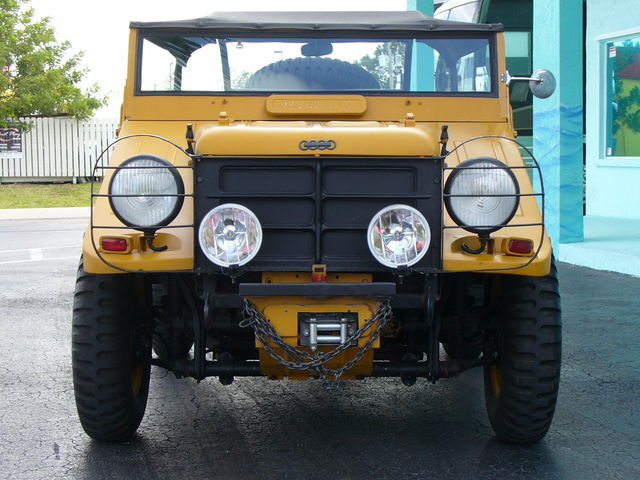
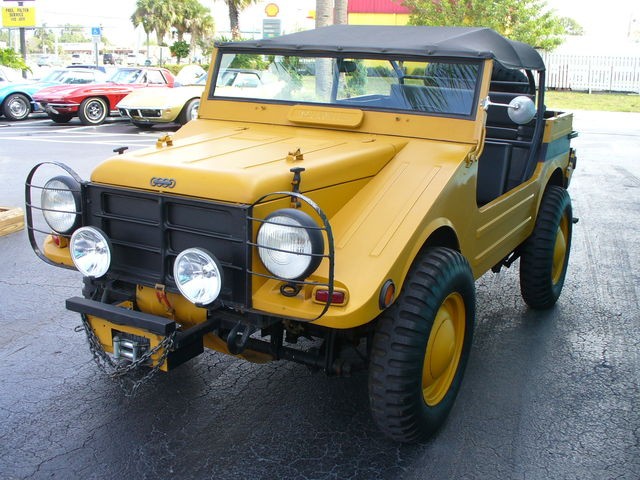
It's a 1960 Auto Union DKW F91/4. Just from the cold sounding name alone you can tell it means business.

Fortunately the seller has a great sense of humor in the listing.

They say that the official German name is "Mehrzweck UNiversal Gelandenwagen mit Allradantrieb", or "Munga" for short. They mention a lot of them were built for the German border patrol, probably for the Berlin Wall among other places. This could make it a historical and political piece.


Auto Union was a group of German automakers. As you might guess from the four-ringed logo above, the company was acquired by Volkswagen and then evolved into modern-day Audi as we know it.

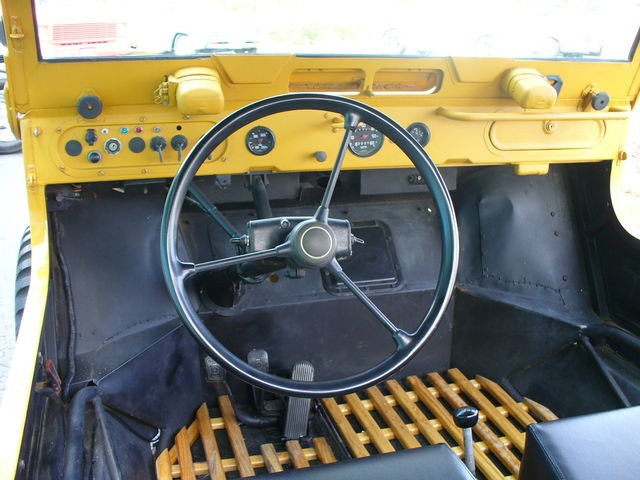
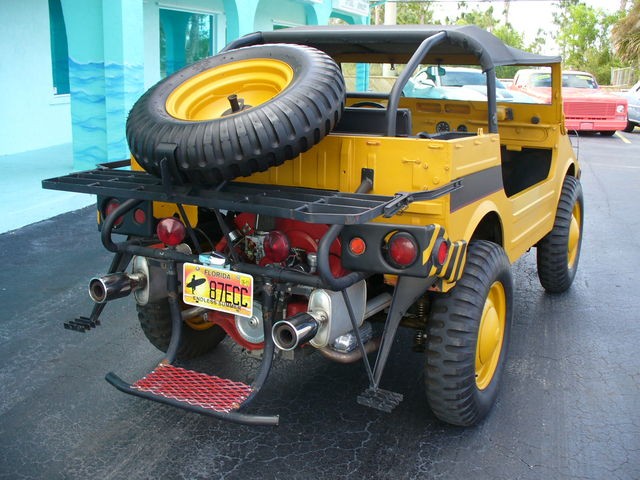
What makes this one special is the custom chopped windshield, seats, seat belts, canvas top, and tubular space frame, among other things. The chopped windshield alone is enough to raise eyebrows, and the seller states, perhaps unsurprisingly, they prefer it over the original.

I googled "munga" and found some images of the original. It is certainly different looking, much less character and more rank-and-file than this yellow beast, which is like the Alpine meets Baywatch.


I also found a cover story two years ago from the legendary Bring a Trailer that included this exact Munga for sale among three others. It elaborates on the story behind this one. Apparently the entire original engine and drivetrain were removed in favor of a rear-mounted Volkswagen engine, among various other custom touches as mentioned above. BaT states it's a 1957 as apposed to the 1958-60 the current seller thinks it is. But officially, the actual year is irrelevant: it's titled as a 1968 VW.


Apparently the 2010 sale ended with this yellow Munga being sold for $9,200, impressive for a custom job that completely alters the car's mechanical geography and driving mannerisms from the manufacturer's original intentions. The current seller now wants $9,900. It's a lot for this vehicle, but whoever is selling it is not trying to make bank on it, and probably couldn't if they tried anyways. It would be fun for a vintage euro truck enthusiast with a beach house who wants to impress guests with rides out across the dunes in it. It'll be the only one for many miles, that's for sure.


Find it here on ebay.

Forever Classic: 47k-mile 1971 Porsche 911T

I never understood Porsche fanaticism until recently.

Then hit me all at once: the superiority of rear engine design, the sexy sloping back, the slightly elitist but still cool aura. I just "got it".

As unmistakably European as they are, they're also intricately tied into the American consciousness. James Dean died driving a Porsche too fast, after all. And the legendary 356 Speedster was made with the American market, especially southern California, in mind. Porsche loved America. And Americans loved Porsche too.


As classic as the 911 has become, it was built to replace the even more legendary and beloved 356, which dare I say, was even prettier.

But with the all-new-for '64 911, Porsche managed to do the impossible: they topped a classic design with another classic design, thanks to the genius of Ferdinand Alexander Porsche, who recently passed away at the age of 76.


Designer's don't know how to do that these days. Heck, they don't even design classic shapes anymore.

Part of the classic shape is due to the ingenuity of a mounting the engine in the rear of the vehicle, for ideal handling and performance.


This is a 1971 911T.

The "T" was the base model, after the 912 was dropped. It does not stand for "Targa" or "Turbo", both other Porsche variants. The engine was simply an air-cooled flat-6-cylinder producing about 123 horsepower. In 1970, the size was increased to 2,195 cc.

This one looks to be an immaculate survivor.

The seller says it has only 47,000 original miles, which is remarkable, but not unheard of. Porsches were often not driven much by owners who either treasured them as weekend cruisers or couldn't afford the time, energy and cost of maintenance and kept them hidden in garages, so a lot do come up with supposedly low miles. Since these older cars probably only had 5-digit odometers, there is always a chance the mileage is not original and the odometer could have turned over. Check the seats, pedals and foot well for wear. I would also ask for any and all documentation. The owner provides no explanation for the low miles, so it could have been in storage for a long time. That might mean the engine will need quite a bit of expensive work to tune up. Porsches are known not to take deep slumbers well.


That said, the seller does say a complete mechanical overhaul was done, including suspension, brakes, transmission and engine. That all sounds pretty remarkable, and a good sign, but again, it needs to be backed up with receipts.

Fortunately, the seller mentions it's a matching-numbers engine and transmission, which is a huge bonus and bragging point. 

Cosmetically, the car also seems good from the photos. The exterior color looks like a deep flat burgundy-brown, which is unusual, and better than the all-too common Guards Red (I dislike a bright red Porsche). I like it. It's perfectly annoying and divisive like almost all colors from the '70s are, but it works somehow. I would inquire whether it's original.

The seller doesn't provide pictures of the seats but the interior looks black, which is a fine match for the exterior color.

I would also demand to have the car jacked up and inspect the underside. Since the vehicle is in the Northeast, I would look for rust in every place imaginable.


I do note what appears to be some front end damage. The bumper looks like it as an indentation, which could be an indicator of either of an innocent slow-speed tap while moving the car in storage or something worse like a road collision. Fortunately, in a Porsche, it's better to hit the front than the rear, since the engine is in the back. I would definitely ask what happened and why they never bothered to fix it, given the obvious attention to detail the car has received elsewhere. How I dislike sellers who don't do easy cosmetic fixes on their cars. I feel like saying, just pay for it, it will go a lot further when selling the car. If a potential buyer notices the damage, it's open season when grilling the seller.

The front bumper is also missing bumper guards, which are present on the back, along with what may be federalized reflectors on the rear bumpers as well. While not as irritating as the reflectors that were slapped on the 356, these could be potentially removed for a clean look to match the front. I would definitely add front guards to match the back, it's a quaint period look that also serves a functional protective purpose (and may have prevented the dent).


The seller is asking for $32,000, which is not cheap, but is in line with what I've seen them go for. The latest NADA value I found ranges from $16,300 low retail to $26,500 high. Hemmings CPI Value Guide places a '71 911T Coupe at fair $11,200, good $20,000 and excellent $38,000. So the $32k price could be considered on the high end. It is the base model, has some cosmetic damage and may have other unknown issues. It's also not particularly rare, though there definitely aren't many left.

It just depends on where you heart is and if you like the color. For $32K, almost a third away from a new 911, you really want to feel confident and be happy. The days when these sell for under $20k is over, so buyers need to be as aggressive as the sellers.

If you do get it, keep it maintained and drive it for those beautiful days when you're feeling fine.

Find it here on Craigslist in Providence, Rhode Island.

Basic Transportation: 56k-mile 1987 Nissan Sentra Coupe

At some point in the future, we'll look back at automotive history and remember the point when cars changed from being overall pretty basic to the mercilessly, needlessly complex vessels they are today. We know that up until at least the early 1990s, cars were still being made in a mostly straightforward, simplistic manner, especially cars from America and Japan.

This is such an innocent, honest car.


This 1987 Nissan Sentra is a surviving document from those days, and could also be remembered as an excellent example of pre-millennium car construction that was perfected by the Japanese. It was decades after they had been developing vehicles, but before they overreached themselves and descended into cliche.


Nissan and other Japanese manufacturers had tapped into an enormous hunger in the American market for cars that were inexpensive but well built and reliable. Domestic cars were certainly affordable, but were never known to be particularly ergonomic. By the 1970s this was especially apparent. Then the oil crisis of 1973 created a simultaneous appetite for fuel-efficient vehicles. The shadow of the '70s fuel crises and the scare it created was cast over nearly every major manufacturer for the rest of the 80s, until the very end when gas was plentiful, prices were low and tastes changed. They continually put out cars with the knowledge that the more fuel efficient and quality built they were, the better chance they had at being a success. The fuel crises therefore worked out well for consumers in the long run: it forced manufacturers to make better products, so that by the time the economy came back, excellent products were available for reasonable prices. The American public bought in droves. Everybody won.


This '87 Sentra is not only a largely symbolic car but also a very useful driver, perhaps the ultimate utilitarian vehicle (although the 4-door sedan or station wagon would probably best earn that title).

It's a two-door coupe version in presumably the bottom-of-the-barrel trim: not only does it have unpainted plastic bumpers and no passenger side mirror, but the seller says it also lacks power windows, a/c, power steering and even a radio unit! This is the leanest little box I've ever heard of. To the modern observer, the absence of supposed basic features is a revelation.


But good things come in simple packages, and there are huge benefits to the lack of features. The less mechanical components, the less chance things can go wrong or wear and need replacement, and therefore the less costly it will be.

Adding to the extreme frugality of this Sentra is a 5-speed manual transmission, for both better gas consumption and a little more driver participation. In the seller's own words, the fuel economy is "second to none", citing 30+ miles per gallon for highway driving, and I believe it.

The condition inside and out is what you'd expect for a 56,000 mile car that has apparently been taken care of by an appreciative owner. The paint looks bright and the body clean and straight, free of any noticeable dings and dents. There is no mention of rust, so it may be something to look for. The seller says the interior needs cleaning which is expected but not a major problem. The simple, clear, angular dashboard begets a typical but classic '80s ribbed pyramidal gearbox cowl.


Quite simply, they don't make 'em like they used to.

It's hard to place a value on this. The model wasn't any special edition or particularly rare in its heyday. This generation Sentra was produced from 1985-1990. It was a basic car then, and it's an extremely basic car now. But that's part of the charm. Currently, there are no cars being made like this. And that's what makes it special. The mileage is low, and there can't be many left east of the Grand Canyon, where they were long ago traded back in to the dealer or crushed at junkers, as they held no great value to the collective populace. But to have a working piece of economical Japanese transportation from the '80s, today? Anything under $5,000 is reasonable. The car should remain a cheap acquisition to make complete sense. Since the mileage is relatively low but not extremely low, I would also drive it, the way the manufacturer intended it: simple, basic, point-A-to-point-B transportation, cost-efficient, hassle-free and dependable.

Find it here on ebay.

Still Fresh: 11k-mile 1991 Alfa Romeo 164

Low mileage cars always fascinate me.

Sometimes they are boring cars. Sometimes they are exciting cars.

This time, it's an exciting car.


This is a 1991 Alfa Romeo 164 with only 11,736 miles showing on the odometer.

That's an average of about only 561 miles a year. In contrast, the average American drives over 15,000 miles per year, according to the U.S. DOT.

This car would therefore classify as an extreme low-mileage survivor.

And what a great car to keep preserved.


The Alfa Romeo 164 was Alfa's flagship sedan during its production from 1987 to 1998 (and only until 1995 in the U.S., when Alfa left the here market altogether). It replaced the obscure Alfa 6, which, to my knowledge, was never offered in America. In the late '80s, however, with the foreign executive sedan market hot thanks to upwardly mobile yuppie tastes, Alfa Romeo probably figured the U.S. market was ripe for an all-new sedan. It also helped they had access to a shared Euro-chassis that would also be used for the equally excellent SAAB 9000 and Lancia Thema.

The results are pretty stunning.


Thanks to Pininfarina's design, the 164 is striking inside and out, and still looks great today. The exterior is crisp, clean, angular and simple. The front end is subtle and uplifting with crystal clear rhombus-shaped headlights. The sides are notable for the trend-setting high-waistline longitudinal notch cut, along which the door handles are placed in-sync. Even more trend-setting was the single-strip taillight unit, in which all rear lights, turn signals and reverse lamps, are integrated. Although many American cars (particularly those from the late 60s and 70s) featured single unit strips, none did it as cool and artistic looking as Pininfarina made it on the 164. It was also the obvious inspiration for the taillights of Toyota's 1997 Camry when it debuted.

This 1991 model has plastic grey lower body cladding and bumpers. The two-tone look was popular in the '80s and early '90s. Some cars purposely contrasted colors, and others just featured plain un-painted bumpers. Here, I believe these bumpers are some kind of semi-gloss painted graphite color, which contrasts wonderfully with the fresh refrigerator-white body color. For the final year of U.S. market cars, the lower panels were changed to body color and chrome trim along the belt-line all the way around was added, along with different alloys. "S" models had even more cladding underneath the bumpers and whatnot, along with different wheels. However the look on this model is my favorite, and works with the proportions of the car best.


The interior is what I like to call "Eighties Mod". Pininfarina managed to capture the muscular lines of the exterior and translate them into a successful dashboard. The instrument cluster is simple and uncomplicated, but with enough gauges to satisfy gadget-geeks. The center console is an amazing column of neatly stacked rows of chicklet-sized buttons, similar to the Cadillac Allante. If you look closely, each button has a corresponding image above it, doubling the space everything needs to take up, which is why it looks so busy, yet so orderly. It's what one calls a very charming design flaw. The angled rhomboid center a/c vents are also a cool feature, particularly as they are three-dimensional, almost pyramidal, carved out-of-the-dashboard looking, as opposed to set flush the way most cars feature them.


What really makes this car however are the mechanical specifications. Underneath the hood of each Alfa Romeo 164 sold in the United States was a 3.0-litre 6-cylinder engine. From 1991 to 1993, the engine was 12 valves, from '94 to '95, 24 valves. This is a 1991, so the engine was just the 12-valve, but it still produced about 183 horsepower. The engine is known to have a sonorous exhaust note. It also has one of the nicest looking engine bays in a modern sedan, complete with "Alfa Romeo" scrawled in red cursive text below polished cylinders.

Perhaps the only downside is the front-wheel drive layout, a turn-off to enthusiasts who loath torque-steer and crave the more ideal rear-wheel drive layout for the better balance and handling it enables. To this day it's still bizarre how a supposedly sport-oriented European car maker like Alfa Romeo could offer a package this well-wrapped along with something as anti-climactic as front-wheel drive.

What partly makes up for that failing is the presence of a 5-speed manual transmission. Frankly, as much as I rave about the 164, with an automatic transmission the car really is simply all looks, no show, because the stats would be about the same in theory and execution as a typical Honda Accord. But a manual transforms this car into something slightly more ideal, an exotic four-door sporting machine. It just makes a lot more sense.


This '91 164 seems to just be the base model, not the 'L'. It has cloth interior, which a lot of people like, but I consider another downside. The leather that came in these cars, particularly the tan leather, had that delicious sand color straight from an '80s Ferrari (and I'm also sure smelled great when new). Cloth seating also wears faster and more noticeably than leather (at least cared for leather) and retains odors and stains. Other than cloth seating, nothing else seems to distinguish it from an 'L'. Exterior wise it looks the same, complete with the gorgeous alloys. It also has a sunroof.

Only so many words can describe what a nifty car the 164 was and what an incredible example this car is. Given the mileage, it's no surprise the car is immaculate inside and out, with no visible flaws, rust, or damage of any kind. Literally, the car looks new. The interior seats show a little wear due to the type of cloth used, but look good and ready for future use.


Lastly, there is value. Alfa Romeo cars of the '70s and '80s aren't worth much yet, and may not be for a while. Sedans in particular don't appreciate well in America. This is already two strikes against the 164. The high NADA value for a 1991 Alfa 164 Base is $3,975. The CPI Value Guide puts a 1991 164 Base at $3,325. The seller advertises this car with a buy-it-now price for a whopping $19,500.00, about 5 and a half times more than the current estimated retail values. The buyer and seller both have good arguments. The buyer can argue that no 1991 sedan is worth that much. The seller can come right back and say, hey this is a rare Italian-made car that is perhaps the lowest mileage example anywhere. They could be right.

Fortunately, they accept offers. Should I whip out my checkbook? I wish.

Find this beauty here on ebay.

Right Hand Drive: 1959 Peerless GT


I didn't know much about Peerless before I found this car. But I know enough about cars to know this is an unusual find.

The seller does too.

They state there were only 325 Peerless GT cars were ever built. This one is #145. The seller also estimates there are only about 40 left. That's not much.

Peerless was a short-lived UK car manufacturer from 1957 to 1960, during which they made this car. It was then supposedly re-started from '60 to '62, but folded again.

The body was a fiberglass unit that has a nice shape, a cross between Aston Martin and Jaguar, with a little Ferrari. The fins are interesting. The engines were from the Triumph TR3. It also had a de Dion tube rear suspension. "Phase 2" cars supposedly had slight improvements over earlier cars.


This example is a Phase 2.

The seller claims its a "barn find", one of the most cliched and over-used terms in the classic car market, and it also seems factually incorrect in this case. Instead, the seller explains it's been sitting for 15 years before they bought it from the previous owner who also let it sit for 15 years. Collectively, it's been overdue for a restoration for about 30 years. There is no 'barn' and no 'finding' in that story. Instead, it just makes you think less of the car if two different owners both felt it wasn't worth restoring and better left to decay outside for almost a third of a century. They must have thought, "Hey, it's fiberglass, it's not gonna rot it'll be around forever." Sure, it'll just look like garbage though.

And yet, there's no disputing in doing anything else than a complete restoration to it. It's definitely worthy, if the production stats are accurate. The question is whether you have the time, energy and deep pockets to restore.


The seller states they think a door handle is the only missing component. I'm not sure if they have a parts bin lying around for this car that wasn't photographed, but there sure seem to a lot more than just the door handle missing. I count a front grille, bumpers, gas cap and side mirrors all visually missing to start. They do say they have the bumpers, however.

It's also questionable on whether you'll ever see your money back. These cars, while attractive, apparently did not have unique engines which no doubt reduces collector value, as they therefore do not offer a wholly unique engineering and driving experience.

The seller also states the car was hit. They make it seem like the fiberglass repair is a piece of cake, "all easy fiberglass work". I've never personally repaired fiberglass, but any repair to a pre-molded fiberglass body, especially with as many cracks and shatters this one has, can't be easy or inexpensive. What would it entail? A total stripping and repaint, for sure.

The up side is that there is no rust on the body at least.

The seller does state the engine turns over, which is good.

I think this is a nice piece as a leisurely long-term project for experts but only for the right price. The bidding is over $3,500 right now and 6 days left and the reserve not met. I have no idea what direction it could go. I think anything under $5k is a bargain. Anything under $10k is reasonable. Anything over $15k is probably way too much.


 Find it here on ebay.