Showing posts with label carsforsale. Show all posts

The Last Saab: 2011 9-5 Aero XWD


The second generation 9-5 was supposed to be a comeback car for Saab. That's what its successful predecessor was in a way. Instead, it was the last Saab ever built, at least under the ownership they had for over two decades. That's not to say the 9-5 was at fault. In fact, it was a pretty great car. The demise of Saab actually goes all the way back to General Motor's meddling in the company starting in 1989. Some say they buy the competition to destroy it. They have every reason to. Saab used to make cars GM couldn't.

Saab is notorious for giving their cars initial designs that were well-executed and conservative enough so that they aged well and didn't need replacing for a decade. The first generation 9-5 replaced the 9000 in 1997, itself dating back to 1986. Both the 9000 and the 9-5 shared European GM front-wheel drive platforms. It was nothing special but got the job done. The 9-5 came at a good time in the mid 90s when the company needed a new car. It came with a sleek all-new body and interior. It was big, comfortable and reliable. These were favorites of middle class New England suburbs and sold in respectable numbers.


Unfortunately Saab (or GM, as nobody really knows who was calling the shots at that point) waited too long to replace the first generation 9-5. It fell above Volkswagen but far below Mercedes-Benz and BMW and somewhere even with Volvo, so it occupied a weird position in the market as a luxurious car with the front-wheel drive and therefore needed extra appeal and marketing to stand out. It received neither, and even after several decent facelifts, gradually just faded to the side as an automotive dinosaur. It was shameful.

In 2010, a new 9-5 did finally arrive. Saab had already tried to stage a comeback with an all-new 9-3, but that was an utter failure as the car was a poorly made and unreliable rebadged Euro GM front-wheel four-banger. It didn't stand a chance against anything Germany or Japan were offering, and it wasn't even better than an Accord or Camry. The new 9-5 was a chance to hit the reset button.


At first things looked promising. For starters, the car came in a super smooth, almost sexy body. It hinted at the brand's heritage while moving into the future. It's simple, clean and well-executed. The blackened a-pillars are cool, and the rear-tailights finish the car on a satisfying note. They also came with nifty alloy wheels that resembled fans. (always a good detail on Saabs).

Inside was one of Saab's best interiors yet, which is saying a lot since they always had good interiors. Saab had made aircraft before cars and designed the car dashboards to resemble the highly functional, user-friendly, wrap-around cockpits of a jet fighter. The result was iconic. Numerals were green, needles orange, and every button, switch and knob was artfully formed to be both easy to use and pleasing to touch. The 2nd gen 9-5 took things to a new level, with beautifully carved shapes, silver accents and artful layouts.


Underneath the hood was even more impressive. Although the previous 9-5 was never really underpowered, it wasn't exactly a hot-rod, either. Saab clearly intended to change that with the 2nd generation. This is the top of the line aero model and comes with a turbocharged 6-cylinder engine that produced 300 horsepower. As icing on top, it was matched with Saab's burgeoning system of all-wheel drive called "XWD". Frankly, I always thought it was ridiculous that Saab never offered all-wheel traction earlier on, seeing it was a Swedish carmaker and they sold so many in the snowy Northeast. But for a moment at least, the 9-5 Aero XWD was a really impressive package, for a Saab at least.


All the momentum was crushed however when Saab's financial troubles climaxed in 2010. The 2nd generation 9-5 barely got out of the gates before production ended in 2011, with just 11,280 units made, making this one of the rarest production Saabs in recent memory. The company has gone through bunch of corporate shifting from then until fall 2013, when it appears it will continue some limited production under the National Electric Vehicle Sweden (Nevs), but who really knows what will happen.

The last 9-5 is an impressive car. The platform and engines were widely used in Europe and shouldn't be too difficult to get parts. Servicing might just have to be done at a specialist, Pep Boys or your garage, though. The one positive fallout is that resale values have plummeted, so what was normally a $35k-$45k car can now be had for less than $25k.

Find this one available here for $22,895.

65k-Mile 1987 Acura Legend


Remember the Japanese invasion? No, not the one at Pearl Harbor in 1941. I'm referring to the peaceful war of commerce waged during the 1980s.

Before the US stock market had its brief bull run, the Japanese were having a party of their own, no small thanks to their culture of close corporate-government partnership that made sure everybody won (although often at any cost). Japanese industrial concepts weren't what you'd call original, but they took European and American designs and built them faster, cheaper and stronger. So when they started exporting audio equipment, televisions and cars to the US, it caused panic among manufacturers, especially the Big Three auto making giants.


Japanese cars were small, affordable and, for the most part, aesthetically pleasing. On top of that, in the wake of the fuel crises of the 1970s and their mile-long gasoline lines, Japanese cars were fuel efficient. Detroit got the message, but it was too late. American consumers loved their Toyotas and Hondas.

Then the US government stepped in and convinced Japan to accept a voluntary limit on exported cars. Since their highest volume movers were economy cars, one clever way around the limit was to move upmarket. The results were often stunning. Toyota spawned Lexus and their brilliant Mercedes-fighting LS400, and Honda created Acura. The sky was the limit.


Acura wasn't as ambitious as Lexus. The cars retained the dull styling and front-wheel drive layout of their Honda counterparts (one magnificent exception being the NSX, but that's a whole other story), but they were better equipped and had larger powerplants.

One of the first Acuras was the top-of-the-line Legend. The sedan debuted in 1986, with a coupe following the next year. The car was an instant hit with the automotive press and consumers alike. Everything that people liked about Hondas - reliability and efficiency - was kept and enhanced tenfold. The cars were also wrapped in sleek, simple, clean designs that had drag coefficients as low as .30. The coupe also came with a new 24-valve, 2.7-litre engine good for about 160 horsepower, not bad for the time. All of it was enough for Motor Trend to name the Legend their Import Car of the Year 1987.


Since they were affordable and reliable, they were driven a lot. Clean, low mileage examples are incredibly rare, especially in the wet, salty East Coast where I hail from. This particular Legend has a remarkably low 65,142 miles. For a late 80s Japanese car, that's just getting broken in. The beige-on-beige color scheme is flattering to the shape and fits the low-key, easy-going nature of the car.

Given that it's in Florida, it was probably elderly-owned since new, and as long as it wasn't in an accident, this charming ride from the last pre-internet decade is a really nice find. The seller is a dealer and is asking $5,900, a tad high but not outrageous for the quality machine you'll be getting. You could easily have this car working for the rest of your life.


The next owner has my sincere envy.

Available here on carsforsale.com

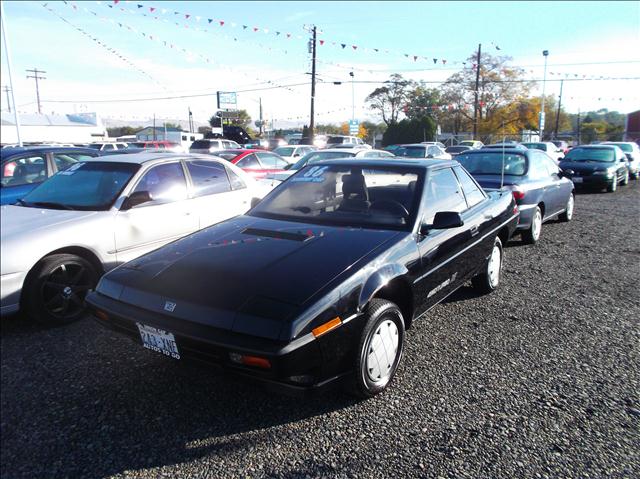
Somebody Buy Me: 1986 Subaru XT Turbo 4WD


The XT is hurdling towards new classic status, so now is the time to grab these while there are still good cheap ones left.

These were only sold from 1985-1991. The styling is befitting of the set of Blade Runner or Total Recall. Subaru designed the greenhouse inside and out to resemble the cockpit of a fighter jet. The XT has as much glass as possible supported by blacked out pillars. The front has hidden headlights. Grooves run along the side of the car that form the taillight taillight strip. The whole thing is sleek and stealthy, especially when painted black like this example.


Of all the XT trim to appreciate in value, the 85-87 Turbo 4WD models like this one stand the best chance. These were produced very briefly and feature a 1781cc turbocharged H4 engine producing 112 horsepower with multi-port fuel injection and two single overhead camshafts. The four-wheel drive system was part-time and activated with a push of a button on the dashboard. When coupled with a 5-speed manual transmission, these were fun and grippy cars.

The seller is a dealer and has only provided two photos and no details, so I can't give you much more. But the car looks clean and and the tires slick with Armor-All. They do list the mileage as just 110,343, so this puppy seems to have been modestly driven over the years, which is more good than bad. Find out if any maintenance records are available, and check for rust. Other than that, it deserves a caring owner who knows what they have and can maintain and preserve it further.

Available here on carsforsale for just $3,999. Me want!

Alternate Past: Euro 1986 BMW 520i 5-Speed


I love Euro-spec cars. For Americans, it's like seeing a whole new car that never was.

When European cars were imported here in the 1970s and 80s, the U.S. federal government required them to slap on mandated slow-speed crash test bumpers (that even the typically more regulatory European governments felt were useless). They were also hideous, and almost ruined some otherwise amazing designs come out of Germany at that time.

Fortunately, more than a couple Euro-spec cars found their way here through the grey market heyday of the 1980s. And as they turn 25 years and older, they can be imported regularly (but not cheaply).


The seller of this '86 520i bought it while living in Germany in 1994 then privately imported it here before registering and inspecting it for Washington state in 1995.

The E28 was very similar looking to its predecessor, the gorgeous Gandini-penned E12. To help keep costs down for the new model, BMW re-used the cabin section of the E12, and redesigned just the front and rear. The changes are subtle, but noticeable. The front is larger and leans forward more, and the taillights grew too and featured chrome bordering that was never used again on any other model. It was these blink-and-you-miss it differences that actually reinforced the memorable image of the cars in the minds of many.

For the U.S., however, the cars gained bumpers that were at least a foot longer, and the headlights were smaller. We also got a very limited range of engines. Of all the 1970s and 1980s BMW models, the E28 absolutely hands down looked the worst with the 5mph bumpers. And I never liked these cars because of that.


So you can understand the attraction of importing one when you see how great they actually look. In addition, the seller wisely choose to bring over an engine that was never offered here, either: the 520i, for 2.0-litre inline 6-cylinder engine, above the four-banger 518 but below the 535i. It was the smallest six available. In this example, it's mated to a 5-speed manual transmission.

Cosmetically, the seller says the "Polaris Blue" paint is original, and has no fade, oxidation or rust. In fact, they say the entire car is rust-free. On the inside, they say there are no rips, stains or any wear at all in the cloth seats. The wheels are later E32/34 V8 alloys but look very appropriate.

Mechanically, they say it runs, drives, accelerates and shifts great. They say the mileage is 132,000, but state that the odometer is obviously in kilometers...so the miles are either 82k or 132k, it's not clear if they converted it already.


The seller is clearly a responsible and adoring owner and say they changed the oil every 3,000 miles and have all records and receipts to back up their devotion to maintaining the car. They say the only upgrades are the wheels and the stereo system.

If you're looking for a solid Euro-spec Bimmer to use and continue to maintain, this could be the one. It's a rare car with even rarer owner qualities. It's a good color combo, desirable engine and transmission, with no rust, and only one U.S. owner who backs up their ownership. Not bad.

The only thing left is the price: $10,500.

Find it here on Carsforsale.com in Renton, Washington.