Showing posts with label 1991. Show all posts

59k-Mile 1991 Peugeot 405 Mi16


The 405 was not only the last Peugeot to be sold in the US, but the last French car as well. It's lack of success here must have come as a surprise to the company, because in Europe it was a hit with the press and consumers alike, winning a bunch of new car awards and selling millions of units. Just chalk it up to one of many differences between the two continents, I guess.

French cars did have a poor reputation this side of the Atlantic, but the 405 was intended to rectify that. It supplanted the smaller and less modern 305 in 1987 with an all-new body and range of engines. However it was only offered as a sedan with just three engines choices in the US from 1988-1991.

The styling was credited to famed design house Pininfarina and, if you love 80s Eurobox sedans as much as I do, you just 'get' the appeal: big greenhouse, clean flat planes, black plastic anti-dent trim all the way around, and a rear awash in red plastic. It's approachable, it's simple, and at this point it's classic. What's that saying about good design? That it is invisible? I wholeheartedly agree, and this car is an example of how subtle design is an art.

Inside, occupants are treated to a simple, functional layout, with clear gauges, manual climate controls and big cushy leather sport seats. Kind of reminds me of the third generation Jetta, and that's a compliment.

Now, the 405 was already a pleasant, capable front-wheel drive cruiser. But what makes this low-mileage survivor even more interesting is the Mi16 trim (VIN# VF3DB1332MS518585) which means that there is a 1.9-liter 16-valve 4-cylinder fuel-injected all-alloy engine under the hood, capable of producing 150 horsepower. Suddenly, an otherwise polite but sedate sedan with a modest curb weight of around 2,700 pounds was faster than Peugeot's own V6 engine.


There weren't many made, less were sold and very few survive. Practically none are in this remarkable condition. The dark green and black interior is a great combo, and the original 15" alloys are present. The chrome paneling below the belt line isn't preferred, but may have been an original factory option. The seller is a dealer who say the car has had just one previous owner and the 59k-miles are accurate. Things certainly look like that low of a mileage. Check for rust and maintenance history.

This is a rare edition of a historically important car. As of this year, there still hasn't been a French car here since the 405. The seller is asking a hefty $14.9k for car, about $9k more than the highest estimates I've read for a 406 Mi16, but they also have the Make Offer option. How do you put a price on this? Regardless, let's hope it ends up in an equally caring next home.

Available here on ebay.

1991 BMW 325iX


The E30 is a new classic BMW. It replaced the E21 in 1982 and some models lasted until 1993. What made it so great wasn't just the minimalist, hyper functional styling by genius Claus Luthe. It was the combination of compact size, 6-cylinder power and rear wheel drive that made them a blast to drive.

The dimensions of the E30 really are a revelation. Here is a design that actually shows constraint, seemingly using as little sheet metal as possible. Taught, clean and no-nonsense. The pillars are thin and glass huge for maximum visibility inside and out. The whole thing is about the same size as a 1990s Honda Civic. Except it looks way better and drives a million times better.


Perhaps the next rarest E30 sold in the US after the M3 is the "iX" models that debuted in the late 80s and lasted until around 1991. These had full time permanent all-wheel drive, utilizing an open, all viscous 10-100% limited slip with three differentials. The torque was divided 37:63 with bias to the rear wheels to retain the rwd feel. The rear and center differential use viscous couplings to split torque, while the font was open.

Inside is one of the greatest interiors of all time. An oversized steering wheel, center console angled towards the driver, and simple white-on-black gauges make a statement that this machine means serious driving business. The leather seats are in unusually good shape. The seller says the dash has cracks but everything is functioning and there are no lights on.


Underneath the hood was BMW's venerable straight 6-cylinder that was good for almost 170 horsepower, which really helped propel this small car. What is gained in weight with the iX equipment is forgiven with the added traction.


The seller of this example is the third owner and has racked up 139k miles. They say it is car fax verified and still wears the original paint. Mechanically, they say everything works except the air conditioning, and a bunch of parts have been replaced. They also say it has a chip boost for extra horsepower, which is awesome, except they say 91 Octane fuel must be used, which should probably be used anyways. Since most were sold in foul weather climates were salt was used on roads, they have mostly rusted away, but this one seems to have survived. The seller says there is no rot except around the rear trailer hitch but they are having it repaired.

This was the debut of BMW's all wheel system and therefore holds a place in history. It's equally notable they were smart enough to put it on an already nifty car. The 'iX' cars got lost in a crowded field of German all-wheel cars with Audi's Quattro and Mercedes-Benz's 4Matic, but it'll still help you in bad weather. I owned an E46 325Xi with a similar system and loved it. These cars cut through rain and sleet like a knife. Parts and fuel will be expensive, but you're getting a car that BMW - or anybody else for that matter - just don't make anything like anymore. If kept up and driven carefully this could see another 100k miles.

Available here on craigslist for $5,900.

1991 Volkswagen Type 2 Syncro


Ah, the third generation Type 2. The last of the rear-engine Volkswagens, before they Toyota-ized themselves into front-engine front-wheel drive oblivion.

But while they were still in production, these things were pretty unique. Long after Detroit had given up on the Corvair, the Type 2 "Vanagon" kept rolling on as the only rear engine van in production. The third generation lasted from 1979-1992, before they switched over to the front-engine "Eurovan".


The third generation featured more modern styling, but it was also larger and heavier. This example wears a nice shade of burgundy paint that contrasts well with the grey lower body cladding. The alloys are cool, and the square headlights are preferable over the poorly functioning round pre-'85 sealed beam units. These are cult classics now, just like almost all Volkswagen products from the late 20th century. Part of the reason is not just the unique layout, but the durability and ruggedness of the construction.


Adding to the appeal of this example is Volkswagen's patented system of four-wheel drive called Syncro. It was only offered on the Vanagaon from 1985-1992, making this one of the last. If these were go-anywhere vehicles before, the 4wd adds even more versatility.

They were available with either 4 or 5 cylinder and either gas or diesel engines. In 1984, Volkswagen switched the engines from air-cooled to water-cooled. This is an air-cooled 4-cylinder gas engine. It won't win any drag races, but it will be reliable if kept up. Earlier U.S. 1.9-liter engines were prone to head gasket failure, but the post-'85 2.1-liter were usually made to remedy that issue. This being a '91, you get all the benefits of years of improvements and upgrades.

The three-speed automatic is a downside for sporting purists, but might be easier on the hand and feet for long journeys. Volkswagen automatic transmissions have spotty reliability though, so that's one thing to watch out for.


The interior looks pretty clean and sorted, and the second row neatly folds up for extra space.

This is being offered by what appears to be a Ford dealer who provide no details on history, maintenance or even current condition. You'll definitely want the scoop on where this has been and how many owners. Vanagons are often kept for long periods by owners and then handed over to another family member or sold locally to a friend, so it's unusual for one to fall into dealer hands, unless it was just an ignorant trade-in. Check for accidents and rust, then on engine upkeep. I believe one of the photos does show rust beneath the rear window. If it all checks out though, this is a rare vehicle in decent shape and a nice color combo. The dealer doesn't list a price, but with the mileage at 150,215 you want to snag it for less than your average new 4wd SUV. Then, pack your bags, bring your family and go on a adventure and blast Steve Moore or Music For Airports-era Brian Eno on the speakers.

The craigslist ad is here and the dealer ad is here.

JDM in the US: 1991 Nissan Figaro


This may look like a car from the 60s, but you read the year right: it's a 1991.

Nissan only made about 20,000 of them in the early 90s for the Japanese market only. They were so popular that owners were chosen by lottery.


The styling is one of the earliest examples of retro designs like the New Beetle, 2002 Ford Thunderbird and Mini Cooper. It works well, especially with the flat periwinkle paint, white top and white wheels (inside very small tires). "Cute" would be a word the casual observer might use.


Inside is a right-hand drive non-airbag steering wheel, nice leather seats with piped trim and classy white face gauges.

The actual mechanicals are just as low key and simplistic, with front wheel drive and a four cylinder engine under the hood. Thankfully, the engine was turbocharged to provide a little extra boost.


The actual mechanicals are just as low key and simplistic, with front wheel drive and a four cylinder engine under the hood. Thankfully, the engine was turbocharged to provide a little extra boost, while also being really good on gas: the seller claims it gets 57 mpg.

The seller says it was titled in Florida and Texas before making its way to California where it is now. They say it has about 75,000 km which is about 46k miles on the odometer. The only flaws they point out are cosmetic: cracked seats and dash. Fortunately, they say everything mechanical works and is ready to go.

The also say it's just one of three in the US at the moment. This one isn't practical. It's all about what your heart says.

Available here on ebay with 1 bid at $10k and reserve not met.

Clean 1991 Audi V8 Quattro


This car has made the blog rounds (deservedly so) and because I love the V8 Quattro (as they were simply called back then) I'm going to do my bit too.

The V8 Quattro debuted in 1988 and lasted until 1993. Audi were having a hard time in the 80s. Their lower range models were suffering from a media-induced hysteria over unintentional acceleration. 60 Minutes even went so far as to fabricate a report! The damage was unbelievable. Sales plummeted and I believe 1990-1991 was their all time low.


Wealthy people were missing out, however. The V8 Quattro had nothing to do with the acceleration debacle and offered one hell of an alternative from Mercedes and BMW. Firstly, it was fresh and new looking. Clean lines, squared off corners, minimal chrome, flared fenders and huge front and rear lights.

Second, it offered a mechanical combination no one else did: V8 power and all-wheel drive. BMW only offered the rather ridiculous V12 750iL and the underpowered 6-cylinder 735i, and Mercedes's biggest and most powerful was the 8-cylinder 560SE/SEL. But they were rear-wheel drive. Audi offered the power of eight cylinders with the traction of all-wheel drive. For people who didn't care about fuel consumption to start with and wanted an even more sure-footed driving experience, the Audi would have been a revelation.


Inside, occupants were treated to exquisitely carved driver-oriened shapes and surfaces with a whole bunch of extra analogue gauges for the geek inside. Seats were huge and comfy. Real wood was swathed everywhere.

Since it was a big expensive car that came out when Audi was unpopular and an economic recession was just setting in, very few V8 Quattro were sold, and even fewer survive today. Resale values plummeted and they were mostly acquired for very cheap in the 90s then abandoned as the price of parts surged. Interestingly, they rarely rusted away as other German cars from the 80s have because Audi brilliantly used galvanized steel on the handsome bodies.


All that makes this puppy a rare find. At 106k miles, it's already broken in, but the mileage and overall condition indicate it must have been pretty well take care of so far. Let's hope the next owner keeps it stock and maintained. It will guzzle premium gas like a truck and be pricey to fix, but it's a sweet vintage ride that won't ever let you get stuck in the snow.

Availble here on ebay for the pretty reasonable asking price of $3,900.

1991 Renault Alpine GTA Turbo


Renault's Alpine followed the spiritual tradition of the rear-engine Alpine of the 60s. In 1978, Renault bought the company. Then, in 1986, Renault debuted their own version. It bore none of the sexy curves of the original Alpine (which resembled a Ferrari Dino), instead featuring hard angles, futuristic greenhouse glass and a grille-less front that looked more demure than a Merkur (sorry I couldn't resist).

Despite the aesthetic rebellion, it still had the rare and intriguing rear engine setup, and this time, it was packed with power. This is the turbocharged V6 version putting out 200 horsepower. Thanks to extensive use of fiberglass body panels, it was lighter and faster than similar Porches of the era.


There are few cars that black-on-black doesn't work and this Alpine is no exception. The seller says the paint is original but has wear. It also mercifully retains its original factory alloys.

Inside, the interior is sparse and all-business. The leather looks comfy but also shows wear.


Mechanically, the seller says the car does run and drive well and recent maintenance includes a new clutch, flywheel resurfacing and engine-out tuneup.

This is a pretty rare specimen in the North America. The seller lists it as in Ontario Canada, and it will need a few more years to be road legal here but could possibly be brought over under the show and display law in the meantime.

'91 was the last year before a mild cosmetic refreshing and some other small changes.

Available here on ebay for $17,900.

Price Buster: $18.5k 1991 Bentley Turbo R


Bentley cars weren't always the super cool and sexy hi-tech mobiles they are today. In the 80s, the company was stuck with just two bodies, one of which was the dull and angular Mulsanne, and the other was the ancient Corniche, which had been in use since the 60s. Both were also shared with Rolls Royce, lessening the exclusivity even more.

With the Mulsanne-based Turbo R, however, the company sought to spice things up a bit.


'R' stood for road holding and referred to various tuning and suspension changes Bentley made to the Mulsanne to make it sportier. Wider tires and alloy wheels were also added. Underneath the hood was a huge 6.75 liter turbocharged V8 engine that pumped out nearly 300 horsepower to the rear wheels, very respectable for the time and still healthy today. If the goal was to blow the Mercedes 500SEL and BMW 750iL out of the water, Bentley succeeded, and it caught the attention of the press and upper crusters, too.


The only drawback is that reliability will be questionable. For a long time, expensive British cars were made with a lot of pride but not much practicality. I have absolutely no idea where you'd have this serviced and how much it could cost, but the huge engine and turbo boost is going to put a lot of stress on things, and it isn't going to be cheap when something does break.

This example is the cheapest I've ever seen, and could be the lowest priced example ever on the market, save for salvage and wrecked ones. The seller says they acquired it from a family friend and the car wears its original paint, has never been wrecked, and is in good running condition. They list the odometer as reading just 60,953 miles. It also looks good in lesser-seen grey, as so many were red.


I'd love to just have it for a Sunday to drive fast on the highway then show off driving slow around town.

Available here on ebay in Long Beach, California with no bids starting at $14k and a Buy It Now of $18,500.

77k-Mile 1991 Toyota Cressida


The Cressida was Toyota's flagship sedan until Lexus took over that duty. Toyota offered four generations between 1976 and 1993. This is the final "X80" generation that debuted in 1988.

These are notable for their slender Camry-like proportions, 6-cylinder power and rear-wheel drive, rare on a Toyota today. With cars like the Cressida, the Japanese offered something the Americans and Germans didn't: luxury and comfort that was affordable and built well. It was this advantage that left a distinctly positive impression on consumers' minds.


The Cressida's body is classic late 80s Japan, heavily influenced by (and influential on) the Lexus LS400 which was developed alongside and launched shortly after. It smooths out the hard edges that were dominant at the start of the decade, but still has a carefully restrained and minimalist look that was lost by the late 90s. Note the slim pillars for maximum visibility in and out. We also love the crisp alloy wheels and factory body-colored mud flaps with rubber ends. The '91 facelift only enhanced matters.

Inside, occupants are treated to soft plastics and a driver-oriented dashboard. The pre-airbag steering wheel is funky and refreshing, and the cloth seats look cozy and keep things feeling simple and frugal. Passengers in the rear can enjoy their own headrests. Although we dock a couple points for those wacky automatic seat belts, the amazing array of buttons on the center console more than make up for it.


Underneath the hood is a 3.0-liter 6-cylinder engine good for a very healthy 190 horsepower, making sure this will be a smooth and strong cruiser on and off the highways. These Cressidas also shared a double-wishbone rear suspension with the Supra. 23 miles per gallon fuel economy was also decent.

Just 9,415 Cressida were sold in the U.S. in 1991. This particular example has just 77,132 miles on the clock and seems to have been extremely very well kept. The seller says it has had just one owner from new and no dents, damage, or rust. They say everything works, including the power antenna and it runs and drives fine.


Sleek looks, V6 power, rear-wheel drive, cheap parts and stellar reliability make this one desirable cruiser. The low miles and good shape are just icing on top. Never has the melding of comfort and practicality been so well executed.

Available here on ebay in Philadelphia, Pennsylvania where an amazing 39 bids have put the price at $3,605 so far with 5 days still left.

New Classic: 60k-Mile 1991 Lexus LS400


The LS400 was the first Lexus ever made. I like to call it a "New Age" car. Whereas cars from the early 1980s coincided with new wave music, the LS400 appeared at the beginning of the 90s and the start of the ethereal new age music and lifestyle movement, the tranquility and smoothness of which is echoed in every facet of the LS400.

It's one of those cars that was so good when new, it's never really needed to be discovered and appreciated again until now, as clean and low mileage early examples are becoming harder and harder to find. When they do appear, it's very notable.

Japanese auto manufacturers were rising stars in the 1980s. They had already demonstrated a mastery of compact economy cars. By the middle of the decade, they decided to conquer the luxury car segment too.


Toyota created Lexus with that exact intention. Although Honda had them beat by launching similar-minded Acura in 1986, early Acura cars too closely resembled their Honda siblings and shared their front-wheel drive platforms and small engines. Lexus, on the other hand, was a clear departure from anything Toyota was offering at the time. Supposedly, Toyota sent an undercover research team to live in Laguna Beach, California and observe the lifestyles of wealthy Americans (one can imagine this also becoming rather hilarious). The results indicated a whole new brand was needed to launch a high-end sedan that could compete with the world's best. It would feature an unparalleled blend of luxury and technology.

Lexus debuted the LS400 at the January 1989 North American International Auto Show in Detroit and it went on sale later that September as a 1990 model. It was an immediate success.

The "400" stood for an all-new 4.0 liter 32-valve V8 engine, capable of 250 horsepower and 260 ft·lbf of torque powering the rear wheels. This thing was a fast and silky smooth performer. In a December 1989 Car and Driver luxury sedan road test, the Lexus LS400 won, and was the second fastest coming off the line to 60 mph in 8.6 seconds, behind just the Infiniti Q45. Compared with the BMW E32 and Mercedes W126, the LS 400 had a higher top speed of 160 mph, a lower drag coefficient, lower curb weight, a quieter cabin with 58 decibels at 62 mph, and all the while remarkably avoiding the U.S. Gas Guzzler Tax.


The LS400 also featured a host of new technologies, like automatic tilt-and-telescoping steering wheel with SRS airbag, power adjustable shoulder seat belts, electrochromic rear-view mirror, fluid-damped cabin fixtures, vibration-insulating rubber mounts, airflow fairings, and sandwich steel body panels.

Styling is extremely derivative, but nonetheless successful. The key is simplicity, utilizing straight lines and gently sloping forms. No shape is odd or offensive. Everything pleases. Lexus took cues from all the existing luxury cars of the time and blended them together very well. Although their cars still have no core theme today (as many Asian automakers suffer from), the original LS is something of a design classic now because it smoothed out the harsh chiseled creases of the German and Italian sedans at the time. It was a "kinder, gentler" luxury sedan for the "kinder, gentler" 1990s.

Lexus did all of these amazing things while not forgetting two of the most important aspects of cars, particularly high-end vehicles: cost and quality. With an initial base price of around $35,000, the LS400 was also the least expensive offering in its segment at the time, costing an astonishing $23k less than the comparable Mercedes W126-chassis 420SEL at $61,210. Lexus were also built extremely well. In 2007 the LS400 made a Consumer Reports list of recommended vehicles that regularly last 200,000 miles or more with proper maintenance.

By 1990, the LS400 was outselling Mercedes, BMW and Jaguar. Over 165,000 first-generation units were made. Lexus had won, and, more importantly, the consumer won too. Free market competition drove quality up and prices down.


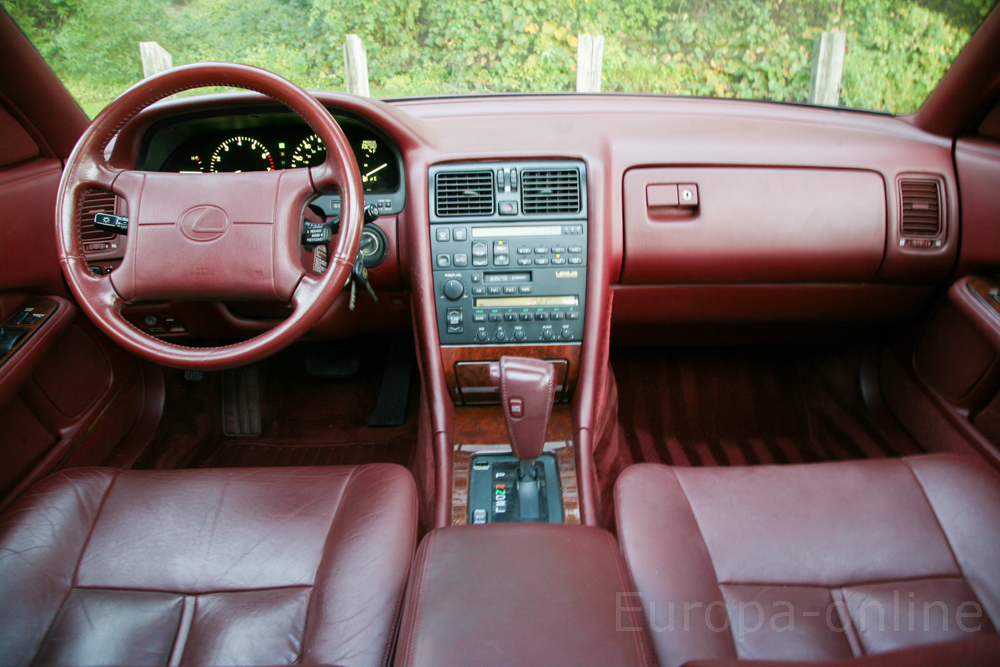
This particular example is colored in burgundy over rare all-burgundy interior, making the car immediately warm and cozy. It's not everybody's taste but it works on this large luxury sedan.

Since so many were made and they were so reliable, a lot of them are still on the road today, but in varying condition. The seller of this example is a dealer who list the mileage as an astonishingly low 60,483 and say it is a one-owner vehicle. This puppy is just getting warmed up.

Mechanically, they say the engine runs strong and smooth and the transmission and suspension are in good shape. They say all electrical options work the a/c blows cold. They also mention the alloys are free of nicks and paint chips. Cosmetically, they say the photos speak for themselves - the car is utterly immaculate looking, inside and out.

This could be an increasingly infrequent chance to acquire an LS400 with relatively low miles and in great shape.


Available here on ebay in Philadelphia, Pennsylvania for $9,950.

Non-Turbo: 1991 Porsche 944 S2 Cabriolet


I never liked the 1982-1991 Porsche 944 much. If the front-engine 928 irked purists enough, then the 924/944 must have really annoyed them. The hatchback version isn't very pretty looking, and was always in danger of becoming irrelevant with less expensive, more reliable, and just as fast competition from Nissan's Z cars.

The convertible 944 S2 is a different story, though. With the flush fog lamp front end and smooth flat rear deck, it looks cool, and Nissan never offered a convertible Z, so it was unique on the market.


Only 2,402 S2 Cabriolet were imported to the U.S. between 1989 and 1991. The S2 featured a 16-valve 3.0-liter inline four cylinder engine that produced 208 horsepower to the rear wheels. It was the largest 4-cylinder in any car at the time. The transmission and gearing were also revived. When mated to a stick shift, the car went from 0-60 mph in 6.5 seconds and was capable of 150 mph.

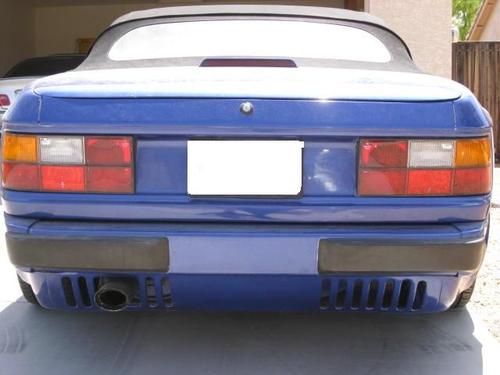
The smooth integrated front-end previously only available on Turbo models does wonders for the look of the car. This example also looks good in electric blue with aftermarket gold BBS Mag wheels. The cabriolet body was built by ASC-American Sunroof Company in Weinsberg, Germany.


The interior is gray and contrasts with the exterior well.

The seller says the vehicle has only 42k miles. Mechanically, they say they have all current service records and the engine has good compression.

Cosmetically, they say it has no rust, straight body and only 1 scratch on the rear.


This is definitely a Sunday or dinner out-only car, but it seems to be a well-kept example of a relatively rare car. Hemmings CPI Value Guide estimates a '91 944 S2 Cabriolet in fair condition to be worth $4,375 and in good condition worth $7,825.

Available here on ebay in Reno, Nevada with bidding at $6,100 and a Buy-It-Now of $7,300.

12 Cylinders for Under $10k: 1991 BMW 850i


I love the E31 8-series.

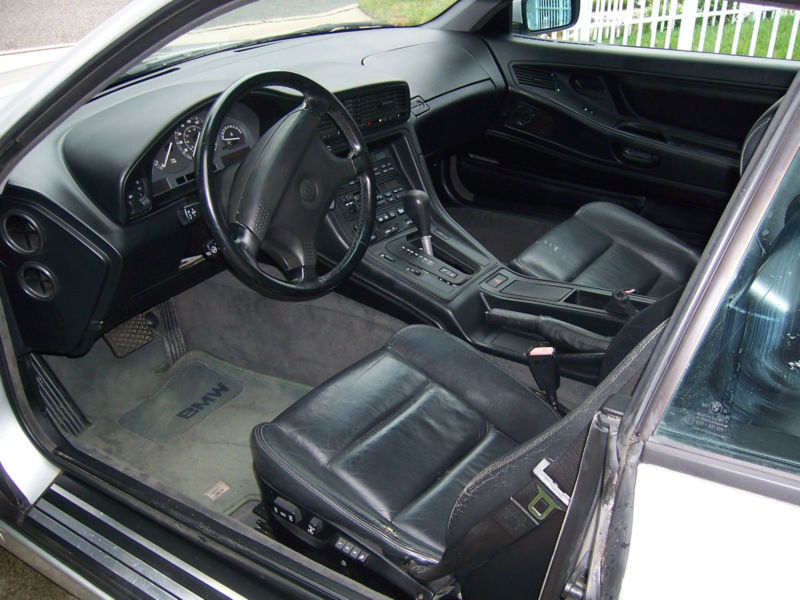
It debuted at the Frankfurt Motor Show in 1989. The E31 did not replace the E24 6-series but heralded a whole new class of grand tourer for BMW. Over 1.5 billion Deutschmark was spent developing the car, and as a result a host of new technology debuted on it. It was the first road car to have a V12 engine mated to a 6-speed manual transmission, among the first cars to have an electronic "fly-by-wire" electronic throttle, and one of the first BMW (along with the Z1) to use a multi-link suspension. The low beams, high beams and foglamps were all integrated together in the pop-up headlights. Inside was a seat-integrated retaining system.

Covering all the mechanical wizardry was a totally new CAD-drafted body with a remarkably low drag coefficient of 0.29. Working closely under legendary chief Claus Luthe, the design is credited to newcomer Klaus Kapitza and is the only production BMW to bear his mark. He helped develop and patent some alloy wheels and a rollbar but that was it before moving to Porsche. 


But what a mark it is! The E31 manages to take all the best elements of several BMW cars leading up to it. The slim nose, hidden headlights and slim horizontal turn indicator recall the M1. The chiseled rear and broad taillights are directly inspired by the E32 and E34 of the same era. The whole thing is sleek and cool the way nothing else is. It was also very influential. The rectangular side mirrors were used on every BMW after until the early 2000s. Inside, the a/c vents housed close to the instrument cluster probably inspired the E36 dashboard.


Initial cars were offered with just the 5.0-liter 498cc V12 engine that produced 295 horsepower to the rear-wheels. Along with the E32 750i/iL, BMW beat Mercedes-Benz in the race to a V12 in German sedans and coupes. In 1994, the same 8-cylinder used in the E32 740i/iL and E34 540i was offered. It had a similar power band as the V12, but was affected by the Nikiasil fiasco.


At the time, BMW was still more synonymous with "luxury" than "sport" in the US, and combined with our preferences and skill level, meant that Most E31 that came to the U.S. were equipped with automatic transmissions. This critically hurt their collector and resale value. And as groundbreaking as the V12 engine seemed, it was eventually proven too good to be true; as in over-engineered, and extremely expensive to maintain and fix. Values on them plummeted and as far as I can tell are still falling, despite only 7,232 being sold here over seven years. Still, it's a modern classic in the making.

These run the gamut in condition now. Maintenance records are a must, and as few owners as possible. Check for rust and accidents (usually speed related). Other than that, get in and zip off. The seller of this example say it has 126k miles.

Available here on ebay in Trenton, New Jersey with 13 bids at $3,177.51 and a Buy-It-Now of $7,500.

Pininfarina Lines: 1991 Honda Beat


Remember when Honda used to make cutting-edge products available at bargain prices? If you can't, don't blame yourself. We were never officially offered their amazing 1991-1996 Beat.

The Beat featured a mid-mounted three-cylinder engine that powered the rear wheels, similar to a Porsche Boxster. It produced 63 horsepower and had an electronically limited top speed of 84 mph. It was only available with a manual transmission. The I3 SOHC engine was the only engine available, and there were minimal changes to the car over the years. That's it. It was what it was, you just had to "get it".


Styling is awesome. Japan and some other parts of the world were privy to a cute subcompact class called "kei cars" that were as small as possible but extremely usable while also conforming specifically to Japanese regulations. Fortunately, what sheet metal the Beat does wear it makes great use of, thanks to famed Italian design house Pininfarina. They give the car the right amount of subtly and edge that makes it a lost classic of late 20th century design. Note how the headlights flow into the front wheel fenders, for swept-back look. The side air intake is thankfully a clean simple cut, probably influenced by Honda's groundbreaking mid-engine NSX a couple years prior. The rear is nicely rounded off with simple taillights and engine intake slots.


The interior is an exercise in more simplicity and frugality. A driver's side airbag was optional. The center console is slim and tall. The instrument cluster is a single standalone unit that houses clear white-faced gauges. Zebra-striped seats spice things up and somehow don't seem tacky, but just fun.

Honda was really onto something with the Beat. This thing easily could have taken a slice out of Miata sales, and probably handled better, too. They were never imported here, and though one or two have shown up, they are extremely rare. This one, unfortunately for my fellow Americans, is located in the United Kingdom.

Available here on Car And Classic UK for about $6,400.

63k-Mile 1991 Honda Accord LX


A lot of people think the short-lived 1990-1993 fourth generation Accord was the best. It improved on the ground-breaking third generation and featured the frugal and simplistic sheet metal the fifth generation lacked. It drove well and lasted forever, and on a penny budget too.

There is no doubting the appeal of this car. Cars just aren't made to look like this anymore, but there aren't any really good reasons why. Our windows are getting smaller, hoods larger, and trunks higher. But in the early 1990s, automakers finally came to terms with U.S. government regulations, fuel efficiency, and cost-effective manufacturing solutions to create cars that kind of did it all. They were safe, affordable, reliable and decent looking. Today's cars, at least today's Accord, may be safe, but it is no longer affordable, reliable, or good looking.


Since they were such decent cars when new, Honda sold a lot of them, and a lot of them were used. What was left was usually spliced and diced following the street-racer craze of the late 90s and early 2000s. So finding any clean, original, low mileage and well-kept example is getting increasingly difficult.

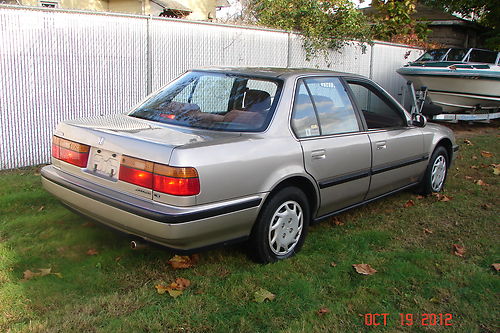
This car is one of those, however. The seller states it's a one-owner vehicle with the mileage as being only 63,699. They say the body and paint are in above average shape, and they just detailed the car (bonus points to sellers who do this before a sale - believe it or not, many don't even bother).


Mechanically, they state it is the 4-cylinder variant and has been maintained regularly. They say it runs great, shifts smoothly and is ready to go.

Inside, the cozy burgundy interior looks tidy and seems to corroborate the low miles.

I do note that the plastic wheel covers are from the fifth generation Accord, a small gripe. Maybe the original pieces broke.

Available here on ebay in Pennsauken, New Jersey with no-reserve bidding at $1,785.