Showing posts with label v12. Show all posts
1992 BMW 850i 6-Speed
The E31 8-Series is a classic in the making. It was an entirely new car at the time of its debut, quite unlike any other BMW that came before it, and it wasn't immediately followed up with a successor. It stood alone, isolated and practically unrivaled in the 1990s. In fact, the V12 6-speed iterations like this one, besides being extremely rare on an E31, are extremely unusual in any car except for a vintage Ferrari.
The styling by Klaus Kapitza working under Claus Luthe is nothing less than brilliant. It's the ultimate expression of 'the ultimate driving machine', encompassing the shark nose of their past with a bold look to the future. I particularly love the big rear lights that taper to the slim turn indicators up front, it's a cool flow. Laguna Green is a color that will no doubt be looked back upon the same way 70s pea green is - that stereotypical shade of an era, but it's certainly vibrant and looks okay in certain lightning.
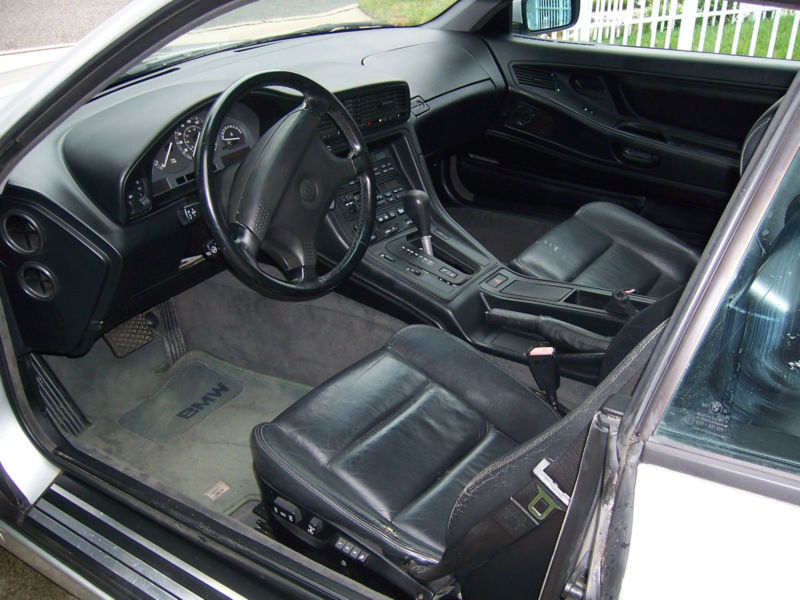
The interior is one of BMW's best, and is a revelation today as their current design department throws nearly 50 years of functional, understated design out the window in favor of potpourri-esque over-design. The speedometer overlapping with the tach is a neat touch. Pixels sometimes fade in the digital readouts but it is fixable. Black or grey are preferred but the tan color scheme is fine. I would consider sourcing BMW's non-airbag three-spoke wheel in place of the bloated unit here, because if any BMW deserves that wheel it's this one.
For a while, buyers had just once engine choice in the E31: the M70B50 5.0-liter V12 that pumped out 295 horsepower to the rear wheels. Now that sounds decent on paper, but the problem is that it had to haul over 4,000 lbs. of vehicle, so it wasn't as quick as you'd think, and it was horribly fuel thirsty. On top of that, depending on which owner you asked, it was either an expensive engine to maintain, or an expensive nightmare of an engine to maintain. In 1993 it was supplemented by a V8, but even that had its own set of problems.
Still, if there's an E31 to own, the V12 mated to a 6-speed manual transmission is among the most desirable.
The key things to inquire about on all E31 are maintenance history and accident damage, both of which are pretty easy to find out about. The seller says this one has just 59k miles on the clock and is in excellent condition.
Only around 7,000 E31 ever made it to the US, and much less with the V12-6-speed combo. This one seems clean, but warrants further investigation.
Available here on craigslist for $24,950.
1983 Ferrari 400i 5-Speed
For a while, these were among the least expensive used Ferrari for sale. They are often found in average shape with little to no maintenance history. They are front-engine and frequently have automatic transmissions, lessening their value in the eyes of exotic sports car collectors. Lately, I think that is starting to change. Not many were built, even fewer made it here thanks to the grey market, and the stark and angular shape is starting to grow on Pininfarina aficionados and general enthusiasts alike.
COTC likes these. They are really off-putting at first, especially the squinty turn indicators and weirdly tapered nose. You get the feeling Ferrari was intentionally trying to make it ugly because they knew it would not be perceived in the same way as their rear-engine sports cars. But beauty is in the eye of the beholder, and once one becomes comfortable with the concept of a more "everday" Ferrari, the styling of the 400 is quite striking and makes startlingly brilliant sense. In some ways, it allowed Pininfarina to breath new design language into Ferrari, even though the themes were mostly never repeated again. And the fact is, the proportions are handsome, the greenhouse large and inviting, the stance appropriate for a two-door coupe with rear seats.
This particular example is being offered up by the owner who says the the vehicle has been in California all its life, has no rust and has been given a quality repaint. Mechanically, they list a ton of expensive work done and say it has a large history file and the vehicle now runs and drives "perfectly".Legally, the say it has a California title and is now in New York.
These were never officially sold in the U.S., and while a couple examples are usually always on the market, very few have the infinitely more desirable manual transmission.
Available here on ebay in Rochester, New York with bidding at $15k, reserve not met, and a Buy-It-Now of $30k.
12 Cylinders for Under $10k: 1991 BMW 850i
I love the E31 8-series.
It debuted at the Frankfurt Motor Show in 1989. The E31 did not replace the E24 6-series but heralded a whole new class of grand tourer for BMW. Over 1.5 billion Deutschmark was spent developing the car, and as a result a host of new technology debuted on it. It was the first road car to have a V12 engine mated to a 6-speed manual transmission, among the first cars to have an electronic "fly-by-wire" electronic throttle, and one of the first BMW (along with the Z1) to use a multi-link suspension. The low beams, high beams and foglamps were all integrated together in the pop-up headlights. Inside was a seat-integrated retaining system.
Covering all the mechanical wizardry was a totally new CAD-drafted body with a remarkably low drag coefficient of 0.29. Working closely under legendary chief Claus Luthe, the design is credited to newcomer Klaus Kapitza and is the only production BMW to bear his mark. He helped develop and patent some alloy wheels and a rollbar but that was it before moving to Porsche.
But what a mark it is! The E31 manages to take all the best elements of several BMW cars leading up to it. The slim nose, hidden headlights and slim horizontal turn indicator recall the M1. The chiseled rear and broad taillights are directly inspired by the E32 and E34 of the same era. The whole thing is sleek and cool the way nothing else is. It was also very influential. The rectangular side mirrors were used on every BMW after until the early 2000s. Inside, the a/c vents housed close to the instrument cluster probably inspired the E36 dashboard.
Initial cars were offered with just the 5.0-liter 498cc V12 engine that produced 295 horsepower to the rear-wheels. Along with the E32 750i/iL, BMW beat Mercedes-Benz in the race to a V12 in German sedans and coupes. In 1994, the same 8-cylinder used in the E32 740i/iL and E34 540i was offered. It had a similar power band as the V12, but was affected by the Nikiasil fiasco.
At the time, BMW was still more synonymous with "luxury" than "sport" in the US, and combined with our preferences and skill level, meant that Most E31 that came to the U.S. were equipped with automatic transmissions. This critically hurt their collector and resale value. And as groundbreaking as the V12 engine seemed, it was eventually proven too good to be true; as in over-engineered, and extremely expensive to maintain and fix. Values on them plummeted and as far as I can tell are still falling, despite only 7,232 being sold here over seven years. Still, it's a modern classic in the making.
These run the gamut in condition now. Maintenance records are a must, and as few owners as possible. Check for rust and accidents (usually speed related). Other than that, get in and zip off. The seller of this example say it has 126k miles.
Available here on ebay in Trenton, New Jersey with 13 bids at $3,177.51 and a Buy-It-Now of $7,500.
1994 Jaguar XJ12
How would you like four-doors and 12 cylinders for $1,999?
The code-name XJ40 body was nearly 15 years in the making. Jaguar had intended it to replace the XJ Series II, but production was delayed for one reason or another. Styling, however, continued at an even pace over the years, culminating in a debut at the British International Motor Show in 1986. The Series II XJ, meanwhile, was sold alongside the XJ40 until 1992.
Below is a development photo.
So what does 15 years of continuous styling yield? Sadly, not a shape everyone loved. Purists scoffed at the squared off edges and single-piece rectangular headlights that replaced the iconic quad round lamps. The instrument cluster was digital. The car was more modern than gothic the way Jaguars of the 1950s, 60s and 70s had been. But if the goal was to modernize the XJ, Jaguar succeeded. In a lot of ways, it was actually a very carefully crafted and good looking car. It still retained the classic long and low profile, and the rectangular headlights actually looked better on the boxy shape than the round units they later added did. It was offered in a bunch of rich colors and it looked good in every one of them, too. Jaguar had to move forward and they did so in the most appropriate way possible.
If most people were eventually won over by the styling, the XJ40 gained no fans for reliability and build quality. Sure, it's a solid car, but it just wasn't designed or made the way Mercedes-Benz were. The problem is that the XJ40 was intended to compete against the Benz, but it fell short yet again. By the end of the 1980s, when the Japanese had jumped into the ring with the Lexus LS400 and Infiniti Q45, both of which were faster, cheaper, far better made and arguably better looking, Jaguar was lagging far behind. They've never really recovered, either.
However, Jaguar still had one card up their sleeve their Japanese competitors didn't: the V12 in a four-door sedan. Jaguar had pioneered this setup, and had offered it before Mercedes and BMW jumped into the game. But Jaguar hadn't offered the V12 in the U.S. since 1979, and the XJ40 series only gained the 12-cylinder in 1993, just a year away from the whole car's demise entirely. By then, however, it made sense, as BMW had the 750iL and Mercedes the 600SEL. Could Jaguar keep up? Would it matter?
Jaguar's engine was a 6.0-litre HE version of their long-running V12 engine that dated back to 1971. More than 140 inner body parts had to be re-designed to accommodate the new V12. It was the same V12 used in the XJS during the same period, and produced a very healthy 318 horsepower powering the rear-wheels.
Only a total of 2,991 were ever made, and just 1,325 were exported around the world. By the time this powerful car debuted, the XJ40's reputation was too damaged to ever recover, and sales reflected that. If you thought the 6-cylinder XJ might be problematic,12-cylinder reliability and upkeep could be an absolute nightmare.
Fortunately, if you want to find one, they are available at inexpensive entry prices. This example is being offered up by the owner who says it runs great and has a functioning tachometer, speedometer and odometer. They state the mileage as 137,000, and wears new tires and a new battery.
I'd ask about any maintenance history available. But if you're looking for cheap and fast transportation, this could easily fit the bill and provide more than enough entertainment as well.
Find it here on craigslist in Tucson, Arizona.
Bottom Of The Curve: 10k-mile 1984 Ferrari 400i Automatic
The Ferrari 400 series was never officially offered in the United States.
For a while, these were among the least expensive used Ferrari for sale. They are often found in average shape with little to no maintenance history. They are front-engine and frequently have automatic transmissions, lessening their value in the eyes of exotic sports car collectors.
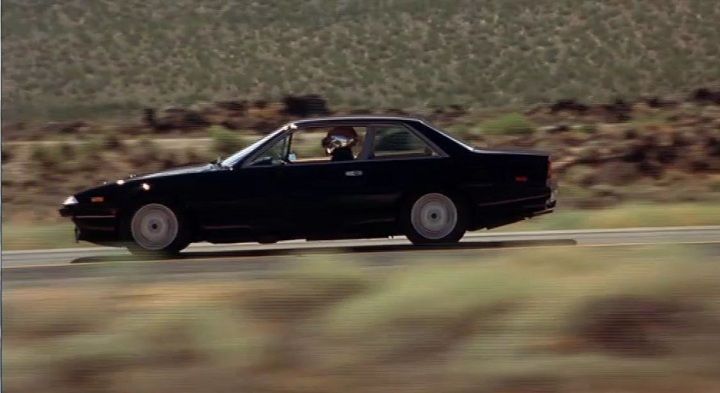
Lately, I think that is starting to change. Not many were built, even fewer made it here thanks to the grey market, and the stark and angular shape is starting to grow on Pininfarina aficionados and general enthusiasts alike. Not to mention that eccentric French electronic music duo Daft Punk drove one across the desert in their movie.
I like these. They are really off-putting at first, especially the squinty turn indicators and weirdly tapered nose. You get the feeling Ferrari was intentionally trying to make it ugly because they knew it would not be perceived in the same way as their rear-engine sports cars. But beauty is in the eye of the beholder, and once one becomes comfortable with the concept of a more "everday" Ferrari, the styling of the 400 is quite striking and makes startlingly brilliant sense. In some ways, it allowed Pininfarina to breath new design language into Ferrari, even though the themes were mostly never repeated again. And the fact is, the proportions are handsome, the greenhouse large and inviting, the stance appropriate for a two-door coupe with rear seats.
This is an '84 400i, so it has some improvements over the 1976-1979 400, most notably Bosch K-Jetronic fuel injection, as well as some minor interior and exterior changes.
It looks great in black over black, although I would delete the red pinstripe if it does not damage the paint.
The seller is scant on details, but mentions the car seems to have never been in an accident and has only 10,800 miles on the clock. The unusually clean and orderly V12 engine compartment is convincing, however, and the interior looks just as good.
They say the engine starts, runs well and shifts smoothly.
If this is what it's being advertised as, it could be a decent snatch for a car whose value and at least appreciation will most likely climb in the coming years.
Find it here on ebay in Jupiter, Florida for a buy it now of $20,000 and the make an offer option. Hemmings CPI Value Guide estimates a 1984 400i in fair condition to be valued at $10,925, good condition at $17,625 and excellent condition at $29,250.
Lost Prancing Horse: 1979 Ferrari 400 GTA
Some of the most common presumptions about an old Ferrari is either that it's worth a lot of money or someday it's going to be worth a lot of money. Both presumptions are hard at work in this ad. Both presumptions are not always true.
At least not with the Ferrari 400.
For a Ferrari to be worth a lot of money, theory says it has to have no rear seats, be mid-engine and have 12-cylinders. I guess 1 out of 3 ain't bad. The 400 had seating for four, a front-engine, and, yes mercifully, a 12-cylinder engine.
The 400 series was produced from 1976-1989, and featured Ferrari's first automatic transmission, a General Motors Turbo-Hydramatic THM400. It was mated to a 4.8-litre V12 producing about 340 horsepower. Reported 0-60 mph times were around 7.1 seconds.
No version of the 400 was ever officially imported to the U.S., an odd mistake given the automatic transmission, U.S. emissions compliance and upper-crust pedigree perfect for the dawn of the '80s.
That makes this car a rare grey market import.
This is a first-run series 400 car, of which 502 were made from '76-'79.
The pointy body was crafted by none other than famed design house Pininfarina, for whom Ferrari was their #1 client. This early '79 example has black plastic bumper moldings which were later body colored, as well as a painted-black rear taillight region, which I'm not sure was factory but looks passable. It is all typical of the era, and I imagine was horribly dated feeling by the mid-'90s, when smooth bodies and subtle curves were in and hard angles out. But it has since grown into a semi-classic of minimalist oddball expressionism. The squinty, sour-eyed front turn indicators and hidden headlamps take a lot of getting used to and they still occasionally annoy me, but I like them. After years of having the Ferrari Testarossa cheese-grater side air intakes burned into my mind, the flat, unassuming planes of the 400 are a refreshing relief and brilliant direction for the brand. This isn't the Ferrari you'd have on a poster in your room, but that's exactly why I like it.
So ground-breaking was the 400 that it might have had something to do with the very similar-looking 1980 Pinin Concept, which was the first and so far only four-door concept Ferrari has ever entertained the notion of. It's half way to Aston Martin Lagonda territory, but it looks good overall and would have fit alongside the 400 very well.
The seller states this 400 was from a private collection and is in great shape without any major flaws in the body and glass. They say it runs and drives and shifts smoothly. However, they say the a/c is not blowing cold and may need a new compressor. Low-mileage Ferraris are the norm, so the 46,578 on the clock is not at all unusual. Wealthy owners held on to them carefully with the hopes that they'll appreciate in value, along with the usual fair-weather-weekend-only usage.
So what's the price of this admission into the hyper-exclusive V12 Ferrari club? The seller here wants $25,900 but is open to best offers. Hemmings values a 1979 400 GTA in fair condition at $9,875, good condition at $15,950 and excellent condition at $26,475. That would place this at the upper end of value and is by no means a bargain, especially given the rumored cost of maintenance, if it's even used. That said, the 400 cars have got to be the least expensive purchase-price V12 Ferrari ever available when adjusted for inflation.
Find it here on ebay in Johnston, Rhode Island.
Subscribe to:
Posts (Atom)