Showing posts with label 1992. Show all posts

1992 BMW 850i 6-Speed


The E31 8-Series is a classic in the making. It was an entirely new car at the time of its debut, quite unlike any other BMW that came before it, and it wasn't immediately followed up with a successor. It stood alone, isolated and practically unrivaled in the 1990s. In fact, the V12 6-speed iterations like this one, besides being extremely rare on an E31, are extremely unusual in any car except for a vintage Ferrari.

The styling by Klaus Kapitza working under Claus Luthe is nothing less than brilliant. It's the ultimate expression of 'the ultimate driving machine', encompassing the shark nose of their past with a bold look to the future. I particularly love the big rear lights that taper to the slim turn indicators up front, it's a cool flow. Laguna Green is a color that will no doubt be looked back upon the same way 70s pea green is - that stereotypical shade of an era, but it's certainly vibrant and looks okay in certain lightning.


The interior is one of BMW's best, and is a revelation today as their current design department throws nearly 50 years of functional, understated design out the window in favor of potpourri-esque over-design. The speedometer overlapping with the tach is a neat touch. Pixels sometimes fade in the digital readouts but it is fixable. Black or grey are preferred but the tan color scheme is fine. I would consider sourcing BMW's non-airbag three-spoke wheel in place of the bloated unit here, because if any BMW deserves that wheel it's this one.


For a while, buyers had just once engine choice in the E31: the M70B50 5.0-liter V12 that pumped out 295 horsepower to the rear wheels. Now that sounds decent on paper, but the problem is that it had to haul over 4,000 lbs. of vehicle, so it wasn't as quick as you'd think, and it was horribly fuel thirsty. On top of that, depending on which owner you asked, it was either an expensive engine to maintain, or an expensive nightmare of an engine to maintain. In 1993 it was supplemented by a V8, but even that had its own set of problems.

Still, if there's an E31 to own, the V12 mated to a 6-speed manual transmission is among the most desirable.


The key things to inquire about on all E31 are maintenance history and accident damage, both of which are pretty easy to find out about. The seller says this one has just 59k miles on the clock and is in excellent condition.

Only around 7,000 E31 ever made it to the US, and much less with the V12-6-speed combo. This one seems clean, but warrants further investigation.

Available here on craigslist for $24,950.

42k-Mile 1992 Dodge Stealth R/T Twin Turbo


The Stealth is a nameplate Dodge doesn't even bother using anymore. That's a shame, because in the 90s it had potency - thanks to the VR4 AWD.

In actuality, the Stealth was no triumph of American engineering. It was a triumph of American dollars and bargaining power. Chrysler made a deal with Mitsubishi and were able to sell cars using their mechanical components. One such car was the Mitsubishi 300GT, from which Chrysler/Dodge made the Stealth.


I guess it was a good deal if you really had to have that American design pen touch...but even then, it was very similar looking to the 3000GT. Still, that's not a bad thing. These are classics of the 90s, all smooth corners, globular shapes and swishy swoopy lines. The big benefit to the driver is aerodynamics and efficiency.

So what were the mechanicals that Chrysler wanted to get their hands on so badly? The Stealth has a 3.0-liter twin-turbocharged 6-cylinder engine good for almost 300 horsepower. That was a big deal then and remains impressive today. It'll be a gas guzzler, but damn this thing will haul on the highways.


As if that wasn't enough, it's got not only four-wheel drive, but four-wheel steering to keep you in total control, glued to the road with the utmost confidence. The 3000GT/Stealth cars were laboratories of 90s Japan hi-technology. The basic fact is that you just don't get this kind of package anymore, at least not for under, what, $40k?

The interior is also impressive, swathed in black leather. This one is mated to a manual transmission and seems to have an aftermarket DVD player upgrade.


I wouldn't expect anything less from a 2-owner, 42k-mile car. Look for accidents, rust and maintenance history. The engine is complex and I imagine would need oil changed religiously.

But if you want a big, safe, powerful sports car from the 90s, this packed with similar power as a 300ZX but has more technology and is less common.

Available here on ebay for $12,500.

A Good E32 Is Hard To Find: 1992 BMW 735i


When I started looking for an alternative to my beleaguered and disappointing '08 Civic Coupe, I originally wanted an E32. I relished the idea of trading a flimsy late 2000s Japanese econony car for a bank vault-like 80s/90s German sedan. What I didn't realize was how few E32 there are left in reasonable condition, especially in New England (where I currently reside). It's basically impossible. And when I did stumble on a clean example, the seller wanted absurd top dollar.

Not that I entirely blame them. The 1988-1994 E32 remains a high point in BMW history. True, it marked a shift towards the "Lexusization" of the brand, when it grew in size and weight from its predecessor the E23 and abandoned manual transmissions. But it was also before the overly complex E38. The E32, then, is the best of both words: contemporary size and space and operable on a manageable budget.


The most desirable E32, in my opinion, are the early 6-cylinder versions which BMW stopped offering in 1992 and replaced with the infamous Nikasil-plagued V8. Sure, you'll get more power with the V8, but worse fuel economy and the possibility it could die at any time (slight exaggeration but still). The 6-cylinder is no drag racer, but it will get the job done and last you a long time.

The exterior styling by Ercole Spada working under Clause Luthe is another highlight. It is an absolute masterpiece, a sculptural icon of the late 20th century, combining industrial form over function, classic BMW cues, and slight art deco-esque flair. The L-shaped taillights, where the trunk lid seemingly cuts into the taillight form to emphasize closure, have been copied many times by dozens of manufacturers. Spada and Luthe took everything that was good about previous BMW designs and leaped into the future, but kept a firm hand on tradition. How they were able to do this balancing act is still a mystery to me, especially as designers are utterly failing to do so today.


Inside is one of BMW's best interiors. The instrument cluster consists of crystal clear white-on-black gauges that illuminate red at night. It's also got a nifty analog fuel economy gauge tucked under the tachometer, a remnant from the fuel crises of the 1970s when consumers and automakers alike paid special attention to thrift and conservation. The center console is a stack of rectangular boxes angled towards the driver for ease of reach. And everything tactile is black to deflect from stains and wear.

This particular survivor is looking unusually clean and crisp in rare light metallic pale blue over tan leather. The seller says this is a one-owner car that was given up due to health issues, and has a 144,200 miles on the clock. They also say it has the premium and cold weather packages, but make no mention of the mechanical status of the vehicle. I'd give it a rigorous test drive and ask for any and all maintenance records. Since it's located in Colorado and wearing Colorado plates, I'd also check for rust. The mileage is high, but this could easily hit 200k without any major problems if it's well cared for. You're getting a solid, stylish, and comfortable cruiser for under $5k. Not bad.


Available on the dealer's site here in Greenwood Village, Colorado for just $2,500.

In the US: 1992 Citroen XM


Shortly after becoming infatuated with the XM one pops up on ebay to taunt COTC with its seductive shape, nifty technology and utilitarian hatchback.

The XM replaced the CX in 1989 and followed a long line of four-door hatchbacks from Citroen. It was, in many ways, their ultimate vision realized. On paper, some of the statistics are misleadingly banal: front-wheel drive, cloth seats, four- and six-cylinder engines. Yet, like the French themselves, there was much more to the XM than meets the eye. As Citroen's flagship vehicle, they loaded it with sophisticated technology they had refined over decades like the Hydractive suspension where electronic sensors monitored dozens of impulses on the car and adjust the suspension accordingly within milliseconds, resulting in the famous smooth Citroen ride. The suspension could also be lowered for high speeds or raised on poor surfaces


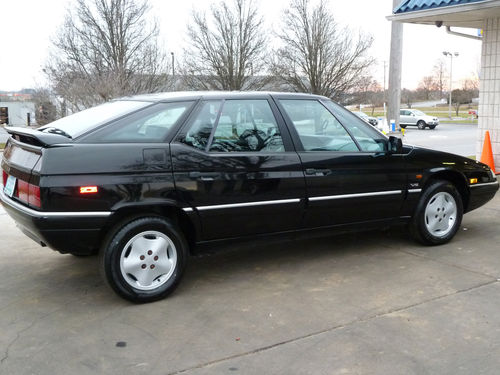
The sleek four-door wedge body was courtesy of Bertone and is truly awesome, building on both past Citroen shapes and themes while moving the company firmly into the future. The low belt-line makes the windows huge and the greenhouse is supported by no less than 12 blackened pillars for a stealthy and futuristic look. It usually contrasts nicely with lighter colors but this looks sharp in black.

Although the turbo-diesel versions are most in keeping with the car's character, this example (VIN VF7Y3AG0004AG5872) has a 12-valve 3.0-liter V6 gasoline engine good for about 170 horsepower.

Inside, occupants are treated to spaciousness and comfort with large leather seats. The trademark single-spoke steering wheel is intact, and although the rest of the dash is unusually subdued for a Citroen it fits the overall theme of hi-tech elegance.


The seller is scant on details but say they have owned the car for 19 years and that it has 78k miles (or kilometers?), new tires, and is "very fast". The rest of their ad is the entire wikipedia file on the car copy and pasted.

Citroen stopped officially selling cars in North America since 1974, and although some importers managed to bring in some over the years, very few XM were sold here (or, more importantly, understood), making this car an extreme rarity and and in seemingly great shape too. If you've been dreaming of owning an XM (and I know I lot of people have), this could be a great opportunity to buy one already here.


Available here on ebay in Virginia with bidding at $5,600, reserve not met, and a Buy-It-Now of $14,500.

44k-Mile 1992 BMW 325iC M-Technic


Looking like it came right off the set of Miami Vice comes this '92 BMW with low miles and the rare M-Technic package.

The E30 really needs no introduction. It is perhaps THE definitive BMW of all time, blending the best of everything that came before it while looking to the future with new levels of performance and efficiency. These were compact, balanced, well-built and aesthetically near-perfect.

The convertible version was just icing on top.


This is a later example with a build date of 7/91 but sold as a model year 1992. The M-Technic package mostly adds just cosmetic changes: all formerly black plastic body trim is now "AlpinWeiss 2" paint, the front and rear gain lower spoilers and the sides get new lines. Foglamps are standard. The cross-spoke alloys are also white. This kind of all-white look was popular in the late 80s and early 90s and still looks striking and fresh today.

The interior is finished in an equally light "LotosWeiss" leather with all-black dashboard.

Under the hood is BMW's venerable 2.5-liter inline 6-cylinder powerplant producing a respectable 168 horsepower to the rear wheels and moved the modest 2,000 lb. weight along nicely.


Unfortunately for motoring purists, this one is mated to automatic transmission. But since these were Sunday boulevard cruisers anyways, a relaxing slushbox makes little difference.

Mechanically, at 29k the seller states a bunch of repairs were done. At 43k, a new power steering pump was added along with a regular tuneup.

This car seems to have been pampered, and if your heart is set on a E30, this well-kept and low mileage survivor could be the one.

Available here on ebay in Bellevue, Washington with bidding already past $7k.

Tokyo Apocalypse: 1992 Mitsubishi Delica 2.5 Turbodiesel


Have you ever wanted a vehicle that does everything?

If so, you might want to check out this awesome 7-passenger Mitsu Delica.

The Delica nameplate has been used for Mitsubishi's micro van since 1968. This is a third generation example, which debuted in 1986 and, amazingly, is still in production to this day in Australia.


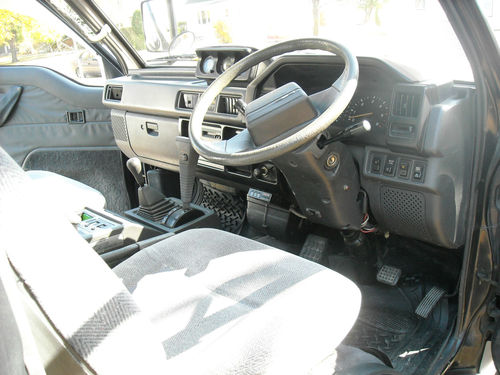
I think these things are great. They're cooler than minivans, provide just as much space, but are easier to drive and park. Then there is the styling. In the same way the Germans mastered the look of the stern, all-business sport sedan, the Japanese aced the feel of this hyper-utilitarian vehicle. Styling is subtle, simple, conservative, form-over-function. Note the large doors that open over the front wheels, and accompanying footsteps to aid entry. This one looks especially great in two-tone grey and pearl, accentuated by mudflaps, tastefully tinted windows, and front guard with yellow fog lamps.

These were sold briefly in the United States as tamed gasoline versions. Fortunately, this is the desirable 2.5-liter turbo diesel engine. Diesels last forever, and are usually torquey as-is, so the additional turbocharger is a welcome addition to make daily driving more fun.


It's also four-wheel drive, for superior traction in all sorts of inclement weather.

Taken all together, you can haul a bunch of friends or cargo, in any type of weather, and almost never have to worry about breaking down. Nice.

The seller of this example is a private owner who imported this rare vehicle to Canada. They say the mileage is 146k miles, but was "safetied" at 130k. Not sure what that means, but it may imply the odometer no longer works. They do say that at 110k the timing belt was changed, injection pump rebuilt and a new battery added. Mechanically, they say it is "excellent."


Cosmetically, they note some interior flaws and exterior scuffs. Typical wear and tear. It's supposed to be a rugged vehicle.

Available here on ebay in Winnipeg, Canada. The seller notes they are 45 minutes from the North Dakota border.

Origin and Epilouge: 1992 Infiniti Q45


The Q45 was the very first Infiniti.

In the late 1980s Nissan were pressured by the launch of Lexus from Toyota to create their own luxury spin-off. To inaugurate the brand, they developed a sedan intended to compete with the best of the best. By 1989, BMW and Jaguar sedans still hadn't touched 8-cylinder engines yet, leaving the sole V8 competition in the Mercedes W126. But Lexus had installed an ultra-smooth and efficient V8 in their new LS400. Nissan sought to do the same with the Q45. They were not only taking on the Germans, but their fellow countrymen as well. It was an all-out competitive free market product war and the consumer had only to win.

Nissan used the new for '89 President HG50 platform for the new Q45. The President was their flagship sedan not offered in the U.S., so it made a perfect basis for the introduction of the Q45 in North America. Initial Q45 cars were 5 millimeters shorter than the President, though that miniscule difference was regained in 1992.


Under the hood was a beastly 4.5-liter 8-cylinder engine that pumped out 278 horsepower to the rear wheels. In a December 1989 Car and Driver road test, the Q45 came in second to just the Lexus in a crowded field of competitors, but its 0-60 mph time was 7.9 seconds, the fastest of the group. It blew the 6-cylinder powered BMW 735i and Jaguar XJ6 out of the water.

The Q45 also featured 15:1:1 ratio steering, multi-link suspension with a viscous limited-slip differential and four-wheel steering on "T" models. This thing was a powerhouse of early 1990s automotive technologies coming out of Japan.

Styling is intriguing, too. While Lexus took a very safe path with designing the LS400, Infiniti tried to incorporate some new and unusual themes not seen in high-end luxury sedan design yet, starting with a grille-less front end that gave car an oddly subdued and androgynous face. Still, the boldness on display deserves some credit.


The profile is low and lean, almost Jaguar-like, but the body is smooth, clean and simple. The tail end does feature one rip-off, however: a taillight sectioned off by the trunk opening, very similar to the BMW E32 L-shaped taillights of just a few years earlier (a design theme that is still being used by several different car makers and has become beyond cliche).

Although the profile is graceful, there are some small details that make up-close inspection rewarding, too. The door handles are large ellipitcal chrome units that are welcoming and make a good first impression.The front badge features a cloisonne floral karakuza pattern behind the recognizable Infiniti logo.


The seller of this 1992 example (thankfully before the more conventional 1993 front fascia update and foolish performance de-tuning) is a dealer and state the mileage as reading 159,789. They offer no other details behind the sale. Since the car was moderately complex for the time and the engine large, any kind of service records would be helpful in understanding just how much life this could have left, and whether anything serious needs to be put into it.

The Q45 made quite an splash when it debuted, and while the industry certainly took notice (with Mercedes adding a V8 to even their W124 with the 400E and BMW finally putting one in their E32, the 740i/iL), it didn't catch on with consumers. That's a shame, and it probably hurt morale at Nissan/Infiniti, not to mention their pocketbooks. Subsequent generations of the Q45 (there have been just two) were never the same, and arguably worse. Currently, there is no Q45 in the Infiniti range, and I find it rather sad considering how full of promise this car was in bringing consumers a competitively priced, innovative, fast and well-built large sedan. Today, the attention is on entry-level and mid-size, understandably. But the credit belongs where it belongs.

Find it here on autotrader in Illinois for $2,999 and the dealer page here.

Good Cop Bad Cop: 1992 Ford Mustang SSP


Have you ever wondered what it was like to sit behind the wheel of a police car (rather than the back seat)?

Now is your chance.

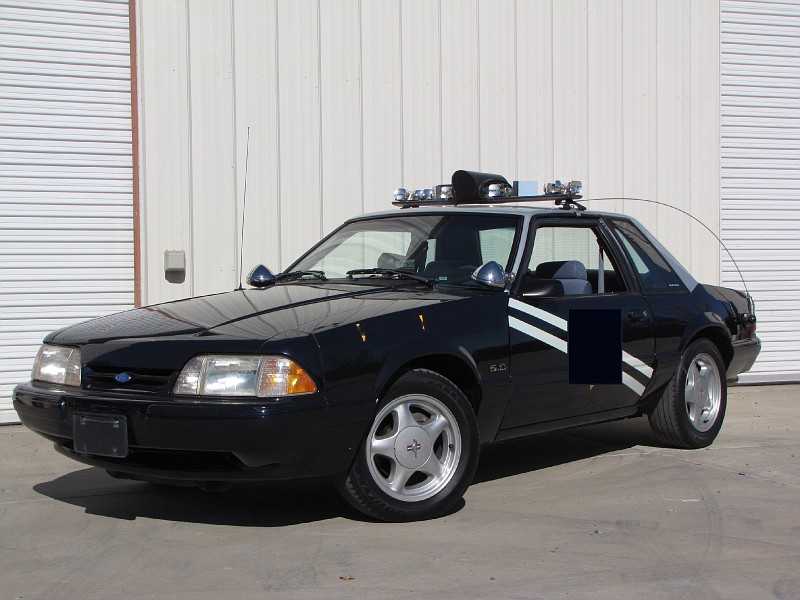
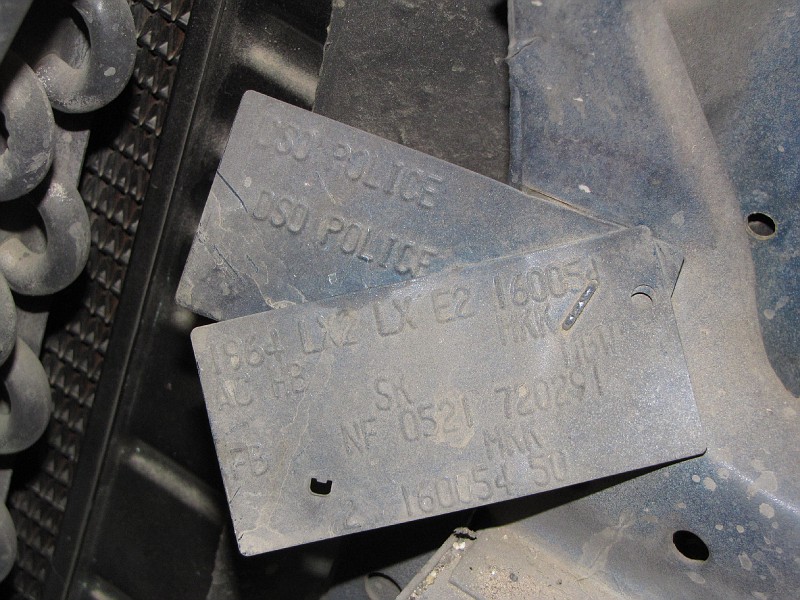
Up for grabs is this Mustang Special Service Package formerly used by the Nevada Highway Patrol. That's right. This is the cop car that would have chased your getaway through the desert at 100 miles per hour.


The seller states only 15 SSP Mustangs were ordered by the state of Nevada.

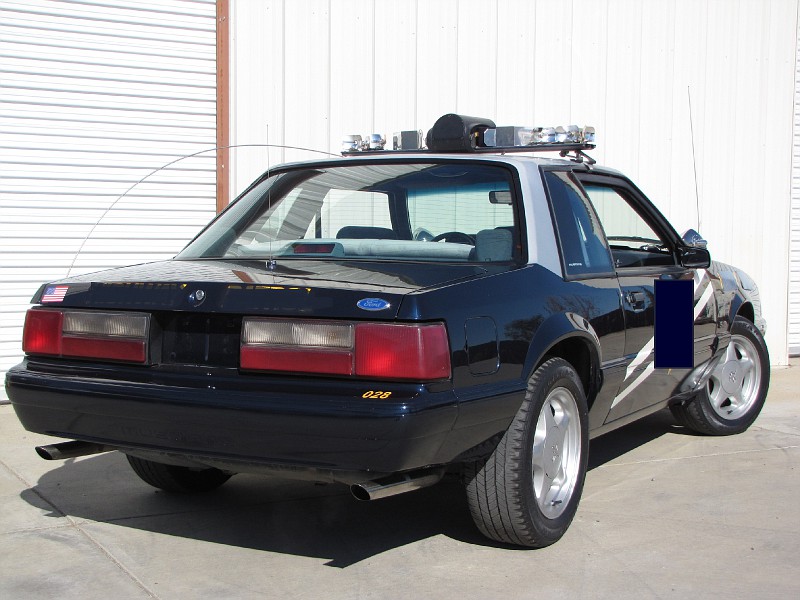
They say this vehicle was used as a patrol car, then used by the military, before it ended in private hands and has now been restored back to Highway Patrol-spec. This includes new paint and new front seats. The seller states there is no rust and no bodywork was needed. Maybe this thing didn't see much action after all.

Fox-bodied Mustangs split the critics. I think about everyone dislikes how they look, and then half think they're a hoot to drive and the rest think they're just awful. But let's face it: with a V8 engine, rear-wheel drive and a 5-speed manual transmission, you'd have to be a stiff not have a blast in this. Who cares if they look best in front of a Domino's Pizzeria on a rainy Friday night, or on the set of Married With Children?


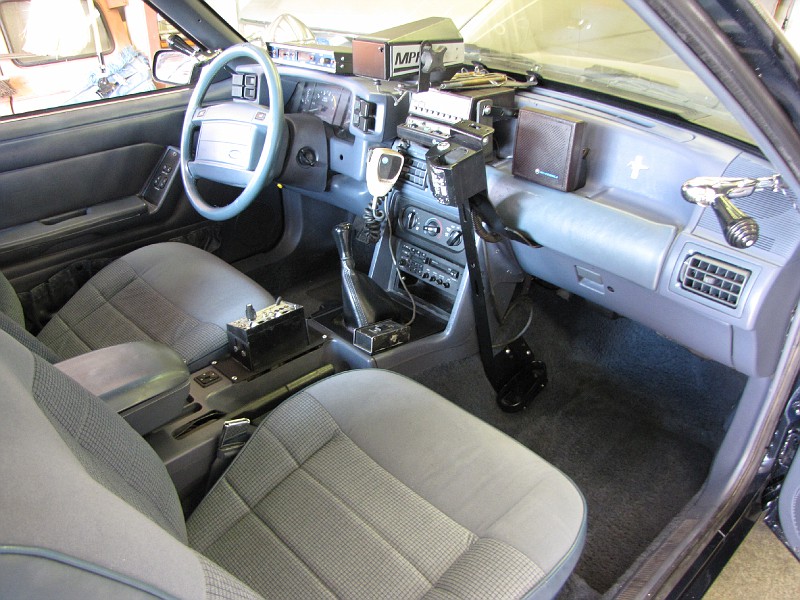
Inside is a feast for techheads...that is, for a techhead from the early '90s. All of the equipment looks outdated, like a bunch of cable boxes (remember those) piled on the dash. How is any of the street legal, anyways? I guess, until you get caught with all of it...

The most interesting thing about this Mustang actually aren't the flashing red and blue lights. It's the fact that you have the moderately rare notchback body coupled with the V8, stick shift, dual exhausts and Pony wheels. This is a better Mustang than your average Fox Mustang, police equipment or no equipment.


Find it here on ebay in Byron, California with bidding at $4,050 and a buy it now of $10,495.

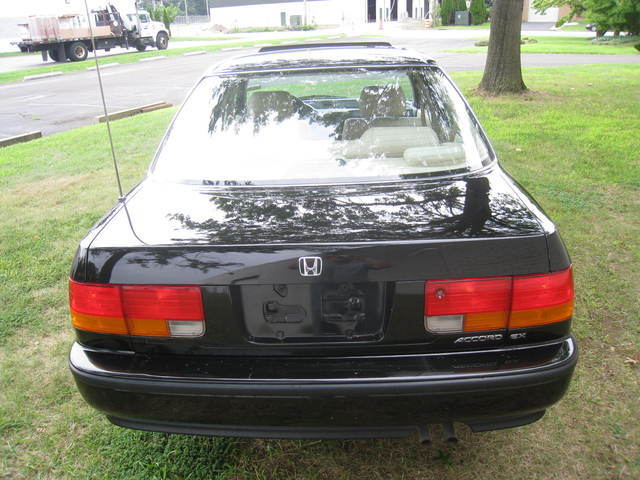
Never This Nice: 41k-mile 1992 Honda Accord EX


I use the Honda Accord as a benchmark of banality.

If a vehicle is fairly basic but dependable transportation, I will deem it Accord-like.

Although the Accord is a respected nameplate that practically defines the whole company and was a bestseller for years, it is just a basic family sedan. Front-wheel drive. Four or six-cylinder engines. Simple electronic systems. Nothing cutting-edge, experimental, or exciting about it. That said, the Accord tried to be the best boring family sedan out there. Solid build quality. Reliability. Ok-styling. They were also reasonably priced (before Honda foolishly tried to upmarket them and rip off the consumer on what are essentially still basic fwd sedans).


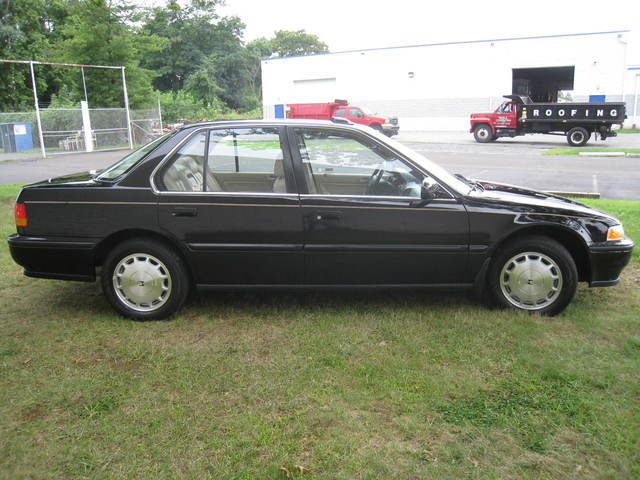
This is a fourth generation Accord produced from 1990-1993. The fourth gen was a huge leap forward and featured totally new styling and new engines. This was when Japanese designers were paying close attention to the ultra-functionalism and common sense styling of the German automakers. Following suit, the Accord has a huge greenhouse for maximum viability in and out and lean sheet metal for a low, sleek shape. Note the rear window kink a la BMW.


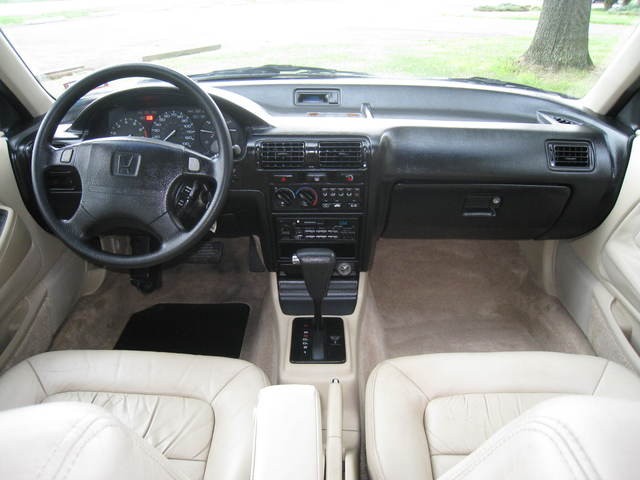
The interior is possibly the best part. The dashboard is extremely clear, bare, and highly useable. This is an EX-trim car, so it has leather seating. Note how the dashboard is entirely in black plastic - dark colors don't distract the driver and absorb dirt, wear and tear better. I do see some wear on the driver's seat which is odd for a 41k-mile car, as well as an unsightly stain on the rear passenger seat belt, but both can be remedied with some work.


1992 saw a facelift, and this Accord wears the modified taillights that came with other slight changes.

The seller says this is a one-owner vehicle and the mileage is accurate. Most Accord were bought by people who drove a lot, and wanted spacious, affordable but frugal transportation, so finding one in overall good shape with this low miles is rare. This isn't a desirable model unfortunately, with an automatic and only four cylinders. But if you want some basic transportation the way they don't make it anymore, check out this car.

Find it here on ebay in Philadelphia, PA with 15 bids at $3,300.

Fast And Furious: 1992 Acura NSX Type-S Zero


This wild Acura NSX custom is like something out of movie.I've been meaning to come across a good NSX for this blog. But most out there are marred with amateur mods, and the pristine untouched examples are too pricey.

This one is however is leagues beyond anything else I've seen and definitely merits a spotlight.

It's been the beneficiary of an extensive custom body and engine job by Kaotic Customs and LoveFab. Those names meant absolutely nothing to me before but certainly command my respect now. Together, they transformed the already superb NSX into an all-out street racer rocket machine.


The NSX debuted at the Chicago Auto Show in February of 1989 and was an instant classic. With a weight of under 3,000 lbs, a mid-mounted 6-cylinder engine, rear-wheel drive and fantastic styling, it was as good a performer as it was a looker. On top of that, it was comfortable to use and relatively simple and inexpensive to maintain, earning it the nickname 'everyday supercar', which it definitely was, although most owners wisely kept use to a minimum. It gave every other exotic car serious competition and is one of my top favorite cars of all time.

Then, the late '90s and new millennium era saw an explosion in car customization, the second great wave of hot rodding since the '50s. This time, generation-x twentysomethings outfitted Japanese cars from the '70s, '80s and '90s with modifications to make them lighter and faster.


This car seems like a full-on professional transformation. In addition to cosmetic changes, the seller says they've added a turbocharger on the engine that produces a jaw-dropping 550 horsepower. These things were quick stock. With this modification I can't really imagine what this is like to drive.

The car now looks like a sneering python. It all works quite well, actually. The color is appropriately loud and is a refreshing change from the usual red. The additional air intakes jive with the rest of the design, including the very cool openings underneath the headlights. There are a lot of small changes, but all well done.


Inside, we have very slick 4 point harness leather seats, a Momo steering wheel and a Sony DVD system, among other amazing features. It looks really good and would be an incredible place to be.

The seller says the chassis has 100k miles but the engine is rebuilt with only 10k miles on it.

It's hard to put a pricetag on this but the modifications have doubtless costed tens of thousands of dollars, not to mention time, energy and sweat. The NSX cars weren't the most expensive exotic in their heyday but values have barely depreciated, so typical examples go for $20-$30k.

Bidding right now is at $25k.

Find it here on ebay in Park Ridge, Illinois.

Last AMC Car: 1992 Eagle Premier


How would you like to own one of the last cars created by the now-defunct American Motors Corporation? I emphasize 'cars' because AMC did continue to make Jeeps, which are technically not cars.

If you're interested, this is the one to get. It's a '92 Eagle Premier. Eagle was a marque made by Chrysler after they bought AMC in 1987 and lasted from 1988-1999.

The Premier was Eagle's flagship car and was produced from 1987-1992. Eagle cars were mostly front-engine, front-wheel drive economical passenger cars. The Premier was Eagle's largest car and the first full-size car from AMC since 1978. There was also a sister clone badged as a Dodge Monaco from '90-'92, which is even more rare.


The chassis was based on the Renault 25. Renault had a partnership with AMC at the time, and this was the last result of their interesting partnership.

Mechanically, the car was offered with either a four or six-cylinder engine.

Styling was handled by famed designer Giorgietto Giugiaro. I love it. He was no doubt inspired by Audi cars of the time. It is the epitome of the late 20th century sedan, all boxes and squares and corners. It's handsome, conservative and reassuring. For the Premier's debut in 1987 I'm sure it was very futuristic feeling. It's also highly functional. Boxy design means more space, and the Premier had 122 cubic feet of interior room.


The seller says this one has 133k miles, no rust and runs well. That all sounds good enough for me.

It appears to be an upper-level trim ES, which apparently meant body color painted white alloy wheels, leather seats, and rear trunk deck luggage rack (love those) among other features. If you're going to get an old sedan, why not treat yourself? Get the most for your money and try to snag high trim cars over base models.

I also think it has the V6, though the seller doesn't say.

1992 was the last year of the Premier so AMC/Chrysler hopefully worked out all the bugs by then. Apparently some cars had electrical issues, but I haven't heard much about it. If this one made it to 133k, it's got to be good to go for at least another 50k miles.


This is the kind of totally forgotten but practical sedan I'd love to have as a daily driver for myself. It's an unusual, great looking and comfortable cruiser. Drive it into the ground, then restore it from the ground up with new paint, engine parts etc. By that time, you might have the only one left. This has got to be one of the top endangered cars. Few were made, few were sold, and very few are left as they have no collector value and typically get junked when owners are done with them.

Save this one.

Find it here on craigslist in Reed City, Michigan for a very reasonable $2,500.

Collector or Driver: 1992 Acura Integra GS-R


This is one of the most honest car ads I've seen in a while.

The seller explains he was so close to a sale last time around that a potential buyer flew out to the car with $6,000 in hand.

Then the seller says the buyer inspected the vehicle from the underside and did discover a few things that would put him over his budget. That, and what sounds like a combination of cold feet and ill-preparedness ended in no sale.

So what was all the fuss about?


This is a 1992 second generation Acura Integra GS-R. The 2nd gen Integra could be considered the rarest Integra that Honda/Acura ever built. Production only lasted a mere 3 years: from '90 to '93, before it was replaced by a whole new body in '94. The 2nd gen Integra is classic late '80s/early '90s Japanese design: simple, conservative, direct, no-frills. People loved it them and still love it today, especially given how far design has strayed since then. These are the "New Classics".

On top of that this is the GS-R model, which had different exterior trim, wheels, and a 1.7-litre V-TEC engine that produced 170 horsepower. That's a good amount for a small, relatively lightweight vehicle, elevating this into pocked-rocket category.

I can't find much into on 2nd gen Integra GS-R cars, but there were doubtless not many sold, are not many left, and those that are left are probably not stock and in good shape as this one appears to be, even with 119,467 on the clock.


So that's why this can make pulses quicken.

But why did the buyer back out?

The seller says they found the car needs new front axles, gaskets, ac compressor, light bulbs and rear brake pads. That's quite a laundry list. Fortunately, you'll be the one who benefits from the previous potential buyer's pricey plane ticket out to discover all these needs.

To account for that, the seller says they have adjusted the price and will let it go for less. But, they warn for buyers to know their budget before bidding, good advice in any scenario.

The Hemming CPI Value Guide places an good condition '92 GS-R at $1,950. Good condition is only $3,775. So this should be a cheap acquisition. The car has lots of needs, and is only front-engine, front-wheel drive after all. Nothing too sophisticated. But, maybe that's part of the charm. That and the super-'90s "Aztec Green" color it comes in.


Find it here on ebay in Allen Park, Michigan, with 4 days left, 4 bids, and no reserve.