Showing posts with label 740. Show all posts

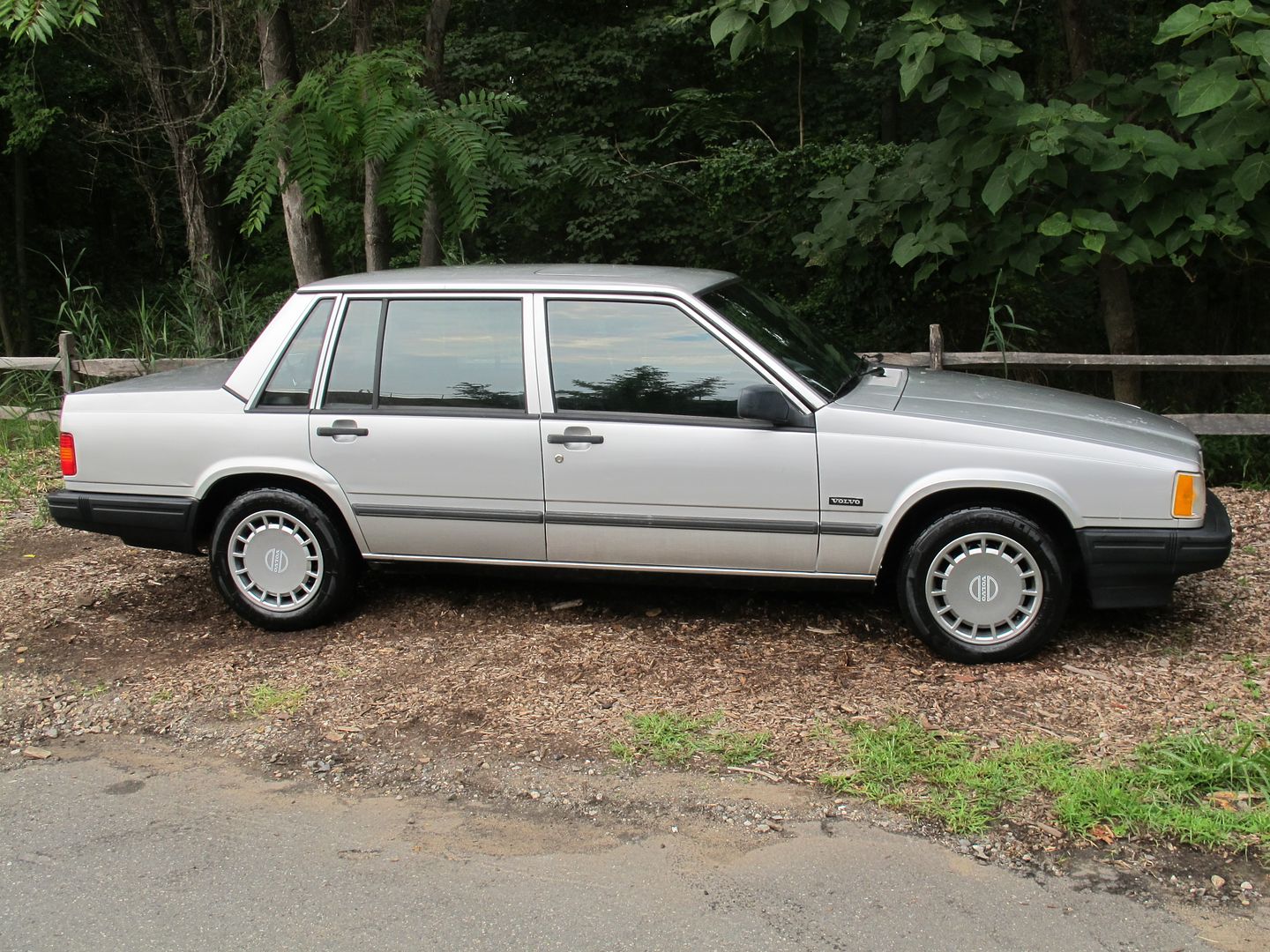
95k-Mile 1985 Volvo 740 GLE Turbo Diesel


I confess. I love diesels. And I love discovering otherwise dull cars from the 80s that were offered (briefly) with diesel engines at one point. The BMW 524TD. The Toyota Camry diesel. Cadillac Seville diesel. Now here comes a Volvo diesel.

The 740 was Volvo's mid-size family sedan from 1982-1992. These were very stoic cars: boxy, upright styling, small engines, but rear-wheel drive and solid-as-a-rock build quality. When their cars were offered with turbos or stick-shifts, they showed surprising signs of life. Needless to say, they have engendered an enormous cult following for a variety of reasons.

In the 1980s, auto manufacturers still had the fuel crises of the 70s in the back of their minds. Diesel engines compress air first then directly inject fuel. Diesel fuel is less volatile than gas and is a better lubricant, making parts work better together and therefore last longer. Diesel engines are typically 20% more efficient than gasoline engines.


Then there are the just plain cool aspects, like a diesel engine theoretically being able to function under water because they are totally mechanical and don't require electronics. Or, similarly, being able to start a diesel engine after a thermonuclear shock wave because the ignition isn't electrically triggered. Talk about dependability. They'll be there for you even in the apocalypse.

Mercedes-Benz mastered the concept of combining diesel reliability and passenger car comfort with a long line of vehicles going back to the first such implementation ever, their 1936 260 D. By the 1980s, their diesel cars were legendary. Coincidentally, diesel fuel was typically less expensive than gasoline. Since the equation of comfort, performance, and reliability was successful for them, a lot of other manufacturers jumped into the fray with varying results, but mostly all unsuccessful in the U.S. At some point it struck Volvo executives as something they must attempt, however.

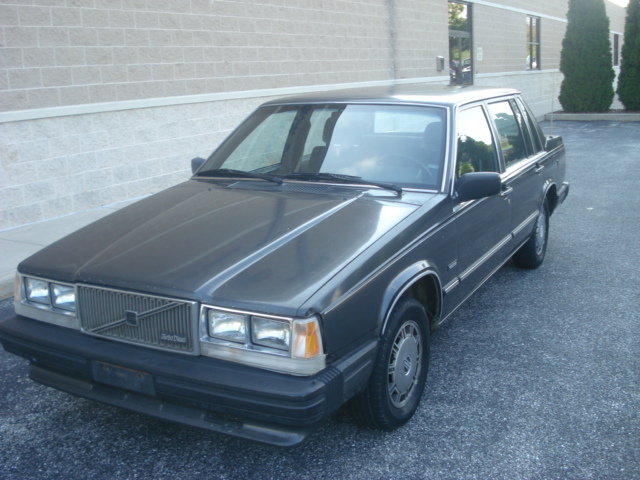
From what I can tell, Volvo only sold the 740 diesel from around 1985-1986. This is an '85 version. On the outside, it's your typical 740, all hard angles and straight lines, and looking even more stern in gunmetal grey metallic paint. The overall car exudes this remarkably harsh and almost oppresssive industrial aura, with the big plastic unpainted 5 mph bumpers, jutting front air dam, sealed-beam quad square headlights and upright rectangular grille. In some ways, the reliable and efficient concept of diesel engines are perfectly befitting of this Volvo's hyper-utilitarian character. It looks like a Mack truck morphed into a sedan.


Most Mercedes diesels featured only five cylinders. Volvo, however, opted for an inline 6-cylinder diesel D24T engine used in Volkswagen trucks, making the 740 TD the first and only known application of the engine in a passenger car. This particular example is also mated to a 4-speed manual transmission and has only 95,128 original miles.

Volvo body. Big truck diesel engine. Stick shift. How did this all turn out?

According to this excellent blog post on this very same subject, the Volvo 740 Turbo Diesel drove like you'd expect a passenger car with a truck engine to drive: not smooth, refined or clean. However, the author has a 740 TD of their own that has racked up a remarkable 215,000 miles, several engines, turbos and transmissions later and enjoy it thoroughly, on principle and performance. They do note a potential trouble area in the timing belt, which requires a rare tool to fix.


All of which makes this 95k-mile survivor rather remarkable. The seller says they acquired it from an estate sale and it runs, shifts and drives fine. They admit not knowing much about the history, but say it seems well maintained and the sale of the vehicle comes with extra parts and service manuals. This Volvo looks cold, steely and reliable, and with a some love and care, it could easily prove to be just that for many, many more miles. Trust me. Volvo collectors out there are daydreaming about this puppy.

Find it here on ebay in Glen Rock, Pennsylvania with bidding already at $3,050 and no reserve.

Cool Box: 1990 Volvo 740 Turbo

Volvos come across my radar every now and then.

Now is one of those times. And man is it a good example this time.


I always thought Volvos were cars people secretly hated but drove because they felt safe. Why else would anyone subject their garages to such 'bland, boxy' styling?

In the white suburban neighborhood of my childhood and adolescence, Volvos were ubiquitous, but they were just as often driven by teenagers as adults. This didn't help the impression of Volvos in my mind. The Volvos owned and driven by the teenagers I knew were dinged up 850 station wagons or the ultra-utilitarian 240 sedans.

I didn't fully appreciate Volvos until the internet age. Then I was able to read rave reviews, fully digest the vast cult following, and see how their values held pretty reasonably, especially for the now-legendary 240.

Turns out that they were actually pretty decent cars. Those teenagers were pretty damn lucky (in many ways beyond what they drove, too)!

Like a lot of European cars from the late 80s to mid 90s, Volvos were extremely durable, well-built, ergonomic and reasonably fuel-efficient. And yes, safe.

But what a lot of other Europeans cars had that Volvo lacked was some semblance of a sportiness.

One of the first cars to change perceptions about Volvo was undoubtedly the 740 Turbo.


The 740 was introduced in 1982 as a whole new range of vehicles for Volvo and lasted until 1993 when it was replaced by the much-lauded 850.

In 1990 the vehicle was given a facelift, replacing the ugly U.S.-spec quad square lamps with larger and more uplifting single-unit pieces and smoother once-piece bumpers.

Also new for '90 was the Turbo, which featured a 2.3-litre intercooled turbocharged inline four-cylinder engine that produced 165 horsepower. Styling wise, swept-star alloys and a stealthy blackened front grille signify the Turbo model. On the rear trunk lid, the badges, in typical 1980s manner, are wonderfully informative, denoting "Volvo" then "740 Turbo" and then beneath that "Intercooler". Why thank you! Fortunately, all badges to wear proudly.

And while the styling may have been once considered stodgy and dull, today it feels delightfully minimalist, conservative and handsome. The angles are crisp and clean. Lines end where you expect them too. The shape just makes perfect sense. Given Volvo's post-millennial shift towards completely uncharacteristic shoulder curves and wild taillights,  their memorable, now "classic" look from the 80s to the mid 90s is aging just beautifully in the minds of many, yours truly included.


I found this 1990 Volvo 740 Turbo offered by a dealer in New York. I've seen a few of their listings on ebay for other vehicles before. They always seem to have unusually good looking and relatively low mileage European cars from the 80s and 90s, complete with decent descriptions and a ton of high resolution photos, a big plus for me when viewing cars online.

With only 88,441 miles on the odometer, this 740 was either driven sparingly over the past two decades or was driven frequently at first, then stored for a long time. The seller mentions the vehicle only had one owner, another plus, so either scenario is plausible.

Whatever the reason for the low miles, assuming they are accurate, the vehicle qualifies as a survivor. The body looks straight. The seller claims there is no rust. The car was obviously washed and detailed prior to photographing so the tires look slick, the alloys crisp and the black plastic dark and clean, again another plus.

The all-black plastic and leather interior is just as good.


Volvo interiors are just as all-business as the exterior. Sharp angles. Function over form. Clean, uncluttered, easy to use. It's been said that you can find everything even if you are blindfolded. The interior of this particular 740 is clean, with no apparent rips, tears or stains on the broad seats.

On a whim I actually googled the VIN and found a vehicle with the same VIN for sale as salvage. I guess that means it was either an insurance loss or donation at some point prior to its current offering. The odometer was reading 88,435 then.


The dealer probably bought it for dirt cheap and now intends to flip it for maximum profit. That's all fine and well, but I'd make sure to question them thoroughly on the full history and what repairs they did, if any.

How many can be left? And in this good shape? For under $5K you get a solid, low-mileage turbo Swedish sedan. That's so much more car for so relatively little money than most new cars today.

Find it here on ebay with only a buy-it-now price of $4,500.