Showing posts with label mercedes. Show all posts

1974 Mercedes-Benz 240D Manual


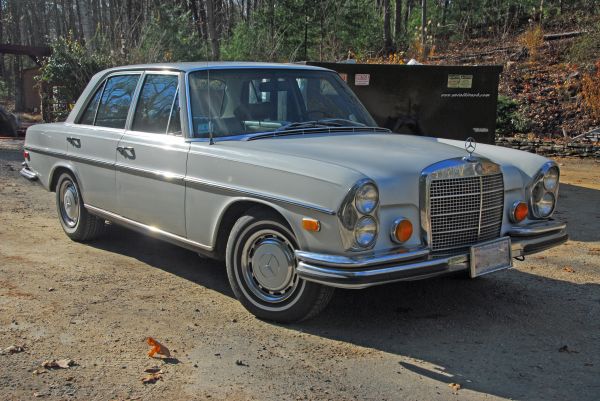
I spotted this vintage Benz yesterday at dusk and went back again today to 'check it out' in more detail. While I was taking some photos, the seller emerged from their house and kindly answered some questions about it for me. Basically, it's a U.S.-spec W115 '74 240 Diesel with a 5-speed manual transmission and over 250,000 miles on the clock. The seller is not the original owner, and didn't elaborate on how and when they acquired it, but said it runs fine.


The W114/W115 was produced from 1968-1976, resulting in over 1.9 million constructed. The W114 chassis signified the 6-cylinder models, while the W115 represented the four-cylinder models, including this 240D.


The body is credited to legendary auto designer Paul Bracq, and is a classic three-box shape, taught, conservative, squared-off and perfectly proportioned. Unfortunately, this being a 1974 U.S. model, it sports the heavy and unsightly 5-mph bumpers and lousy sealed beam headlights. Fortunately, it looks utterly charming in pale flat moss green, a relic of the 70s but still fresh looking today.


The '240D' signifies the 2.4-liter OM616 diesel-powered 4-cylinder engine that powered the rear wheels. These are not fast cars. I've actually read they are downright slow, even dangerously so, in modern traffic. Fortunately, this one is mated to a 5-speed manual transmission to bring both some liveliness to the engine and engagement to the driving experience. And what it lacks in overall performance it more than makes up in reliability. Mercedes-Benz diesels from the 60s, 70s, and 80s are some of the most durable engines ever released to consumers.

Cosmetically, the car is far from perfect, with obvious rusting and faded paint among other defects in the body. I didn't go inside, but the dark green interior sported what has to be that indestructible MB-Tex vinyl leatherette, as the seats looked really good.


The seller is asking just $2,500. This could easily be a great first car for someone, a temporary set of wheels for a college student until the end of the semester, or really just about anybody's beater car. It's good looking, diesel-powered, and has a stick-shift. What do my readers think? Thumbs up or down?

1972 Mercedes-Benz 280SE 4.5 V8


I absolutely adore these old Mercedes-Benz sedans. There is just something so perfect about them. Classy but not stuffy. Cool but timeless. They are strange in that Mercedes designed them in an engineering-first manner, as reliable and efficient as possible, with styling supposedly an afterthought, and yet they are undeniably a fashion statement first and foremost.

The W108 were produced from 1965-1972 and replaced the legendary W111 "Fintail". French designer Paul Bracq (who later helped BMW) was responsible for squaring off the corners, increasing greenhouse size and lowering the stance, and in the process ever so subtly created the modern Mercedes-Benz shape. Braq was brilliant and knew the enormity of the task at hand, and like all Mercedes designers, he passed the torch carefully but steadily.


These were offered in a variety of engines and trim levels. This one, the 280SE 4.5, is the best for the money: it's the short wheelbase with a huge 4.5-liter 8-cylinder engine under the hood. The long-wheelbase W109 are unnecessary for all but collectors as these are large and comfortable enough inside in normal body length.

The name is a bit of a misnomer, and was a problem for Mercedes until they devised the alphabetical class system in 1993. "280" initially referred to a 2.8-liter 6-cylinder, and "SE" is means "Super Einspritzung", or super fuel injection. Yet, the engine is much larger, so they tacked on the 4.5 at the end, negating the whole 280. Oh well. The actual car, in all its aesthetic and mechanical glory, more than makes up for it.


The seller of this delightful example says it has 150k miles on it. I'm fairly sure these had only 5-digit placeholder odometers, so any mileage claims would have to be an estimate. What's more important is what's been done and what hasn't over those miles.The seller says this one has always been garaged, and has new brakes, new tires and a recent service. They say it now runs well.

The only lingering questions are rust and rot, which seem to be a non-issue given it was "always" garaged. I'd see how many owners it has had and any maintenance records proving it was cared for.


If it checks out, you have my sincere envy. These are classics, and the 4.5 gives plenty of power to keep up with modern traffic, and look damn good doing it. Not many classic cars are this comfortable, reliable and useable.

Available here on craigslist in Carlisle, Massachusetts for only $3,900.

Winter Proof: 1987 Mercedes-Benz Unimog Snow Blower


I can't resist. Here is another Unimog within the span of a week. This one will make sure you never, ever get stuck in snow, or any inclement weather for that matter.

The Unimog is perhaps the ultimate 4x4 vehicle. As far as I can tell, there has never been a purely civilian version offered. They were initially military vehicles. The ones that pop up for resale are usually decommissioned civil service vehicles. They were never officially sold here until 2002, when Daimler Chrysler attempted sales of the U500 variant for only 5 years, resulting in just 184 units sold.


This is a 1987 U-1500, based off the 1976-88 424 series. These featured more angular styling than the beloved 406 series. The "classic" 406-style was categorized as a "light" truck, while the new 424 became "middle" and "heavy".

The seller of this example says it is a Class 6 vehicle, weighing between 19,000-26,000 lbs. The seller says is is powered by twin diesel engines. It's mated to no less than 8 forward and reverse gears. Attached to the truck is a Sicard Snow Blower that is powered by a twin-turbocharged 12-cylinder OA424A engine.


Mechanically, the seller says both engines run great, and have low miles and hours logged. They say the tires are good and the blower is effective, throwing snow "great distances".

Cosmetically, this thing is a beacon of hope in the desolate winter landscape with bright orange paint and black accents. When the Unimog is used for military and civil work for the German government, they are aesthetically pleasing in a level of detail only the Germans can master. This one comes close, but could use some more details. I'd paint the rear bumper guard in yellow and red diagonal hazard stripes.

It is not clear whether this example was used for a public or private entity.


If you own large commercial space or a farm in areas that get dense snowfall, this could be a nifty tool all winter long.

Available here on ebay in Stanley, South Dakota with bidding and a Buy-It-Now of $33.9k.

1981 Mercedes-Benz U3100 Unimog with HIAB Crane


The thing I love about the Unimog is that it makes any arduous task look easy and even stylish.

Need to cross a shallow river? Scale a mountainside? Trek the Sahara? No problem.

Add one more thing to that list: need a portable crane to lift something really, really heavy? This particular one can do it no problem.


The first Unimog prototype was created in 1946 and to the present day Mercedes is still offering some variation of this vehicle. In 1955, the classic Unimog 404 was created, and is perhaps the most aesthetically pleasing, along with the 406 from the 60s.

This is a later '81 424 series launched in 1976 and features more angular and modern styling. It's no less macho and cool looking however. Note the headlights have been moved to the bumper for an ultra-utilitarian look.

The seller says this example has a diesel engine that is mated to a 12-speed transmission, with front and rear locking differentials, and a Pintal hitch with standard ball as well.


This version has a three-way tilting rear bed. The seller says it just needs a piston to fully function. In between the bed and cabin is a PTO-driven HIAB crane with outriggers for extra stability.

The seller mentions the flat jaybird blue paint is "beautiful" and there is no rust. Inside, they say the seats are perfect, gauges function, and the dome lights turn on correctly.

The crane might seem to limit functionality, but I bet it folds up neat, and, along with the bed, will find itself useful one way or another. Tough guys would rather have it than not.


Available here on craigslist in Bedford, New Hampshire for $35,000.

Under $20k: Euro 1983 Mercedes-Benz 500SL


I love the R107 SL-Class.

I just don't like the hundreds of thousands of North American versions imported here.

One of the more unfortunate chapters in auto history is when European automakers were forced to comply with inane U.S. government vehicle regulations in order to sell their cars here. One of them required cars to be able to withstand 5-mph impacts, so automakers were forced to slap on large, heavy and unsightly bumpers over their original designs. On the otherwise graceful Mercedes R107, the bumpers basically ruined the car.


There were also rules pertaining to headlights, so Mercedes had to ditch the progressive and handsome small square units they debuted with the car and instead install these sealed-beam quad round lights that made the car look ancient, not to mention make visibility at night worse. The sad irony of the American regulations is that European cars were and remain far safer in general than American cars.

So when your comfortable elderly neighbors are selling their low mileage American-spec SL for some outrageous price, don't budge. You don't want it. During the Reagan Era, loosened restrictions on importing created a vibrant grey market culture, so European versions filtered through in surprising numbers. On any given day on ebay, you'll find a handful of European versions in varying quality.


This is one such example, and it's absolutely gorgeous in gunmetal grey over black, a very rare and desirable color combo. The 500SL was never offered here. Sure, we got the larger-engined 560SL, but the 500 is faster, pumping out a very impressive 245 horsepower with 0-60 mph times around 7.4 seconds and more torque at 296 lb·ft (401 N·m) at 3200 rpm.

The small square Euro headlamps are a revelation, showing us how truly modern and fresh Mercedes made the R107. It gives the car and utterly devilish and charming front end. The slim chrome bumpers are beautiful, and when combined with the later '92 R129 alloys, make this car look startlingly current. I could do without the black plastic rear spoiler, but it's factory and still looks fine.


Another great thing is the size. These cars are so small, yet they're comfortable inside and pack so much power under the hood. Just another German wonder.

The seller lists the odometer as reading 138,945, which must be in kilometers and equals about 86k miles, low for an R107. Inside and out, the car looks immaculate. They say that a whopping $15,000 in service work was recently done, and they have the receipts to prove it. I would check for accident damage and rust. Beyond that, there's not much you can argue with after $15k of work done.

If you are a serious collector looking for the right SL in Euro-spec and a great color combo, this could easily be the one. It also includes the removable hardtop. Awesome, awesome, awesome car. The next owner will be a lucky.


Available here on ebay in Dallas, Texas for $19,995.

COTC Exlusive: Franco Sbarro Mercedes Gullwing 6.9


In the history of coachbuilding, Franco Sbarro has earned a special place. Inventor of the hubless wheel. Sculptor of wild body designs. Engineer of uninhibited speed and performance. If coachbuilding is an art form, then Sbarro is a great artist, expressing himself through automobiles that capture our imagination but also transform our notions of how they should look and work.

Italian-born and Swiss-bred Sbarro founded his company in 1971 to do just that. Over the years they crafted dozens of bodies, borrowing chassis and tweaking engines to create a unique vision. Coachbuilding allows for a manufacturer to build the cars of their customer’s dreams, without the cost associated with mass production. As such, all of their creations are produced in low quantities, making them even more rare and desirable.


Sometimes, though, coachbuilding isn’t just about innovation but inspiration and homage. That’s why Sbarro also builds high-quality replicas of classic cars like the BMW 328, Bugatti Royale, and Ford GT40. Although Sbarro’s designs are ultra-modern, he appreciates the classics too.

In the 1980s, something of a conundrum occurred in automotive manufacturing: Mercedes-Benz were building high-quality cars that were both modern and instant classic at the same time. For the ever-watchful eye of Franco Sbarro, these cars were ripe for the ultimate expression of gratitude towards Mercedes-Benz for their products.

Which brings us to his custom Gullwing 6.9. The first people of notoriety to customize the Mercedes C126 380-500SEC were Styling Garage out of Hamburg, Germany. Then, Sbarro debuted his legendary take at the 1983 Geneva Auto Show. These guys were the original “pimp my ride”. They were Europeans who loved European cars and wanted to add their own special touch. This usually called for extensive revisions of the interiors, exteriors, and engines.


For Sbarro’s 500SEC, he uses elements from not just one Mercedes-Benz, but two: the C124 coupe and W116 sedan. At first glance it appears to borrow more from the C124. The body is imposing to say the least. Sbarro has crafted entirely new sheetmetal in ways that Styling Garage did not.

The most striking aspect are the gullwing doors, a tribute to the classic Mercedes-Benz 300SL Gullwing of the 1950s. These were popularized by the 300SL and have since become a trademark Mercedes feature, despite being used mainly on concept cars until their 2010 SLS. Sbarro's gullwings are made of plastic for easy lifting and less overall weight added to the vehicle.


The car has a unique roof that is lower than the C124. The trunk is higher, and the wheel wells are flared. Mercedes designs of the time featured an emphasis on horizontal lines, so Sbarro takes it new a new level. The whole front is covered in thin slats that hide the headlights and grille that are reminiscent of the rear of a Ferarri Testarossa. The lower panels feature horizontal groove lines too that mimic the iconic ribbed taillights.

Inside, Sbarro has completely reworked the interior, while retaining a Mercedes-Benz vibe throughout. The dashboard is from a W116 sedan. The steering wheel is unique. The center console houses climate controls and an aftermarket radio. The seats appear to be Recaro and are power adjustable from buttons on the seats themselves. Despite the ambition of the overall project, the interior is relatively modest and tasteful.


Underneath the hood lies an enormous 6.9-liter 8-cylinder engine, previously only available in the rare high performance W116 450SEL sedan from 1975-1980. Sbarro is a speed hound and wanted to put as much power in his creation as possible. The 6.9 put out around 286 horsepower, big for the time and still respectable today. It will easily move this thing along.

Most customers of Sbarro were royalty from the Middle East. This particular example was built for an Arabian princess before being owned by Celtics basketball player Dennis Johnson.

Cosmetically, the vehicle is in very good shape. It underwent a 5 year restoration and has been driven around 9,000 miles since. The paint is in good shape, with only some minor scratches and wear from typical usage. The interior is also in good shape.

Mechanically, the car starts, runs and drives fine, with no apparent issues. The owner has maintained it very well. The hydraulic gullwing doors open and shut easily. The car also has height-adjustable suspension.


Only 6 were supposedly built with this configuration, from a total of 28 including the later Biturbo. It could very well be the only one in the U.S. This is a rare piece of European coachbuilding history. The car is in good shape and should be ready to go. At the very least, it will be a big hit at the local car show and the cause of many scratched heads as people try to figure out what exactly it is.

The vehicle is being donated. Proceeds from the sale will benefit the Arthritis Foundation. The vehicle is currently located in Monroe, North Carolina. Click here to send an inquiry if interested.

Julia's 1993 Mercedes-Benz 190E 2.6


After her Toyota Camry started falling apart, my friend Julia knew she wanted either a Jaguar or Mercedes-Benz to replace it. “Jaguars are the most beautiful,” she says, noting that she'd see a lot of them for sale on the side of the road. But they have a reputation for poor quality and reliability. So when it came time to find a replacement car, she set her sights on an older Mercedes-Benz. For Julia, an artist and bartender, they look just as good as a Jaguar but were built much better.

Sure enough, she spotted a 1993 Mercedes 190E 2.6 for sale at a nearby gas station. The odometer reads over 137k miles, so while not low, it's actually below average for a 19 year-old car, given that Americans drive around 13,000 miles per year. She test drove the car and had a trusted mechanic look at it. He gave the car the OK, but his only words of caution were about the possible future costs of fixing it: “He told me I would not be happy when I see the first repair bill,” Julia recalls. But she was undeterred. “All cars require maintenance,” she reasoned. Since she had been without a car for about a year, and the Mercedes checked out in every other way, she bought the car.


Part of why this particular Mercedes stuck out to Julia is the color, a newer coat of paint in what Julia describes as “ultramarine blue”. It has this high sparkle gradient that, while we agreed was not something the Germans would have originally painted it in, happily reminded us of the flamboyant colors of Hot Wheels cars when we played with as children and befitted the car’s charming aura. Mercedes-Benz look good in blue anyways, and Julia loves the color, so much so that she wore a pair of blue floral-patterned pants the day I saw her and also grew a blue crystal specifically to hang from the rear-view mirror as a good luck charm. 

Examining the doors we noticed the jams were black, likely the original color.

The 190E (internal code W201) was nicknamed the “Baby Benz” and was Mercedes-Benz’s entry-level model. Over 1.8 million were produced between 1982 until 1993, making Julia’s model a final-year example. The "E" stands for Einspritzung, or Fuel Injection. Most had four-cylinder engines under the hood, but in 1987 an inline 6-cylinder was introduced. While “190” denoted the original 1.9-liter engine size that wasn’t even offered in the U.S, the numerical designation was kept and different displacement sizes added after for clarification. Therefore, Julia’s 190E “2.6” denotes a 2.6-litre inline 6 engine under the hood. Since the 190 were small and relatively light cars they moved fine with just four cylinders, but the 2.6 producing a healthy 160 horsepower made them even faster and highway travel and passing cars even more enjoyable.


Design is courtesy of Bruno Sacco, Mercedes Benz’s brilliant chief stylist from 1975-1999. It is claimed to be his favorite work ever, likening the chiseled lines and tapered rear-end to the precise cuts of a fine diamond. To think that it came out in 1982 is unbelievable, especially considering other cars being produced around that time. It must have looked amazing then and it still looks amazing today. “Another thing about this is the size,” Julia says, noting the dimensions that make the exterior feel tight and compact, yet extremely spacious inside. Parking, especially in an urban area where Julia resides, is easy.

On the inside, Julia’s 190E features rare black seats, as most you see are tan. The material doesn’t seem to be leather but rather Mercedes’ indestructible "MB-Tex", essentially a durable yet comfortable vinyl surface. There are basically no rips, tears or stains. It’s incredible. The dashboard is also black and is small, clean, and simple. Everything is within easy reach of the driver. The gauges are in white and yellow and are clear and easy to read. The instrument cluster also has a tiny analog clock nestled underneath the tachometer that is a nice touch. The center console is covered in a wood surface. Only the climate controls are confusing. “What do all these symbols mean?” Julia wonders aloud, pointing to a row of small square buttons. Indeed, they don’t seem to follow universal air conditioning signage and instead veer into the mechano-wunder world of German engineering, where only the designers really know what their symbols mean.


Then there’s the tape deck, or decks I should say. Julia tells me to look down at this nondescript stack of rectangular buttons and suddenly it pops out, waiting to accept a cassette tape. But not just one. There are six of these holders. Julia is only disappointed that the aftermarket CD-player installed below it doesn’t allow her to actually play cassettes, but the idea of being able to hold them neatly in your dashboard is enough to impress both of us.

In back, Julia discovered a first-aid kit behind the rear seats. We opened it up and there was a perfectly organized array of bandages, medical tape, sterile pads, and antiseptic gel, all courtesy of "Mercedes-Benz of North America." Why thank you! Of course, it would be irrelevant in the worst of car crashes, but it's the thought that counts. I'd rather have it in my car than not.


On the road, the car drives great. Because it's rear-wheel drive, the housing that powers the rear wheels is situated between them and balances the car immensely, improving overall ride quality and handling that front-wheel drive cars just can't duplicate. It's also got that amazing heavy steering that has now become a trademark feel. Julia thinks it's just common sense, which it is if you think about it. "You're turning the weight of the car", remarks Julia, "so it should feel heavy." This is precisely in line with the reigning form-over-function design philosophy of the late 20th century, perhaps no better embodied than by Mercedes-Benz. Objects were made to look like the function they perform, and by extension, should perform like the function they perform. So many manufacturers miss this simple but crucial concept. Turn the wheel of the 190E, and you feel the bank-vault body navigate with you. 

The car is not without some flaws. The windshield is cracked, and there is some surface rust on the body. But those are small cosmetic issues on an otherwise solid car that's running fine and should be good for many more miles. You can't expect perfection when buying a used car. But the beauty in owning a second-hand Mercedes-Benz is that it comes about as close as possible.


Julia and I think the car has mega potential classic status Whereas the Baby Boomers are nostalgic for cars of the 50s, 60s and 70s, my generation will appreciate the ultra-utilitarian German and Japanese cars of the 80s and 90s. And for good reason: they've given us solid, reliable and attractive transportation. Even Mercedes-Benz seems to think so too, despite the many changes the manufacturer has gone through since the 190E. They've launched a "Young Classics" store in Stuttgart that finally officially recognizes their masterpieces from the 70s and 80s.

What's next for Julia's 1993 190E 2.6? A good waxing and buffing before the New England winter sets in. "I imagine it will be very satisfying," she says excitedly. Just one of the joys of maintenance. And it will feel extra good knowing she's beautifying such a nifty little car.


Rare 1991 Mercedes-Benz 300SL 5-Speed


After the R107 SL had been in production for 18 years, Mercedes finally rolled out its replacement, the R129, in 1990. Since the R107 had been slapped with ugly U.S. government mandated headlights and bumpers, it was never the car is should have been. But the R129 had universal styling and a whole new level of appeal.


Bruno Sacco's design was a masterpiece of classic lines but progressive shape. The hood is long and low, and the rear is handsomely squared off, accented with the trademark ribbed taillights. The early models are some of the best looking, with the three-opening air intake slots on the sides, full-faced alloys, and more detailed front air dam.

The underpinnings were based on the excellent W124 sedan chassis. Mercedes initially offered just a six or eight cylinders, then later 12.

This example is a the 24-valve M104 straight-six cylinder engine that produced a healthy 228 horsepower. Many were the more complex V8, so the six-cylinder engines are a neat find for someone looking for something relatively tame but still plenty sufficient to start out with.


What makes this version especially appealing is the very rare 5-speed manual transmission. Mercedes stick shifts are very hard to find, especially in their cars from the 80s and 90s, which were considered by the general populace as "luxury" rather than "sporty" cars, a sentiment echoed and reinforced by Mercedes themselves.

It's difficult to find an exact number of how many 5-speed 300SL were sold here, but the seller says it was only 100 - whether for that year, or total, is unknown. Another source says about 800 total. Either way, it's not much.

The seller of this example says its a two-owner car with a clean accident-free carfax and meticulous ownership. They say the oil was just changed and it drives like a "dream". They list the odometer as having around 95k-miles.

Find it here on ebay in Pompano Beach, Florida with 5 bids at $3,050 and reserve not met.

Der Camino: 1978 Mercedes-Benz 450 SEL Custom


What if Mercedes decided to make a two-door pickup based on the body of the W116 chassis sedan? They didn't, but someone else thought they should have. So they created this wild custom car in the style of a Chevrolet El Camino.

The seller says $75,000 was spent making this dream come true. Based on the model name, I'm assuming they used a standard 450SEL long-wheelbase sedan, a good place to start. The extra length means more bed space, and the 4.5-litre V8 engine means plenty of power and torque to help haul or pull.


The body has undergone a radical transformation. The rear passenger seats and doors have been completely obliterated in favor of a small two-seat only cabin. The rear bed is enormous, but not too deep. It also features a sleek toneau cover that limits cargo height but looks really cool. The slim Euro bumpers and single-unit headlights combined with the black exterior and interior give this a no-nonsense, utilitarian look. The Germans love frugality, practicality, and functionality, so the concept of this Benz is actually quite fitting of the brand, at least where they were in the 1970s. I could see it being sold alongside the Geländewagen for use on farms in the European countryside. It would also be cool with a turbo diesel engine.

In keeping with superior build quality of Mercedes vehicles at the time of the original build date, the seller says the custom bodywork was professionally done and features "impeccable workmanship" with no visible seams.


The vehicle also has a moonroof, custom wheels (that look to be genuine OEM G-Class alloys), new tires, dual exhaust, and a carpeted bed.

Personally, I think this thing is awesome. The seller claims it is one of a kind, and it probably is. There can't be many people with the talent or skill to pull this off, but the idea was good and the execution seems mostly pretty successful. Job well done.


Find it here on ebay in Volo, Illinois with 1 bid at $14,500 and reserve not met.

Glamtastic Voyager: 41k-mile 1973 Mercedes-Benz 280C


This is totally something you would have seen parked along the curb of a well-manicured lawn on Long Island or Beverly Hills in the 70s. What I love is how accessible they are now, and yet also on the cusp of becoming a true classic.

Production of the W114 lasted from 1968-1976 and resulted in almost 2 million units made, although only about 67,000 of those were two-door coupes like this.

In the U.S., the W114 was offered with fewer engine choices and DOT required alterations, which meant inferior headlights and larger bumpers. Fortunately, this stunning example wears slim bumpers, although it does have the poor sealed-beam headlights.


This is a 280C. It features the 2.8-litre M110 inline 6-cylinder engine and produced somewhere between 145-160 horsepower, ok for the time but will probably seem slow today. Still, the Germans designed all of their cars for solid and stable Autobahn cruising so this is probably pleasant once up to speed.

The seller of this vehicle claims it has only 41,499 miles and no rust, except for a dime-sized bubble on the driver's side. That's nothing considering how quickly these rust when exposed to the elements over time.

The tin-foil gold exterior color would be atrocious on any other car but works perfectly, especially with the charming matching tin wheel covers.


The seller mentions the leather seats were refreshed and it shows. The tan leather looks smooth and soft. I appreciate owners who re-do their interiors, especially on older cars. It's smart and goes a long way.

This 280C is equipped with an automatic transmission and air conditioning. They make no mention of mechanical status, but with the low mileage and clean body, hopefully the inner workings were cared for as much too.

Hemmings CPI Value Guide estimates a 1973-1974 280C in fair condition to be worth $1,850, good condition $3,900 and excellent condition $8,850, with a 4 point percentage increase over time.

Find it here on craigslist in Braintree, MA for $7,950.