Showing posts with label 00s. Show all posts
2001 Mercedes-Benz A160
In the late 90s Mercedes-Benz started moving far away from the angular and no-nonsense look and feel of their cars of the 70s and 80s with some unusual additions to their lineup: the retractable hardtop convertible SLK (1996), the sport utility vehicle M-Class (1997), and the supermini A-Class (1997). Bruno Sacco's touch was no longer on every design. Quality was also starting to be a concern.
The W168 A-Class was unique for Mercedes in a lot of ways. It featured front-wheel drive, shocking for a company whose core tenet was the balance and refinement that rear-wheel drive provides. The compact but versatile body squeezed in four doors and a rear hatchback.
Some aspects of the A-Class were typically Mercedes, however. It featured an innovative "sandwich" system where the engine and transmission slide underneath the pedals instead of into the cockpit in the event of a major front impact.
Styling is credited to a Steve Mattin. While a departure for the brand, it still bears resemblance to other models at the time, with the ribbed taillights and integrated front-grille.
Mechanically, the seller says this one has only 73k miles. They state a 1.6-liter 4-cylinder engine is under the hood, and is mated to a 5-speed clutch-less manual transmission. Cosmetically, they say it wears the original paint, has had no accidents and is sitting on lowered springs and aftermarket wheels that don't hurt it aesthetically.
These were never sold in the U.S., despite some clamoring by consumers. The seller of this example says it has a clear California title, but will not pass the final stretch of those pesky, finger-wagging, nanny-state smog tests and is therefore illegal on in-state public roads. Whether it can be driven outside of California is anyone's guess.
Although it's essentially the same layout and size as a Honda Fit, there is a much higher cool factor here.
Available here on ebay in Camarillo, California with bidding at $6,100.
2002 Lexus IS300 Sportcross
For a while, BMW's 3-series was the undisputed king of the sport sedan segment. In fact, it pretty much invented the segment. There really wasn't much competition until the dawn of the new millennium, when cars like the IS300 were launched to directly take a bite out of 3-series sales. Just as the full-size luxury sedan segment was extremely competitive at the start of the 90s, the race to develop the best entry-level sports sedan was really heating up by the end of the decade.
The first generation IS was actually a re-badged Toyota Altezza AS200/300, which went on sale in Japan in 1998. Power was directed from 6-cylinders to the rear wheels. For markets outside of Japan, it was known as the Lexus IS200/300. It was available here from 2001-2005.
Styling is pretty basic but hits the right notes and doesn't offend. The Japanese designers are better known for their interpretations then outright creativity, and the IS300 follows suit, mimicking the long-hood and short rear deck of the 3-series. The body is smooth and simple. The sharp and slanted front headlights give the car a feisty look coupled with the huge five-spoke wheels. The exhaust-like round taillights covered by clear perspex were trend-setting however in that tons of aftermarket taillights have copied the look directly, which could be seen as a good or bad thing.
Inside the driver was treated to a pretty cool red-lit chronograph-style instrument cluster, with miniature gauges for temperature, battery life and fuel economy tucked neatly inside the speedometer. The rest of the interior is hard and cold grey, silvery and black plastics. There is no wood, emphasizing sport and frugality over luxury. The shifter features a chrome-ball knob a la Ferrari. Lexus, long known for their dull interiors, aced this one.
All IS300 were offered with automatic transmissions until 2002, when a 5-speed manual was offered. In 2002, a wagon version was also added. It basically took the sedan styling and added an extended roof and rear hatchback, with new taillights. Aesthetically, it worked. I don't have sales figures but you never see these on the road. Given how Americans don't take to wagons, I'm sure not many were sold. But since the IS300 is a pretty neat car already, the wagon version is especially noteworthy.
This example is being offered up by a dealer who state the mileage as 157,400 and say it runs, drives, and looks "fantastic". Since these were actually Toyota, parts and repairs should be relatively inexpensive. I haven't heard of any major problems with them. This thing could be good for another 100k-200k miles of rear-wheel drive hauling.
Available here on carsforsale.com in Lebanon, Indiana for $7,500
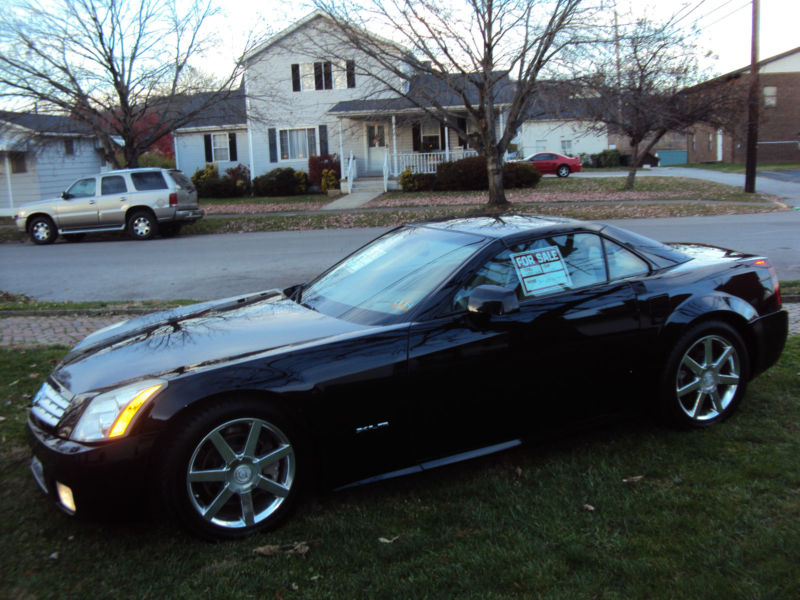
Future Classic: 2004 Cadillac XLR
The XLR was Cadillac's second attempt at a luxury performance two-seater convertible after the mixed results of the Allanté.
When production of the Allanté ended in 1993, Cadillac was without a flagship convertible for a decade. However, in 1999 they tested out a two-door concept, the Evoq, at the Detroit Auto Show. It wore a startlingly fresh body by Kip Wasenko of razor-sharp lines, edges, and creases. It was bold and new, yet still very American and very Cadillac. Under the hood was the familiar Northstar V8, but for the first time in a while, power was directed to the rear wheels. It was a hit, and Cadillac has been utilizing its design themes ever since.
When asked what current designs he likes, legendary Mercedes-Benz designer Brunco Sacco stated he admired Cadillac most. Indeed, in the same way Sacco created a memorable face for all Mercedes-Benz, Cadillac, starting with the Evoq, finally found a design theme to fit across the whole range and instantly identify their cars, especially against stiff competition. No other cars wear Cadillac's ultra-mod sharp body lines, while German and Asian cars are looking more and more alike with each passing model year, much to their detriment.
Based on Corvette's rear-wheel drive Y platform, the XLR debuted in 2004 and featured a unique body, interior and suspension. It also had a power-retractable hardtop that needed just under a foot of clearance for retraction. The hardtop was supplied by Porsche and Mercedes-Benz (who had employed this setup on the groundbreaking SLK) and was made of aluminum to reduce the addition of weight as much as possible.
Only 15,460 were produced until 2009, when it was never followed up with a successor. Currently, Cadillac is two-seat convertible in their range.
The seller of this example states their daughter bought it in 2006 from the original owner, then the seller swapped his four-door Lexus for the XLR. He now finds the XLR too small and needs to sell. The seller states the odometer as reading 70,500, slightly high for an XLR, which were usually acquired by older people who drove them sparingly.
Cosmetcially, the seller says the vehicle is in excellent condition "but not perfect", whatever that means. They do say everything looks and works as it should. Mechanically, they state it runs and drives well, and they invite local prospective owners to inspect and test drive it.
Since the V8 is a large and somewhat complex engine and the vehicle relatively new, it should come with a stack of records and receipts to document the 70k miles put on. If the seller is just getting rid of it for lack of need, it could check out however.
Regardless, with a Buy-It-Now of just $22,000, this is one of the nicest and least expensive XLR I came across on the market right now.
Find it here on ebay in Kenova, West Virginia.
Post-Soviet: 2001 Lada 110 1.5 GLI
One of the things that happened after the fall of the Iron Curtain and collapse of the USSR was the opening of trade, technology and information between East and West. This included automobile culture. Of course, since the Russians have historically made pretty poor cars (by Western standards) it was basically a one way relationship. But without Gorbachev, we would probably never have access to this charming little Lada built exactly one decade after the USSR bit the dust. So how far they have come?
Lada have been making cars since 1970. They exported a lot of vehicles, though never officially to the United States (for obvious reasons - but can you imagine a Cold War comedy about a Russian car dealer in the U.S.? Bugged cars, suspicious neighbors, jokes about drinking vodka while driving).
They have had close relationships with Fiat, and more recently, Renault.
The 110 was produced from 1995 until 2010, quite a run for this little thing. It's a typical compact economy car, with 1.6-litre four banger pumping out just 90 horsepower that powers the front wheels. Weight came in at 2315 lbs. These are not innovative, special, or sophisticated in any manner, but rather standard transportation from point A to B.
Styling, however, isn't half bad. The tires are too small, but it looks decent in silver and is relatively simple and clean. I like the rear taillights. From what I've seen of Russian car designs, they range from hideous to passable. This moves beyond years of poor and anti-asthetic styling towards a global city-car-look, acceptable in any of Europe's capital cities as a frugal commuter machine.
What is most interesting is to find one right here in the good ol' USA. Unfortunately, the seller is one of those people who writes in all-caps, and says things like "it's in great shape for Russian standards" and "you get more noticed in this car than in a Ferrari". They also drop the worst bomb possible when considering with a foreign car not exempt from the U.S. gov.'s current 25 year or older vehicle importation rule: this Lada has no title and cannot be registered! Yikes. They say it can be used with dealer plates only and must be taken on a trailer to "shows". What kind of show would that be? Illegal cars currently here somehow? As frustrating as the ad is, it's somehow perfectly fitting of a Russian car made in 2001...a creaky country emerging awkwardly into a new world.
Find it here on ebay in Arlington, Massachusetts with 1 bid at $3,500.
Subscribe to:
Posts (Atom)