Showing posts with label coupe. Show all posts
1987 Subaru XT Turbo
If you were to ask me, "Are there any Subaru classics?" I would respond with a resounding, "Yes!" And then I would ramble on and on about the XT.
The 80s were a pivotal time for Japanese automakers. Like a phoenix rising from the ashes of World War II, the Japanese rebounded remarkably and excelled at making cars. But when it came time to infiltrate the American market, they had stiff competition from both Detroit and Europe.
One way to buck both was to offer cars that were well-made (which American cars weren't) and affordable (which German cars weren't). This way, they appealed to consumers best instincts: thrift, value and quality.
Subaru had already made an impression with their compact all-wheel drive sedans and wagons. To take on the compact sport coupe, they introduced the all-new XT in 1985. Like other Subaru, it was a simple, uncomplicated front-wheel layout with the option of all-wheel drive. But unlike Subaru's existing models, it wore a radical wedge-shaped body of laser-straight lines, blackened pillars and hidden headlights, looking like a Syd Mead-designed prop for the set of Blade Runner.
The futuristic vibes continued into the interior with an asymmetrical steering wheel, digital layout and stalks of vital buttons and controls housed in two pods flanking each side of the steering wheel for access within finger-reach.
The only initial complaints about the XT were lack of power, especially in the naturally aspirated 4-cylindr. Fortunately, this is the much more desirable turbocharged 4 mated to a 5-speed manual transmission. It put out just 115 horsepower, but with the stick shift, aerodynamic body and relatively light weight, could easily feel sufficient and nimble.
The seller says this survivor is rust free, and the paint shows just some oxidizing. Mechanically, they say it not only has a rebuilt engine but a suspension transplanted from an '03 WRX! Whoa! Not surpassingly they say it handles amazingly. Always nice to find older cars with sweet sleeper upgrades like this, and the seller isn't passing down the cost of the swap, either.
These are flying totally underneath the elite collector radar, despite Subaru restoring one for their museum recently and Gen-X car fans looking back on them with nostalgia. But to those in the know, these are a best kept secret, blending outrageous styling and fun, economical performance.
Available here on ebay for a $5,000 Buy It Now.
1988 Ford Thunderbird Turbo Coupe
Ford ended the legendary Thunderbird nameplate a while ago, having come full-circle with a retro version at the start of the new millennium. Every generation had some appeal, and a lot of people were puzzled and saddened to seed it go. It's like if McDonald's got rid of their Big Mac suddenly one day for no good reason.
Speaking of fast-food, this is a fast ruiser that would totally be rad to go to the drive through with. In 1983, Ford launched an all-new, totally redesigned Thunderbird that finally erased any memories of the bloated barges of the Malaise 70s. The new car was handsome, well-proportioned and perhaps most importantly very aerodynamic, with a drag coefficient of just 0.35.
It mercifully shared the rear-wheel drive Fox platform with the Mustang of the era. This meant a balanced chassis, decent handling and a real shot at taking on the European competition.
In 1987, Ford gave the Thunderbird a refresh which ditched the awful sealed-beam headlights in favor of flush units, shrinked the grille and tweaked the taillights. The thing I really like about this generation Thunderbird is that it aesthetically offers something Europe still couldn't replicate, a mix of muscle and modernity.
There were a bunch of engine options, too. You could get a V6, V8, or a special turbocharged 4-cylinder engine like this one.
Of all the engines, I'd want the turbo 4. The V6 wasn't like today's powerful 6-cylinders and had to move a relatively large and heavy car. The V8 made the car too fuel thirsty and irrelevant, as the similar and better appointed Lincoln Mark VII was essentially the same car. But the 4-cylinder turbo offered everything: decent fuel economy and gobs of power. Ford knew they had a hit and gave the engine a air-to-air intercooler from the SVO Mustang that boosted output to an impressive 190 horsepower.
Other features included 4-wheel disc brakes Automatic Ride Control, functional hood scoops for the intercooler and 16-inch "snowflake" alloy wheels.
These are new classic American muscle cars. The 80s were a mixed decade for the US auto industry, as they had to stave off serious competition from Europe and Japan, but cars like this show they still had interesting things to say. '88 was the best year for the Turbo Coupe, and the last year for this entire generation.
The seller says this example has over 120k miles, and although they say it isn't perfect, it looks clean and well kept enough. The seller also says they have a bunch of spare parts.
Available here on craigslist for $3,000.
1973 Fiat 130 Coupe
The 130 looks like a combination of a Maserati Kyalami, Peugeot 604, Ferrari 400 and Bitter SC but that's a all a compliment. The thing about this design is that it's all good for the customer. You can actually see out of the car, and enjoy the view while driving.
Like a lot of Italian cars, the interior is a nice place to bee, with a black dashboard contesting with a healthy helping of wood and beautiful tan leather seats. I bet it smells damn good too, even if it's 41 years old. Steering wheel is retro-future-cool, too.
Underneath the hood is an OHC V6 good for about 160 horsepower to the rear wheels. This one mercifully also has a stick. Unfortunately, against a 3,400 lb. curb weight, it had a lot of work to do, and won't be terribly fast or remotely fuel efficient. It may make a nice tenor, though.
The seller says the car was imported under the 25-year-and-older rule and so does not have to comply with the DOT. As such, it comes in complete Euro trim, with lovely headlights, small bumpers and unconstrained engine. Mechanically they say it runs and drives well. Cosmetically they say it does have some bubbling but the undercarriage is rust free.
With slightly over 4,000 made, this is a rare car in general and even more obscure in the US. I think it has a lot of appeal though, as either a garage queen, weekender, show car or possibly daily driver, if you've got deep enough pockets, however.
Available here on ebay.
1991 BMW 325iX
The dimensions of the E30 really are a revelation. Here is a design that actually shows constraint, seemingly using as little sheet metal as possible. Taught, clean and no-nonsense. The pillars are thin and glass huge for maximum visibility inside and out. The whole thing is about the same size as a 1990s Honda Civic. Except it looks way better and drives a million times better.
Perhaps the next rarest E30 sold in the US after the M3 is the "iX" models that debuted in the late 80s and lasted until around 1991. These had full time permanent all-wheel drive, utilizing an open, all viscous 10-100% limited slip with three differentials. The torque was divided 37:63 with bias to the rear wheels to retain the rwd feel. The rear and center differential use viscous couplings to split torque, while the font was open.
Inside is one of the greatest interiors of all time. An oversized steering wheel, center console angled towards the driver, and simple white-on-black gauges make a statement that this machine means serious driving business. The leather seats are in unusually good shape. The seller says the dash has cracks but everything is functioning and there are no lights on.
Underneath the hood was BMW's venerable straight 6-cylinder that was good for almost 170 horsepower, which really helped propel this small car. What is gained in weight with the iX equipment is forgiven with the added traction.
The seller of this example is the third owner and has racked up 139k miles. They say it is car fax verified and still wears the original paint. Mechanically, they say everything works except the air conditioning, and a bunch of parts have been replaced. They also say it has a chip boost for extra horsepower, which is awesome, except they say 91 Octane fuel must be used, which should probably be used anyways. Since most were sold in foul weather climates were salt was used on roads, they have mostly rusted away, but this one seems to have survived. The seller says there is no rot except around the rear trailer hitch but they are having it repaired.
Available here on craigslist for $5,900.
1989 Subaru XT
I love the Subaru XT. These were forgotten for years until just recently when Subaru themselves restored an XT for their museum that caught a bit of attention. Subaru also doesn't currently offer anything similar to it.
The XT was sold from 1985-1991. It featured either front or four-wheel drive, four or six cylinders, and was either normally aspirated or turbocharged.
Perhaps the coolest aspect is the avant garde styling. At first glance it looks like a 1980s vision of the future, perpetually auditioning for a background shot in Blade Runner or Total Recall. But a careful examination reveals the design to unusually thoughtful. The wedge shape provides for a .29 drag coefficient, and the large greenhouse glass and blackened pillars give it superior visibility in and out, while also looking super stealthy. The thin taillight strip no doubt inspired the Alfa 164. The whole thing is almost primordial, progressive but ancient feeling, like some kind of aborted project or lost code, and reminds me of the Apex building in Pawtucket, RI, like it should be the structure's emergency shuttle craft or something.
Inside, the futuristic theme continues with an asymmetrical steering wheel, joystick-like gearshift and tightly spaced and intense instrument cluster. This one has obviously been cared for with a windshield block to prevent the sun from cracking the dash and covers to protect the cloth seats.
Not many were sold and most were thrashed during ownership so even less have survived. The seller of this example doesn't give the milage but says it was well maintained, and it looks ok in the photos.
If Subaru is restoring these, we're not far off from the days when individuals start doing so too. These are interestingly styled and fun to drive. This is just the front-wheel drive version, but the turbocharged four cylinder examples with four-wheel drive are first in line to become modern collector classics. Snatch these up before they all get scrapped.
Available here on craigslist for $2,200.
Lost Giugiaro: 1984 Isuzu Impulse
I love the Impulse! This is a forgotten chapter in Isuzu history. Today, the company has been reduced to selling commercial diesel trucks in the US. But during the Japanese Invasion of the 80s, Isuzu was striving to stand out against a crowded field of competitors like Toyota, Honda, Nissan and Subaru.
I give them a lot of credit for trying. They specialized in small, efficient cars but weren't afraid to take design risks. One such was the Impulse, otherwise known as the Piazza outside of North America.
Isuzu commissioned legendary designer Giorgio Giugiaro to style a new sporty coupe for them in the late 70s. The result was the Piazza/Impulse. It was classic Giugiaro: simple two-box design, long hood, sloping rear hatchback, flat simple planes, sharp edges and square shapes. If you appreciate modern design, you appreciate Giugiaro and the Impulse.
The car debuted in 1980 but wasn't available in the US until 1983. Unfortunately by that point, the entry level two door rear wheel drive segment was very competitive. The Impulse was initially only offered with a naturally aspirated 2.0-liter 4-cylinder, then gained a turbocharger and fancy Lotus suspension in later years. Production ended around 1990.
This is a nice early example with the basic 4-cylinder engine mated to an automatic transmission. The seller doesn't say much about the condition except it runs and drives. The car was obviously used a lot. A photo of the odometer shows it reading 140,636. The engine compartment, accessible through a cool front-hinged hood, looks decent and tidy enough. The exterior clear coat and rubber look worn, although what appear to be the sweet original alloys are a huge plus.
Inside, the cloth seats are torn, but the dash looks intact. These had cool adjustable steering wheels that moved the instrument cluster with them for maximum visibility.
The seller does say they have lowered the price down to $2,500, which is a good deal provided the car runs ok, has some maintenance history and no rust. This could become a daily driver, but would be nice to restore sooner or later, with fresh paint, mechanical going over and fixed upholstery. Japanese cars of the 80s and early 90s are the new up and coming classics, and mean a lot to the twenty and thirty-something crowd today. This car is a cool, easily obtainable new classic that can function as transportation and a piece of auto history. Not bad.
Available here on craigslist.
1984 Mercedes 230CE Euro
Oh Mercedes-Benz. How far you've come. I'm slightly worried about you despite your incredible fame and fortune, however. Sure, you're one of the oldest and richest car companies in existence and show no signs of slowing down. But you just aren't the same anymore, and I'm not sure that's a good thing.
Mercedes changed once BMW caught up with them in the 80s. They were really never the same from the 90s onward. Instead of careful attention to detail and quality that could last forever, they increasingly focused on flash, bling and the yuppie market instead of long term planning for the future. The designs got sloppy. The cars lost the heavy steering. Electronic gadgets were everywhere. Reliability plummeted.
In the mid-80s however they were still king, and perhaps no other car can exemplify their craftsmanship than this European specification 230CE. The engine was never available in the U.S. and has more power and spunk. The beautiful headlights and small chrome bumpers are Euro-only delights.
The W123 lasted rom 1976-1985 and resulted in 2.7 million units made. It was a commercial and critical success and is to many the definitive Mercedes-Benz, blending their old-world grace with new world durability, practicality and refinement.
The seller says the car was well-kept by the first owner and still wears its original paint. The rare cloth interior looks terrific too. They say the clutch shifts well and the rest of the car has no mechanical issues.
The seller has an auction and a $9,500 buy-it-now, which ain't bad. Considering this is easily one of the greatest cars ever built, you're getting your money's worth. This baby is fine doing weekend errands or making long trips. It's a versatile, strong, sexy automobile. And it has many more miles to go.
Available here on ebay.
22k-Mile 1989 Ford Thunderbird
Thunderbird is one of those priceless, iconic American names that is sadly not being used by Ford at the moment.
Between 1955 and 2005, however, the Thunderbird saw a total of eleven generations, most very different from each other. There was the original classic that gave birth to the concept of a personal luxury coupe, then the equally classic designs of the 60s, then the 70s gave way to big, bloated, very un-sporty designs, until a drastic rebirth in the 80s resulted in a slight reduction in size and great improvement in aerodynamics, aesthetics and efficiency.
This is the 10th generation that debuted in 1988. Ford changed American auto making with their 1986 Taurus, which was sleek and futuristic but practical. The new Thunderbird followed with similar styling cues: large, flat, smooth planes, a nearly grille less front, and a gently sloping rear. It's a big car, but it's styled so well that you don't realize it.
COTC likes these early Thunderbirds for their presence and style, as the later cars got more rounded and jellybean like and thus detracting of the persona going on here. Relive the American Empire days in all their glory.
These were also mercifully rear-wheel drive in a sea of American front-wheel drive cars in the late 80s and 90s. With the subtle styling, rwd and big V8, these could be sleeper drag racers and a nice alternative to the Mustang of the time.
Unfortunately this is just an early V6 version. But what an example it is. The seller claims it has just 22,501 miles and one previous owner. The car's condition is therefore like new. The exterior paint and plastic trim looks like it just rolled out of the factory.
The interior is also looking great. No dash cracks, clean gauges and buttons and immaculate cloth seats.
While not a collector car, it could easily be someone's daily driver or a great first car for a teenager. It's a big, comfortable boulevard and highway cruiser. Sure, the V6 isn't preferable, but it might save you a little bit of gas compared to the V8. This one makes most sense if the price stays under $5k.
Available here on ebay with no reserve.
Early Bangle: 1996 Fiat Coupe Turbo
Utter the name of designer "Chris Bangle" among auto enthusiasts and a collective shudder will ensue. Bangle is an American who was hired as a stylist for BMW, and beginning with the 2002 E65 7-Series, radically altered the look, tone, and feel of all BMW vehicles, much to the public's disdain. During the late 20th century, BMW designs under Claus Luthe were always evolutionary, building carefully on each predecessor. These cars, like the E30, E32 and E34, were also built extremely well and when combined with the conservative styling, became seared in the minds of drivers all over the world as superior products. Bangle broke the evolutionary chain in favor of revolution. It backfired. The E65, with its bloated proportions, ridiculous trunk, overly complex electronics and unintelligible "iDrive", was a step in the wrong direction after the beloved E38 it replaced.
So what was Chris up to before he "bangled" up BMW? He worked for Opel and then Fiat, and this '96 Coupe bears his mark.
The Coupe was produced from 1993-2000. Bangle designed the body, and Pininfarina did the interior. Bangle's work here isn't half bad. It's quite in line with that Italian designers were striving for in the 90s, moving past the chiseled-from-steel edges and lines of the Eighties and into soft curves and minimalist panels. The unorthodox wheel arch shapes are interesting but give it an odd look from certain angles. The round taillights are nice. It's kinda futuristic, kinda pretentious. I also appreciate the rear wiper.
Inside, exterior color flows in and wraps around the dashboard to brighten things up.
Like Alfa Romeo at the time, which Fiat owned, the Coupe is front-wheel drive. Fortunately, under the hood of this example is the later 2.0-liter 20-valve 5-cylinder turbocharged engine. It pumped out around 217 horsepower and propelled the car from 0-60 mph in 6.5 seconds, not bad. This one is mated to a 5-speed manual transmission.
The car is located in Canada and the seller says it has only 69,999 kilometers on the clock, which is only about 42k miles. They say it's in "perfect" condition inside and out. The also say it's one of just a handful ever imported to North America. The US currently doesn't allow cars newer than 25 years old to be imported for road use, but there are exceptions. Perhaps this could be made into one of them? The seller warns however if you are a US bidder and you don't have a concrete plan on getting the car across the border, don't bother bidding.
Available here on ebay with no bids starting at $6,000 and a Buy-It-Now of $12k.
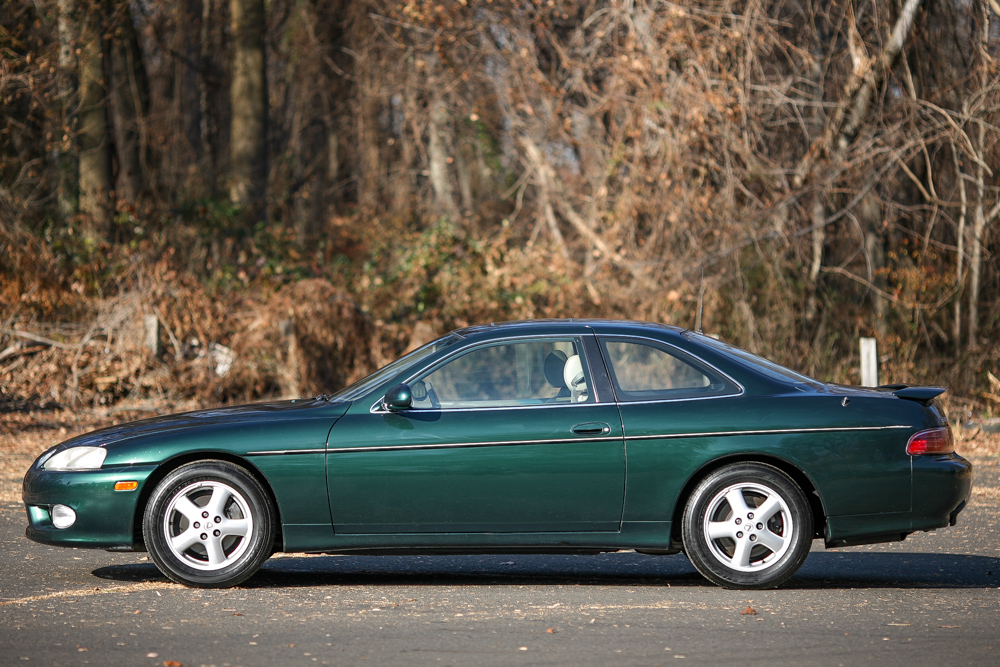
58k-Mile 1998 Lexus SC400
Lexus's original lineup - the LS, GS and SC - were instant classics when they debuted and 24 years later they keep gaining critical appreciation, even as their prices bottom out. Lexus touched upon every facet of automaking - engineering, efficiency, design, build quality, and marketing - and revolutionized each as well. All of their cars were stylish, extremely well built, and (initially) competitively priced. The brand was a high water mark for the entire industry.
The SC was the crown jewel in the arsenal. As if taking on the legendary Mercedes-Benz W126 with the LS400 wasn't enough, Lexus decided to cut into the premium coupe segment by launching the SC400 in June of 1991 as a 1992 model.
As fundamentally Japanese as Toyota and Lexus are, they are quite American, too. Lexus specifically designed their cars with the American market in mind. Styling of the SC was even transferred over to an American team at Calty Design Research Center in California. The original lineup were lean on the outside, spacious on the inside, had powerful V8 engines and automatic transmissions. They weren't exactly sporty but they were great long distance highway cruisers. In essence, they were super sleek and hi-tech reinterpretations of American cars of the 60s and 70s for the New Age 90s. The Japanese, having risen like a phoenix from the ashes of Hiroshima in 1945, had come to better understand what Americans wanted than Americans themselves.
Chief designers Denis Campbell and Erwin Lui said the SC body was based on "emotion and feeling" and possesses almost no straight edges. It is a complete rejection of the angular Blade Runner look of the early 80s, and even the slab-sided techno-industrial look of Bruno Sacco's Mercedes-Benz designs. Instead, it almost starts to recall the soft curves and slopes of cars from the 30s and 40s, but without the excess. The jellybean look became a trend for the rest of the decade and was almost parodied by Ford's ridiculous looking third generation Taurus, but on the SC it works beautifully.
Underneath the hood is the same 1UZ-FE V8 engine from the LS400 that pumped out a very healthy 250 horsepower to the rear wheels. Only an automatic transmission was available. A 6-cylinder version was also offered and with the option of a manual, but the added power of the V8 is preferable, even if you sacrifice the ability to shift manually, which isn't in the spirit of the car anyways.
Inside is classic early 90s Japanese design. In the same way that Mercedes-Benz and BMW mastered interior design of the 80s, the Japanese keep the same overall simplicity and functionalism but soften the edges, lighten the colors and smooth out the tone and feel of everything for the ultimate tactile and visual experience. It's like a spa or a vacation, but without the frivolity. It practically beckons for a Kenny G disc to be blasting in it.
The SC400 was produced until 2000 with minimal changes over the years - a testament to the success of the original design. Plenty were produced but they are often scooped up quickly and modified in the second hand market, making immaculate and low mileage examples like this rare. The seller says it has just 58,547 miles on the clock and that everything works. A carfax report and any maintenance records will fill out the rest of the story. Otherwise this thing could be ready for another 50k-100k miles.
Available here on ebay in Pennsylvania with a Buy-It-Now of $14,950 and the Make Offer option.
No Reserve 1985 Volkswagen Scirocco
If there are any classic front-wheel drive cars, the Scirocco must be one of them.
After Volkswagen launched the K70 it was clear they were intent on heading away from their air-cooled rear-engine glory days of the Beetle and Karman Ghia and into a new era of water-cooled, front-engine front-wheel drive cars. To soften the blow, they managed to clothe the setup with some nice sheet-metal thanks to Giorgetto Giugiaro, who penned the Golf and Mark I Scirocco.
In 1982, Volkswagen launched a second version of the Scirocco. Although it was based on the same platform, the body was entirely different, more stark, low, lean and angular.
This kind of simple two-box shape has been erased from the market, despite being so visually and functionally successful. It's form over function, and yet it's undeniably fun and sporty. Just how do some simple angles and clean lines evoke so much? It's a powerful reminder that less is more in car design, something totally lost on virtually all of the major automakers today.
Underneath the hood is a small four-cylinder engine. It's not big and powerful, but it's mated to a stick and you can bet it feels fun driving along looking out from the cockpit.
The seller of this example says they purchased it from the original petite female owner and that it has only 118,000 kilometers, which is only about 73k miles. They say it was a short distance commuter car and was not driven in the winters. Inside, they say it is spotless and all gauges and instruments work. On the outside, they say the paint still shines well, but there is some surface rust. Mechanically, they say it starts, runs, shifts, and stops fine.
Volkswagen sold nearly 300,000 MK II Scirocco but they have seemingly vanished from US roads, as their original owners usually drove them into the ground and they often succumbed to rust. Finding a good clean example of the MKI generation is extremely difficult and the second generation is getting harder too.
Available here on ebay in Ontario, Canada with bidding starting at $2,000 and no reserve.
Post-War Blues: 1946 Packard Clipper Coupe
Packard built automobiles from 1899 to 1958. American automakers put new models on hold during WWII, so when the war ended they continued producing designs from 1942 with some subtle changes.
The Clipper series was introduced in 1941 as just a sedan, and although 34,000 were sold, production quickly ceased when priorities shifted after Pearl Harbor. The Clipper (and to an extent, Packard) never really recovered. By the time they rolled out the Coupe after the war, stiff competition from Studebaker, Kaiser-Frazer and Cadillac had outpaced Packard, and their 1946-47 coupe fell to the wayside. Only about 600 post-war examples are known to be built.
Styling is quite pleasing. Since the early post-war cars are essentially designs from the late 30s and early 40s, it still has a cool, minimalist art-deco design before tail fins and excess chrome took hold.
This one looks particularly fresh in flat grey over green and tan interior and Coker Classic white wall tires. The seller says that the exterior was repainted and the chrome is showing some pitting, but the insides and engine look better.
Mechanically, they say it starts and runs but has not been test driven, although they suspect it would shift well. They say the odometer shows 53,000 miles and is believed to be original.
Under the hood is a 6-cylinder engine.
The seller says the vehicle was in a storage unit for years until it was given to the facility after years of unpaid rent, and say the current owner is only the second officially recorded owner.
Although it's not the rarer V8 version, this is still a lovely piece that has fortunately been garage kept over the years and seems remarkably intact.
Available here on ebay in Phoenix, Arizona with bidding at $24,766.
1990 Subaru XT
If you haven't noticed already, I love the Subaru XT. These were forgotten for years until just recently when Subaru themselves restored an XT for their museum that caught a bit of attention. Subaru also doesn't currently offer anything similar to it.
The XT was sold from 1985-1991. It featured either front or four-wheel drive, four or six cylinders, and was either normally aspirated or turbocharged.
Perhaps the coolest aspect is the avant garde styling. Sure, at first glance it looks like a 1980s vision of the future, perpetually auditioning for a background shot in Blade Runner or Total Recall. But a careful examination reveals the design to deceptively thoughtful. The wedge shape provides for a .29 drag coefficient, and the large greenhouse glass and blackened pillars give it superior visibility in and out, while looking super stealthy. The thin taillight strip no doubt inspired the Alfa 164. The whole thing is almost primordial, progressive but ancient feeling, like some kind of aborted project or lost code, and reminds me of the Apex building in Pawtucket, RI, like it should be the structure's emergency shuttle craft or something.
Inside, the futuristic theme continues with an asymmetrical steering wheel, joystick-like gearshift and tightly spaced and intense instrument cluster.
Not many were sold and most were thrashed during ownership so even less have survived. The seller of this example says the odometer reads 119,997 miles, but a complete engine rebuild was done at 101k. They say nothing is wrong with it and they are just selling because of excess vehicles. Cosmetically, they say it has normal wear, dings, and scratches but nothing major. They say the interior is even better.
If Subaru is restoring these, we're not far off from the days when individuals start doing so too. These are interestingly styled and fun to drive. This is just the front-wheel drive version, but the turbocharged four cylinder examples with four-wheel drive are first in line to become modern collector classics. Snatch these up before they all get scrapped.
Available here on craigslist in Seattle, Washington for $2,300.
Subscribe to:
Posts (Atom)