Showing posts with label i6. Show all posts

1970 Volvo 164


The 164 was a slightly upscale version of the 140. The 1966-74 140 was Volvo's breakthrough model, selling over 1.2 million units. Then the 164 came along in 1968. It was Volvo's attempt to compete with Mercedes-Benz, BMW and Jaguar. As the numeric designation suggests, it had '6' cylinders instead of the 140's '4'.


Although sharing many parts with the 140, the front end was unique, drawing more inspiration from it's predecessor, the Amazon. It's tasteful looking without being too stodgy. The rest of the body is classic 1960s/70s European sedan, with a high waistline and overall bathtub shape inspired no doubt by the NSU 110, itself inspired by the first generation Corvair. White is a very flattering color, too, giving it a clean, bright, appliance-like vibe that suits the functionalism on display.


The interior is this incredible breath of fresh air from today's claustrophobic, over-designed interiors. The dashboard is essentially a single rectangular strip of faux-wood and simple gauges. The pre-airbag steering wheel is especially charming. It looks good. Part of the beauty of simplicity is that there is simply less to go wrong.


For those who complain the 140 is underpowered, the 240's inline 6-cylinder is the perfect antidote. It's a moderately heavy car, but the engine was able to kick out 160 horsepower to the rear wheels, and it managed to be more efficient than some competitors. This one has the column-mounted 3-speed Borg Warner automatic, but it'll be good for cruising easily with friends.

The seller says this survivor is an original daily driver, has no rust and runs strong. If you're looking for a sweet retro people carrier for short to medium trips, this is a pretty nice piece.

Available here on craigslist for $2,800.

1985 Mercedes-Benz 280SE Euro


The W126 is one of those rare cars that was better than both its predecessor and successors, crystalizing it in time as a pinnacle of achievement. It debuted in 1979 and was more aerodynamic, efficient, spacious and faster than the outgoing W116.


The brilliant styling was courtesy of genius Bruno Sacco and was the first all-new design to emerge after his ascension to head of styling at Daimler-Benz in 1975. He took everything that was good about the W116 and made it better. This standard wheelbase SE trim means slightly better handling and lower weight than the SEL long wheelbases.


Unfortunately, Sacco's new integrated bumper design had to be extended on US-bound models to comply with the DOT, but this Euro-spec example mercifully has the original pieces that transform the proportions and look of the car. It's a sight to behold for discerning eye, especially auto fans here so used to the other inferior bumpers we got.


Another cool feature of Euro-spec cars are their interiors, like this one with rare cloth seats that weren't an option in the US. I actually prefer leather, but these sure do look comfy. The rest is classic Mercedes-Benz, which means utter perfection: high-quality plastics, easy-to-read and operate controls and gauges, and a delightful oversized steering wheel.


Another thing we never got is what lies under the hood: the M110.989 version of a 2.8-liter inline 6-cylinder engine that produced a competent 185 horsepower. The 6-cylinder is a sweet spot for these, especially in short wheel base form. It's one of the best engines Mercedes ever put out, and will provide power, economy and reliability if routinely maintained.

The seller says it was imported when new, and has a federalized gauge cluster. It now has about 110k miles. They say it's in good shape, including the paint, except for a corner that was resprayed, but it's been garaged during their ownership. It certainly looks sharp, and could easily go for another 100K miles of comfortable, state-of-the-art cruising. It's a lot of car for the price.

Available here on craigslist for $3,800.

Award-winning 1965 Chevrolet Corvair Hardtop Sedan


The Corvair is one of the greatest American cars ever made. Historically, Europe has always led the way in auto innovation and especially aesthetics. Volkswagen burst onto the post-war scene with their iconic lineup of air-cooled rear-engine cars. Sensing the inevitability of that engine layout, General Motors conceived of the Corvair to stave off competition. What it lacked in mechanical originality it made up in bounds with styling and performance.


The Corvairs are divided between two generations. The first one was brilliant. The bathtub styling was so well done it finally influenced European designers for a change - famously inspiring Claus Luthe and his NSU Prinz 4. This is a second generation up for sale. The second generation was arguably even better looking. I prefer it over its predecessor. It's slightly more modern, but still retains cues from the first generation. It was one of the best looking cars of its time and still looks terrific today.


A range of body styles were offered, but most sold were the two door hardtops and convertibles. This is the lesser seen hardtop sedan however, which was dropped from the lineup in 1967, making it available for just two years in the second generation body style and therefore rather rare. The pillar-less body is elegant, liberating and beautiful. This one looks particularly good in dark blue over tan. The rear luggage rack seems a period option and works perfectly with the people-carrying setup.

Underneath the rear (how nice it is to say that for a change) is a flat-6-cylinder engine. GM mercifully understood the cars would have been grossly underpowered with just 4-cylinders. Even with 6 they weren't lighting the street on fire, but this one is fortunately a 110-horsepower optioned car, not shabby for the time and just adequate for modern traffic.


The seller says it runs and drives excellent, is original, has no rot and has accrued just 40k miles over its lifetime. It certainly looks terrific in the photos. They also say it was won awards presumably for its good condition.

This seems like an honest, proud and well-kept example of a car from an all-too brief high point in American auto history.

Available here on craigslist for $9,500.

1993 BMW M5


I love the E34. And what better E34 than the veritable M5.

The E34 is one of the greatest BMW so far and really one of the best cars of all time. It's spacious but not too big, extremely well-built, safe, aesthetically sharp, fun to drive, and very reliable. The only thing they aren't is fuel efficient and immune to rust. But those are small nits to pick when you consider the overall greatness that is the E34. Subsequent generations have only gotten larger and less attractive, too.


The M5 version was produced during the model's entire run of 1988-1995 with slight changes over time. In the US, it received a special 3.6-liter 6-cylinder engine that produced a very healthy 311 horsepower. Combined with special tweaking and a 5-speed (and later 6-speed) manual transmission, it was a standout sport sedan of the era and can easily provide thrills today. It was somewhat undermined by the later 540i, but it's still the star of the two.


This one looks pitch-perfect in black over black. Note the later cosmetic details such as the "throwing star" wheels, which, while preferred by some, did not ventilate the brakes as well as the more conservative initial pieces (which I liked better anyways), and the teardrop side mirrors shared with the E36 M3 but really don't jive with the rest of the car's hard angles. Again, that's probably a minority opinion but worth noting nonetheless.


The seller says this car has 132k miles (normal and even desirable), no accidents and original paint. They say it will need new tires (predictable and no big deal) and the electric rear windows move slowly, a weak point on many older German cars, but certainly not a deal breaker.

With no accident history, this is certainly a nice find that seems to have also been mercifully left unmodified. The seller also says they are becoming hard to find - and that is a true statement. While the succeeding E38 generation M5 introduced a roaring V8 in the game, BMW's classic inline 6-cylinder philosophy makes this E34 truer to the soul of the brand while also marking the end of an era.

Available here on ebay for $16,995 or the Make Offer option.

1987 Toyota Cressida Wagon


The Cressida was sort of a preview of Lexus from Toyota before they launched that luxury division. It was their top-of-the-line sedan, with rear-wheel drive, 6-cylinder power and abundant comfort and convenience features. It was never followed up with a successor in North America, partly because the Lexus LS400 debuted and took the torch as Toyota's flagship presence.

Outside North America, the Cressida was simply known as the Mark II. This generation debuted in 1984 and lasted until 1988.


Styling is classic early 80s rising sun, all hard angles, rectangular shapes and large safety regulation bumpers. This kind of pure functionalism was abandoned during the second half of the decade when design departments discovered sex appeal and started pioneering sleek, round jellybean shapes that Japanese cars would become synonymous with for the rest of the 90s. But I don't mind this early sparse look at all, for one thing it saves exterior space and usually adds interior room. Also look at how big those windows are! You can actually see out.


The same philosophy goes for the interior, which will be familiar to anyone who remembers a Camry from the era. Other than the steering wheel, most surfaces seem to have held up extremely well. The well-bolstered cloth seats look super comfortable, too.

Underneath the hood is a 2.8-liter inline 6-cylinder engine. This gave the Cressida an advantage over a mostly underpowered field of competitors back in the day and will still be appreciated now, especially if you're hauling cargo.


Speaking of cargo, this is the rare wagon version of the Cressida. Apparently they were only here for only a handful of years and I can't imagine they were a big seller. Someone who would spring for an import sedan wouldn't want the look and stigma associated with wagons in America. But for real auto enthusiasts wagons are usually a delight, adding a bunch more space and use to vehicle without crimping style or adding too much weight. I also love the double wipers on the rear window.

The seller of the car purchased it from San Francisco before shipping it to Hawaii where it resides now. They say it has over 200k miles, but has been well maintained and is entirely original except for new replacement parts. I believe it. The Cressida is from Toyota's glory days as masters of relatively inexpensive, simple and insanely reliable cars. This could see another 200k with more love and care.

Available here on craigslist for $4,500.

She's Gone: I Sold My 2003 BMW 325xi


Last summer, without much fanfare (on COTC at least) I traded a 2008 Honda Civic coupe with around 80k miles for a 2003 BMW 325xi with only around 34k miles. At first glance, it might have seemed unusual. Trading a newer car for an older one? A "reliable" Japanese car for an "expensive" German one?

On paper, however, there was no comparison. The Civic was two doors, front wheel drive, and four measly cylinders. After driving it for about 5 years I can tell you that it got pretty annoying, especially from the critical perspective of an auto enthusiast like me. It was unrefined around town, and slow on the highway until around 70-80 mph when V-TEC finally kicked in. It was pretty good at handling, but it blew like a ragdoll in crosswinds. The automatic transmission felt rough. Exterior styling was ok, but the interior was full of foolish flaws: a gaudy electronic speedometer that cast glare on the windshield, cheap spray-painted silver accents, and a steering wheel logo that started peeling (which I ended up replacing but was a huge pain in the neck to do). As for that famous Honda reliability, it needed a whole new engine block at 60k miles, which was mercifully under warranty, but after that all four coils broke, which wasn't covered, and upon hearing that, I became so angry that the dealer gave in and replaced them for free, sparing me $1,000+ in repair costs. A little bit of rage goes a long way sometimes.

So, feeling fed up with the Honda I decided to look for a replacement vehicle, before the Civic needed anything more. I knew I wanted four doors, rear or all-wheel drive, and more power. And since I had just come from a Japanese car, I wanted one of the coveted German automobiles I had read so much about.


There really weren't many options that were affordable and practical. The pre-owned Mercedes-Benz C-Class were all overpriced. Then I considered BMW, whose resale prices depreciate notoriously, making them available to basically anyone. At first I was dead set on an E32, then an E36, until I finally set my sights on a silver 2003 BMW 325xi I had found not too far away. The mileage was low, carfax clean, and the body free of major damage. The engine bay was spotless. The interior smelled delicious. It started strong and drove flawlessly. I was instantly addicted to the absurdly heaving steering, silky acceleration and sexy sheet metal. I bought it and drove it home.

The '03 325 was also known as the internally designated E46 chassis code, which debuted in 1999 and replaced the beloved E36. In 2002 it was given a cosmetic refreshening. The 325xi designates it as the 3-series with a naturally aspirated gasoline powered 2.5-liter six cylinder engine, fuel injection and all-wheel drive. In 2006, it was replaced by the E90.

Perhaps the most peculiar aspect of this car is the pre-XDrive all-wheel drive system BMW used on these cars for a couple years, simply called "xi". It was based on the X5 SUV concept and featured a permanent full-time system that divided the torque 38:62 front:rear, so there was still a bias towards desirable rear-wheel drive, but with the added stability of power to the front wheels as well.


Inside, the interior was one of BMW's best. The analog instrument cluster was crystal clear, buttons were all in reach, and everything was composed of high grade plastics and looked and felt great. Mine was rather unique in that it had vinyl seats, which I loved and preferred over leather because they are indestructible. I also had heated seats, but no headlamp washers and no cruise control.

So, was it the ultimate driving experience? In short, compared to the Honda Civic, yes, absolutely. There's a reason why these cars have reputations and the E46 was no exception. Every act, every switch, every function of the car is so deliciously engineered feeling, from the turn of the key to the heavy steering, that it was thoroughly satisfying to routinely operate. Around town, the 185-horsepower inline 6-cylinder engine was quiet yet torquey, like a coiled lion purring as it eyes prey. On the highway it was a true performer. No, it wasn't fast off the line. That's for drag racers and Corvettes. Where the car really excelled was in maintaining a high rate of speed for long distances. 85-100 mph did not feel nearly as fast as those speeds really are. The car was solid as a rock, composed, refined and stable. I had found it! It was the anti-Civic.


As for the all-wheel drive system, which was really rather basic and more truck-like than anything else, it worked really well. In rain it cut through puddles like a knife, sending a tidal wave over the hood where other cars would start to hydroplane. The winter of 2012-2013 also brought a massive snowstorm to the New England region, so I was able to test the car's foul weather resistance to the true limits. During one snowfall I was able to cruise long stretches of dark, icy highway at 60-70 mph (yeah yeah faster than I should have been going) and felt completely safe and comfortable doing so. The car also got me home alive in the thick of the later bigger storm. So in a way, it saved my life. Can the AWD system climb mountains? No, but the car wasn't designed for that. It was designed to add more control and predictability to the car's handling in inclement conditions. And after years of dingy FWD Hondas, this thing might as well have been a Land Rover in the snow.

What were the downsides? The sunroof slide (not the actual glass sunroof) fell off the tracks, and one mechanic told me repairing it would mean a whole new sunroof which blew my mind but may not be entirely true. Some plastics wore unfavorably. No cruise control was rather irritating. But perhaps the biggest flaw was fuel efficiency. If you drive with a lead foot like I do, combined with the full-time AWD system always churning, and add in the cost of premium gas during an era of escalating prices, this thing costs a lot to operate energy-wise. I was used to $40 or less bucks for a full tank after a week of normal driving, and the BMW was now costing me $60 or more.


As for reliability, I can't say much as I owned it for just around one year. The coolant light came on at first until I topped it off myself and it never came back. Oil changes could either be $20 mixed or $100 synthetic. I did need new rear springs, however. And of course, being the immaculate owner I was, there were the small cosmetic fixes I couldn't resist: a new OEM front emblem, new OEM wipers (hard to find), an OEM replacement rest pedal, factory OEM floor mats, European-spec OEM convex side mirror glass pieces, and a sliding-cover storage bin that replaced the 'ugly american' cup holders and was what actually came on European-specification models. But beyond routine maintenance, the springs, and some voluntary changes, nothing terrible happened. The engine is bulletproof and known to go many thousands of miles, and even the automatic transmission (normally another problem area) was sourced from General Motors on the E46 xi so those aren't too exotic.

A change in location forced me to sell her, but it's with a tad of nostalgia for last summer and the subsequent tumultuous winter that I'm here writing about it all, my brief flirt with a fancy, hi-tech German sedan. I can say it was definitely worth it and I recommend that model to anyone else interested. I savor the days I spent flying through sleet and slush, basked in the glow of the red gauges, safe behind the wheel of German silver-steel.

Matching Numbers 1959 Jaguar Mark IX


The first time I saw this listing, the seller had a post script that said the vehicle could be the same exact Jaguar driven by Kim Novak in Vertigo. My attention immediately piqued so I did some research and sure enough there was a similar car in the film. Hitchcock's movies are already A-list, and the cars that appeared in them (remember the Aston Martin from The Birds?) are iconic to say the least. I was ready to post it when poof - the listing disppeared.

Then I was reading Old Parked Cars this morning and I came across their in-person encounter of this car, along with a link to a new ebay listing. Thanks guys!


Only 10,009 produced Mark IX were produced from 1959-1961. These come from a long line of beautiful Jaguar cars, and was one of the last of its shape before it was replaced by the wider, lower and more modern Mark X. They were available in one or two-tone colors. This one is pitch-perfect in dark green/light moss green over grey leather interior.

These were powered by just one engine: a large 3781cc inline 6-cylinder that pumped out a very respectable 220 horsepower to the rear wheels. It came to an equally forceful stop thanks to four-wheel disc brakes.


Older Jaguar sedans run the gamut in price and condition. They aren't as desirable and worth nearly as much as they coupes and convertibles, but they are just as pretty and intriguing to look at. This is undoubtedly the high point of the British auto industry, before the successes of the Germans and Japanese in the 70s and 80s.

The seller of this example states it is a matching numbers older restoration with a complete engine, transmission, body and interior. They note the paint is likely not new, but the job was done well and still looks presentable.

Mechanically, they say it had problem with the starter, but was garaged while sitting. The seller says they did get it running, so it could be an easy fix.


Available here on ebay with 16 bids at $4,156 and a Buy-It-Now of $6,300. Hemmings CPI value guide puts a 1959-61 MK IX in fair shape at $7,550 and good at $13,500, with a 4% increase over time, so this seems like a good deal.

Julia's 1993 Mercedes-Benz 190E 2.6


After her Toyota Camry started falling apart, my friend Julia knew she wanted either a Jaguar or Mercedes-Benz to replace it. “Jaguars are the most beautiful,” she says, noting that she'd see a lot of them for sale on the side of the road. But they have a reputation for poor quality and reliability. So when it came time to find a replacement car, she set her sights on an older Mercedes-Benz. For Julia, an artist and bartender, they look just as good as a Jaguar but were built much better.

Sure enough, she spotted a 1993 Mercedes 190E 2.6 for sale at a nearby gas station. The odometer reads over 137k miles, so while not low, it's actually below average for a 19 year-old car, given that Americans drive around 13,000 miles per year. She test drove the car and had a trusted mechanic look at it. He gave the car the OK, but his only words of caution were about the possible future costs of fixing it: “He told me I would not be happy when I see the first repair bill,” Julia recalls. But she was undeterred. “All cars require maintenance,” she reasoned. Since she had been without a car for about a year, and the Mercedes checked out in every other way, she bought the car.


Part of why this particular Mercedes stuck out to Julia is the color, a newer coat of paint in what Julia describes as “ultramarine blue”. It has this high sparkle gradient that, while we agreed was not something the Germans would have originally painted it in, happily reminded us of the flamboyant colors of Hot Wheels cars when we played with as children and befitted the car’s charming aura. Mercedes-Benz look good in blue anyways, and Julia loves the color, so much so that she wore a pair of blue floral-patterned pants the day I saw her and also grew a blue crystal specifically to hang from the rear-view mirror as a good luck charm. 

Examining the doors we noticed the jams were black, likely the original color.

The 190E (internal code W201) was nicknamed the “Baby Benz” and was Mercedes-Benz’s entry-level model. Over 1.8 million were produced between 1982 until 1993, making Julia’s model a final-year example. The "E" stands for Einspritzung, or Fuel Injection. Most had four-cylinder engines under the hood, but in 1987 an inline 6-cylinder was introduced. While “190” denoted the original 1.9-liter engine size that wasn’t even offered in the U.S, the numerical designation was kept and different displacement sizes added after for clarification. Therefore, Julia’s 190E “2.6” denotes a 2.6-litre inline 6 engine under the hood. Since the 190 were small and relatively light cars they moved fine with just four cylinders, but the 2.6 producing a healthy 160 horsepower made them even faster and highway travel and passing cars even more enjoyable.


Design is courtesy of Bruno Sacco, Mercedes Benz’s brilliant chief stylist from 1975-1999. It is claimed to be his favorite work ever, likening the chiseled lines and tapered rear-end to the precise cuts of a fine diamond. To think that it came out in 1982 is unbelievable, especially considering other cars being produced around that time. It must have looked amazing then and it still looks amazing today. “Another thing about this is the size,” Julia says, noting the dimensions that make the exterior feel tight and compact, yet extremely spacious inside. Parking, especially in an urban area where Julia resides, is easy.

On the inside, Julia’s 190E features rare black seats, as most you see are tan. The material doesn’t seem to be leather but rather Mercedes’ indestructible "MB-Tex", essentially a durable yet comfortable vinyl surface. There are basically no rips, tears or stains. It’s incredible. The dashboard is also black and is small, clean, and simple. Everything is within easy reach of the driver. The gauges are in white and yellow and are clear and easy to read. The instrument cluster also has a tiny analog clock nestled underneath the tachometer that is a nice touch. The center console is covered in a wood surface. Only the climate controls are confusing. “What do all these symbols mean?” Julia wonders aloud, pointing to a row of small square buttons. Indeed, they don’t seem to follow universal air conditioning signage and instead veer into the mechano-wunder world of German engineering, where only the designers really know what their symbols mean.


Then there’s the tape deck, or decks I should say. Julia tells me to look down at this nondescript stack of rectangular buttons and suddenly it pops out, waiting to accept a cassette tape. But not just one. There are six of these holders. Julia is only disappointed that the aftermarket CD-player installed below it doesn’t allow her to actually play cassettes, but the idea of being able to hold them neatly in your dashboard is enough to impress both of us.

In back, Julia discovered a first-aid kit behind the rear seats. We opened it up and there was a perfectly organized array of bandages, medical tape, sterile pads, and antiseptic gel, all courtesy of "Mercedes-Benz of North America." Why thank you! Of course, it would be irrelevant in the worst of car crashes, but it's the thought that counts. I'd rather have it in my car than not.


On the road, the car drives great. Because it's rear-wheel drive, the housing that powers the rear wheels is situated between them and balances the car immensely, improving overall ride quality and handling that front-wheel drive cars just can't duplicate. It's also got that amazing heavy steering that has now become a trademark feel. Julia thinks it's just common sense, which it is if you think about it. "You're turning the weight of the car", remarks Julia, "so it should feel heavy." This is precisely in line with the reigning form-over-function design philosophy of the late 20th century, perhaps no better embodied than by Mercedes-Benz. Objects were made to look like the function they perform, and by extension, should perform like the function they perform. So many manufacturers miss this simple but crucial concept. Turn the wheel of the 190E, and you feel the bank-vault body navigate with you. 

The car is not without some flaws. The windshield is cracked, and there is some surface rust on the body. But those are small cosmetic issues on an otherwise solid car that's running fine and should be good for many more miles. You can't expect perfection when buying a used car. But the beauty in owning a second-hand Mercedes-Benz is that it comes about as close as possible.


Julia and I think the car has mega potential classic status Whereas the Baby Boomers are nostalgic for cars of the 50s, 60s and 70s, my generation will appreciate the ultra-utilitarian German and Japanese cars of the 80s and 90s. And for good reason: they've given us solid, reliable and attractive transportation. Even Mercedes-Benz seems to think so too, despite the many changes the manufacturer has gone through since the 190E. They've launched a "Young Classics" store in Stuttgart that finally officially recognizes their masterpieces from the 70s and 80s.

What's next for Julia's 1993 190E 2.6? A good waxing and buffing before the New England winter sets in. "I imagine it will be very satisfying," she says excitedly. Just one of the joys of maintenance. And it will feel extra good knowing she's beautifying such a nifty little car.


1979 BMW M1


Now here is something you just don't see everyday.

This thing easily ranks as one of the coolest cars of all time.

The M1 was originally intended to be a racecar, but in order to qualify for the World Championship, BMW made a limited production run of just 456 units between 1978 and 1981.


The body was styled by none other than Giorgetto Giugiaro and is absolutely awesome looking. Giugiaro was among the first to embrace the now-classic "wedge" shape for supercars, and the M1 stands as a fine example of that trend. The wedge is perhaps the ultimate expression of the dominating form over function design philosophy of the 20th century, as the rear-engine design requires large tail ends which taper to slim front noses that hold just spare tires or luggage. For the M1, Giugiaro followed this formula exactly, but used BMW design language. The results are stunning. I also like the apparent thrift with the reuse of E24 6-series taillights.

This example looks appropriately moody in dark blue over black. The BBS wheels look fine, but I prefer the stock alloys which mimic the louvers and air vents on the body and keep with the ultra-mod-deco vibe of the overall car. In one photo, they appear to be in the trunk, but the seller makes no mention of them.

Underneath the metal lay a rear-mid positioned twin-cam M88 3.5-liter inline 6-cylinder engine producing around 274 horsepower, with a top speed of 160 mph. Handling and performance must have been incredible.


The seller of this example says this was 11th chassis and 16th car built, making it an even more rare early example. They say it was completed in December of 1978 and was retained by BMW for promotional purposes, before it ended up in California by at least 1981. They state the odometer reads a mere 23,723 miles, but they say it runs great. They also say the car has factory air conditioning, a nice feature if you live in warmer climates.

Interestingly, one could consider the M1 a flash in the pan for BMW. As influential and iconic as it has become, it's so far their only mass-produced rear-engine car.

This is a special opportunity to buy an extremely rare, desirable, and beautiful automobile that performed as good as it looks. The seller is asking $195,000 but has the auction starting at around $50k with reserve. Hemmings CPI Value Guide estimates a 1979-1980 M1 Coupe to be worth $71,175 in fair shape, $115,000 in good shape and $191,500 in excellent shape.


Find it here on ebay in Astoria, New York.

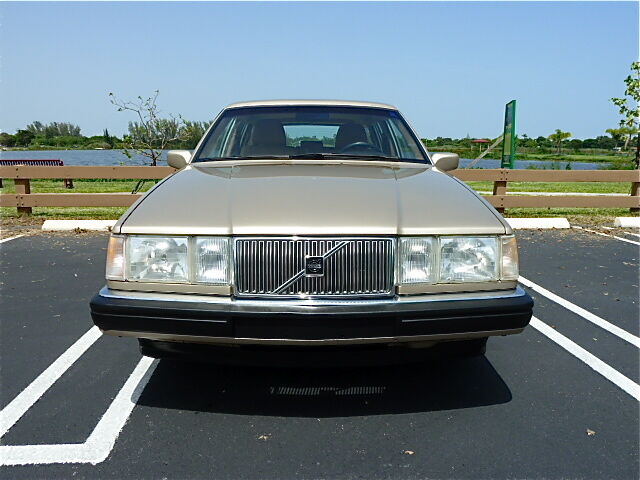
Never This Nice: 75k-mile 1993 Volvo 960 Wagon


This Volvo looks to be in the kind of exquisite condition you never find them in anymore.

The 900 series were made from 1990-1998 and were, sadly, the last rear-wheel drive cars they made.

This is a pre-facelift '90-'94 960, before the car was moderately updated in 1995. Both the pre- and post-facelift models are nice looking, but the black plastic side molding on this early model absorbs wear better than the all-body-color strips on later cars.


The car is powered by a 2.9-litre, 24-valve DOHC inline 6-cylinder engine.

Exterior design is ultra-conservative, but it works so well. It's boxy and relatively simple but the price paid for not being stylish is a wonderful amount of useful interior space. And that's what a station wagon should be (as opposed to the loony Dodge Magnum, for example).

This one is pitch-perfect in gold over saddle leather interior. The alloy wheels are also really nice.


Since these were the mom car of the '90s upper middle class suburb, they were often driven a lot and with children in the back seats. Seeing one in this great shape is kind of bittersweet, as if it was never used as intended, but so nice to see it almost as nice as new.

The seller states the odometer clocks in at just 75,466 miles.


The vehicle is being offered by a dealer who are "Volvo specialists" and was driven by the seller and his wife.

They say it has also never been in an accident, reaffirming the low miles are just due to sparing use.

These are great cars. Since the mileage is unusually low but not museum-quality low, I would keep driving it for another 100-200k miles, as they were designed to go.

The price for this all this? A buy-it-now of just $4,975. You won't find another one like it, and you won't find any new car with this kind of build quality.

Find it here on ebay in North Miami, Florida.