Showing posts with label 1993. Show all posts

1993 BMW M5


I love the E34. And what better E34 than the veritable M5.

The E34 is one of the greatest BMW so far and really one of the best cars of all time. It's spacious but not too big, extremely well-built, safe, aesthetically sharp, fun to drive, and very reliable. The only thing they aren't is fuel efficient and immune to rust. But those are small nits to pick when you consider the overall greatness that is the E34. Subsequent generations have only gotten larger and less attractive, too.


The M5 version was produced during the model's entire run of 1988-1995 with slight changes over time. In the US, it received a special 3.6-liter 6-cylinder engine that produced a very healthy 311 horsepower. Combined with special tweaking and a 5-speed (and later 6-speed) manual transmission, it was a standout sport sedan of the era and can easily provide thrills today. It was somewhat undermined by the later 540i, but it's still the star of the two.


This one looks pitch-perfect in black over black. Note the later cosmetic details such as the "throwing star" wheels, which, while preferred by some, did not ventilate the brakes as well as the more conservative initial pieces (which I liked better anyways), and the teardrop side mirrors shared with the E36 M3 but really don't jive with the rest of the car's hard angles. Again, that's probably a minority opinion but worth noting nonetheless.


The seller says this car has 132k miles (normal and even desirable), no accidents and original paint. They say it will need new tires (predictable and no big deal) and the electric rear windows move slowly, a weak point on many older German cars, but certainly not a deal breaker.

With no accident history, this is certainly a nice find that seems to have also been mercifully left unmodified. The seller also says they are becoming hard to find - and that is a true statement. While the succeeding E38 generation M5 introduced a roaring V8 in the game, BMW's classic inline 6-cylinder philosophy makes this E34 truer to the soul of the brand while also marking the end of an era.

Available here on ebay for $16,995 or the Make Offer option.

58k-Mile 1993 Audi 90 CS


Remember Audi cars before they were cool? For a while they were still in the shadow of Volkswagen. In the 80s, sales in the US plummeted after 60 Minutes fabricated a report about unintended acceleration. 1990-91 was their all-time low.

Audi spent the rest of the 90s were making a slow but steady comeback. Part of that was accomplished with the 80/90 model. The "90" was an upmarket version of the 80, which was released in the mid 1980s. The B4 generation for sale here debuted in 1991.


The styling is a revelation in today's sea of bulbous, over-styled designs. Lines are straight, shapes gently squared off,  and planes are long, flat, smooth and simple. The greenhouse glass is enormous thanks to thin pillars and allowing for terrific 360 degree visibility. US versions have slightly longer bumpers.

Inside offers a peak into equally old-school but still fresh interior design. Audi have nailed interiors for a long time and the 90 is no exception. Materials are high grade, gauges are clear, easy to read and within reach, and a spattering of wood accents here and there.


Part of what helped Audi stand apart from BMW and Mercedes was their patented Quattro system of all-wheel drive. Unfortunately, this is just a front-wheel drive version. I always thought non-Quattro cars were a bit of joke, because without the unique system you're basically getting a fancy front-wheel drive car along the lines of a Volvo or Saab.

To make up for matters this one is equipped with a 174 horsepower V6, so that highway onramps and passing traffic won't be too difficult.


I've seen this seller before, they're out of New York and have a knack for finding unusually low mileage European cars of the 80s and 90s. This is another odd find. It's not particularly remarkable or fast car, but the mileage is low and condition really clean. I'd prefer it over a Camry, Accord or Volvo of the same era, though.

This one is low-mileage enough that if it's driven pretty carefully it could last for a while, but keep an eye out for rust and electrical gremlins. Also, Volkswagen/Audi automatic transmissions have terrible reputations. A 5-speed swap down the line may make things significantly cooler.

Available here for $4,400.

67k-Mile 1993 Honda Del Sol SI


The Del Sol was almost a stroke of genius by Honda in their glory days of the early 90s. Hot off the heels of breaking through the US market in the 80s, their strategy for the next decade was to expand the lineup and take on Toyota. For a while, it seemed possible.

In 1992 they debuted the Del Sol, just in time for a Gen-Xer's job promotion or a Baby Boomer's midlife crisis. The styling is pretty clever in that it recalls the mid-engine cars of the 70s or early 80s like the Fiat X1/9, but was in fact just another front-wheel four banger. What made it different than their other cars of the time was a removable targa top. This filled in a gap of customers pining for a Civic-like driving experience but with open-air fun.


Honda wrapped that concept in what turned out to be a body that has aged surprisingly well, even in the exotic colors they offered. The whole thing is classic 90s rising sun, all smooth yet taut planes, bubbly shaped lights and hidden-lug alloys. I particularly like the rear taillights, reminiscent of the BMW Z1.

Inside is equally successful with spartan plastic that is simple, clear and functional. For a touch of excitement, they seem to have color-matched the seats and floor with the exterior.


Purists will scoff at this one's automatic transmission, but to make up for it is the SI trim, which included a 1.6-liter SOHC 16-valve 4-cylinder VTEC engine, power side mirrors, cruise control, rear disc brakes, anti-sway bars and wider tires. Frankly, if you're going to track down a Del Sol, you really might as well only get the SI.

Mechanically, the seller says its been serviced by Honda and runs well. Cosmetically they say it has normal dings and dents but thankfully no rust.


Targa tops were never really in fashion and are rarely offered on any cars anymore, although that could change with Porsche's hi-tech new reworking of the whole thing. Regardless, this can easily be a fun daily driver. Honda stopped making the Del Sol in 1998 and haven't made anything like it since.

Available here on ebay for $7,995 and the Make Offer option.

JDM Project: 1993 Honda Acty Pickup 4WD


I love Japanese domestic market vehicles. They offer all sorts of practicalities American and European manufacturers just won't touch. This is a miniature pickup truck. How many times has that enormous Ford F-150 blocked your view of traffic before it rudely cut you off? It makes you wonder if they are really necessary. And I'm sure they are, but I can't help but wonder if American pickup buyers wouldn't mind trying out something as compact as this Honda Acty. They like thrift just as much as the next guy.


Honda has been making variations of the Acty non-stop since 1977. This is a later and more modernized 2nd generation version from 1993.

The engine, rather amazingly, is a tiny 660cc straight 3-cylinder SOHC unit positioned in the rear and can be accessed via a removable porthole on the floor of the bed. This enabled the cabin to the spacious and the front to be short and gives the Acty its ultra-compact dimensions and quirky look.

This example features four-wheel drive for extra traction, and a 5-speed manual transmission.


Unfortunately this example has seen better days. It has visible wear, tear and scuffs. Mechanically, the seller states the timing belt broke, some valves are bent and the head gasket is off. This will need a lot of work to get running again, but it's definitely worth it. Not many are here, and this is otherwise a solid and reliable little cargo hauler that could be good for many more miles. I'd haggle the price way down, fix the engine, then give her a fresh repaint in appliance white.

Available here on craigslist in Tampa Bay, Florida for $1,450.

Julia's 1993 Mercedes-Benz 190E 2.6


After her Toyota Camry started falling apart, my friend Julia knew she wanted either a Jaguar or Mercedes-Benz to replace it. “Jaguars are the most beautiful,” she says, noting that she'd see a lot of them for sale on the side of the road. But they have a reputation for poor quality and reliability. So when it came time to find a replacement car, she set her sights on an older Mercedes-Benz. For Julia, an artist and bartender, they look just as good as a Jaguar but were built much better.

Sure enough, she spotted a 1993 Mercedes 190E 2.6 for sale at a nearby gas station. The odometer reads over 137k miles, so while not low, it's actually below average for a 19 year-old car, given that Americans drive around 13,000 miles per year. She test drove the car and had a trusted mechanic look at it. He gave the car the OK, but his only words of caution were about the possible future costs of fixing it: “He told me I would not be happy when I see the first repair bill,” Julia recalls. But she was undeterred. “All cars require maintenance,” she reasoned. Since she had been without a car for about a year, and the Mercedes checked out in every other way, she bought the car.


Part of why this particular Mercedes stuck out to Julia is the color, a newer coat of paint in what Julia describes as “ultramarine blue”. It has this high sparkle gradient that, while we agreed was not something the Germans would have originally painted it in, happily reminded us of the flamboyant colors of Hot Wheels cars when we played with as children and befitted the car’s charming aura. Mercedes-Benz look good in blue anyways, and Julia loves the color, so much so that she wore a pair of blue floral-patterned pants the day I saw her and also grew a blue crystal specifically to hang from the rear-view mirror as a good luck charm. 

Examining the doors we noticed the jams were black, likely the original color.

The 190E (internal code W201) was nicknamed the “Baby Benz” and was Mercedes-Benz’s entry-level model. Over 1.8 million were produced between 1982 until 1993, making Julia’s model a final-year example. The "E" stands for Einspritzung, or Fuel Injection. Most had four-cylinder engines under the hood, but in 1987 an inline 6-cylinder was introduced. While “190” denoted the original 1.9-liter engine size that wasn’t even offered in the U.S, the numerical designation was kept and different displacement sizes added after for clarification. Therefore, Julia’s 190E “2.6” denotes a 2.6-litre inline 6 engine under the hood. Since the 190 were small and relatively light cars they moved fine with just four cylinders, but the 2.6 producing a healthy 160 horsepower made them even faster and highway travel and passing cars even more enjoyable.


Design is courtesy of Bruno Sacco, Mercedes Benz’s brilliant chief stylist from 1975-1999. It is claimed to be his favorite work ever, likening the chiseled lines and tapered rear-end to the precise cuts of a fine diamond. To think that it came out in 1982 is unbelievable, especially considering other cars being produced around that time. It must have looked amazing then and it still looks amazing today. “Another thing about this is the size,” Julia says, noting the dimensions that make the exterior feel tight and compact, yet extremely spacious inside. Parking, especially in an urban area where Julia resides, is easy.

On the inside, Julia’s 190E features rare black seats, as most you see are tan. The material doesn’t seem to be leather but rather Mercedes’ indestructible "MB-Tex", essentially a durable yet comfortable vinyl surface. There are basically no rips, tears or stains. It’s incredible. The dashboard is also black and is small, clean, and simple. Everything is within easy reach of the driver. The gauges are in white and yellow and are clear and easy to read. The instrument cluster also has a tiny analog clock nestled underneath the tachometer that is a nice touch. The center console is covered in a wood surface. Only the climate controls are confusing. “What do all these symbols mean?” Julia wonders aloud, pointing to a row of small square buttons. Indeed, they don’t seem to follow universal air conditioning signage and instead veer into the mechano-wunder world of German engineering, where only the designers really know what their symbols mean.


Then there’s the tape deck, or decks I should say. Julia tells me to look down at this nondescript stack of rectangular buttons and suddenly it pops out, waiting to accept a cassette tape. But not just one. There are six of these holders. Julia is only disappointed that the aftermarket CD-player installed below it doesn’t allow her to actually play cassettes, but the idea of being able to hold them neatly in your dashboard is enough to impress both of us.

In back, Julia discovered a first-aid kit behind the rear seats. We opened it up and there was a perfectly organized array of bandages, medical tape, sterile pads, and antiseptic gel, all courtesy of "Mercedes-Benz of North America." Why thank you! Of course, it would be irrelevant in the worst of car crashes, but it's the thought that counts. I'd rather have it in my car than not.


On the road, the car drives great. Because it's rear-wheel drive, the housing that powers the rear wheels is situated between them and balances the car immensely, improving overall ride quality and handling that front-wheel drive cars just can't duplicate. It's also got that amazing heavy steering that has now become a trademark feel. Julia thinks it's just common sense, which it is if you think about it. "You're turning the weight of the car", remarks Julia, "so it should feel heavy." This is precisely in line with the reigning form-over-function design philosophy of the late 20th century, perhaps no better embodied than by Mercedes-Benz. Objects were made to look like the function they perform, and by extension, should perform like the function they perform. So many manufacturers miss this simple but crucial concept. Turn the wheel of the 190E, and you feel the bank-vault body navigate with you. 

The car is not without some flaws. The windshield is cracked, and there is some surface rust on the body. But those are small cosmetic issues on an otherwise solid car that's running fine and should be good for many more miles. You can't expect perfection when buying a used car. But the beauty in owning a second-hand Mercedes-Benz is that it comes about as close as possible.


Julia and I think the car has mega potential classic status Whereas the Baby Boomers are nostalgic for cars of the 50s, 60s and 70s, my generation will appreciate the ultra-utilitarian German and Japanese cars of the 80s and 90s. And for good reason: they've given us solid, reliable and attractive transportation. Even Mercedes-Benz seems to think so too, despite the many changes the manufacturer has gone through since the 190E. They've launched a "Young Classics" store in Stuttgart that finally officially recognizes their masterpieces from the 70s and 80s.

What's next for Julia's 1993 190E 2.6? A good waxing and buffing before the New England winter sets in. "I imagine it will be very satisfying," she says excitedly. Just one of the joys of maintenance. And it will feel extra good knowing she's beautifying such a nifty little car.


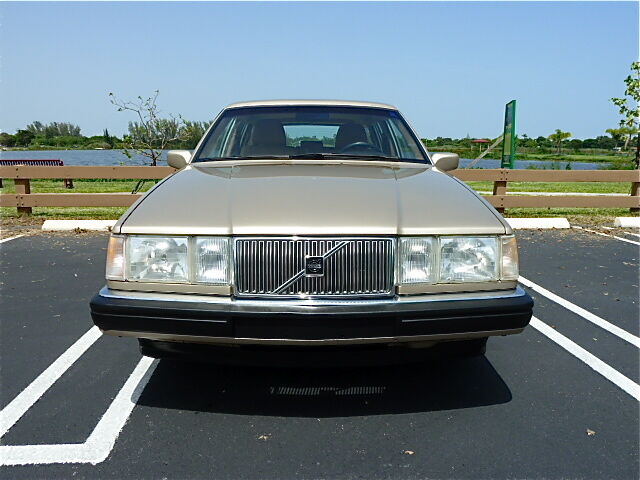
Never This Nice: 75k-mile 1993 Volvo 960 Wagon


This Volvo looks to be in the kind of exquisite condition you never find them in anymore.

The 900 series were made from 1990-1998 and were, sadly, the last rear-wheel drive cars they made.

This is a pre-facelift '90-'94 960, before the car was moderately updated in 1995. Both the pre- and post-facelift models are nice looking, but the black plastic side molding on this early model absorbs wear better than the all-body-color strips on later cars.


The car is powered by a 2.9-litre, 24-valve DOHC inline 6-cylinder engine.

Exterior design is ultra-conservative, but it works so well. It's boxy and relatively simple but the price paid for not being stylish is a wonderful amount of useful interior space. And that's what a station wagon should be (as opposed to the loony Dodge Magnum, for example).

This one is pitch-perfect in gold over saddle leather interior. The alloy wheels are also really nice.


Since these were the mom car of the '90s upper middle class suburb, they were often driven a lot and with children in the back seats. Seeing one in this great shape is kind of bittersweet, as if it was never used as intended, but so nice to see it almost as nice as new.

The seller states the odometer clocks in at just 75,466 miles.


The vehicle is being offered by a dealer who are "Volvo specialists" and was driven by the seller and his wife.

They say it has also never been in an accident, reaffirming the low miles are just due to sparing use.

These are great cars. Since the mileage is unusually low but not museum-quality low, I would keep driving it for another 100-200k miles, as they were designed to go.

The price for this all this? A buy-it-now of just $4,975. You won't find another one like it, and you won't find any new car with this kind of build quality.

Find it here on ebay in North Miami, Florida.