1960 BMW Isetta 600


BMW actually did not create the Isetta. It was originally created in 1953 by an Italian firm called Iso. Isetta meant "little Iso". Iso made refrigerators and scooters, and the Isetta is, in some ways, a combination of the two, being a tiny box with a tiny engine. In fact, Iso used their scooter engine in early models.

The original Isetta was just a small three-seat vehicle with three wheels, and a rear-mounted engine that powered the rear wheels. The car had just one door: the entire front of the car opened up for easy access in and out. It was a hit at the 1953 Turin Motor Show, and is an uplifting example of the good ways Europeans can use their technological prowess in the post-war years.


Since post-war Western Europe was still re-building together under the Marshall Plan, a greater sense of community emerged, and the Isetta was licensed for production beyond Italy in several other nations. Which brings us to BMW.

In typical German fashion, BMW thoroughly re-worked the Isetta inside and out. The most significant changes were a new four-stroke, 1-cylinder engine from their motorcycles, some cosmetic touches and new suspension. Sales took off, becoming the the top-selling single-cylinder car in the world.

In 1957, they launched an all-new bigger body style, the 600. This featured a stretched chassis, four wheels, a second row of seating and an additional door on the side to access the rear seats.


Power came from a 582cc flat twin engine that produced 19.5 horsepower. Rear suspension was a sophisticated semi-trailing arm and was used on almost every production BMW until 1984, when it was replaced by the Z-axle multi-link suspension.

Only 34,813 were built until 1959.

This immaculate and immensely charming example is finished in two-tone white roof and pale yellow body. The seller says the only cosmetic flaws are a dash lip seal that does not align to the windshield and a small crack on the door wing. The seller doesn't say if this is all-original or a restoration, but it's amazing either way.

Mechanically, they say it starts, idles smoothly, shifts well and accelerates fine.


This is a unique piece of European automaking history. Not many were made, none were sold in North America, and very few are in this kind of pristine condition. It was an innovative car then, and it still impresses today as a feat of engineering and aesthetics.

Available here on ebay in Laramie, Wyoming with bidding at $17,600 and a Buy-It-Now of $45,750.

1 of 192: 1969 Iso Rivolta Fidia


Feast your eyes on this!

In the late 1960s, Italian automakers were trying to catch up with the Germans in the race for the perfect upscale executive sedan. Mercedes-Benz had already mastered this segment, but their cars still wore a conservative, upright styling that, while now timeless and classic, was to be outdone at the time. The Italians already had an edge in the supercar segment, practically inventing the wedge with Gandini's iconic Alfa Romeo Carabo in 1968.

For the Iso Fidia, they asked up and coming designer Giorgetto Giugiaro, then of Ghia, to design their flagship sedan. Iso was an edgy post-war manufacturer who created the legendary Isetta bubble car. In the 60s and 70s, they turned to performance oriented sports cars, before launching the Fidia.


Giugiaro delivered. The Fidia wears a long and low shape that is well-proportioned and balanced, especially from the side. The front is a little less graceful and more muscular with quad square sealed-beam headlights (complete with French yellow driving lamps). The greenhouse is large and inviting, and the window profile swoopy. The whole thing is very sexy and somewhat ahead of it's time, as this shape is currently being revived to a degree in the Fisker Karma.

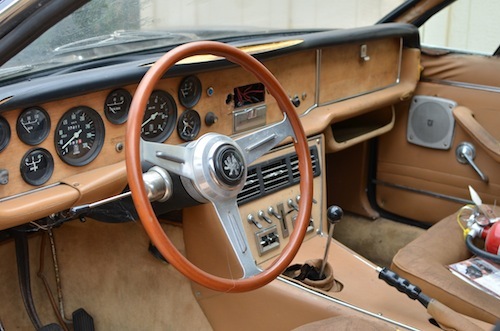
Inside, occupants are treated to polished wood and hand-stitched leather. This is the pre-'71 update interior, so the dashboard is clearer and less cluttered. The white-on-black guages and wood-and-aluminum steering wheel are pitch-perfect here.


Like the DeTomaso Pantera the Fidia engine was sourced elsewhere and had either Chevrolet or Ford V8 engines under the hood. Pre-'73 cars such as this one feature a 5358cc Chevrolet V8 that propelled the 3,483 lb. car to 0-60 mph in around 7 seconds, which is remarkable for the time and still really impressive today. Italy didn't have any Autobahn, but a day trip away and this could be seen ripping along speed-limitless highway.

Iso only made 192 Fidia before the firm went bankrupt in 1974.

This ultra-rare survivor is found in California where the seller says it has been for the past 30 years. Cosmetically, they say it was repainted once but does have rust, cracks, and fading. Mechanically, they say 350 HO engine has been rebuilt. It's mated to a 4-speed Borg Warner transmission.

The classic car elite see sedans as less collectible, but with a Giugiaro-carved body, big V8 power and super-low production numbers, this Iso Fidia definitely bucks that trend.


Available here on ebay with 12 bids at $8,400 and reserve not met.

Not So Iron Curtain: 60k-Mile 1988 Yugo GVX


Oh, the Yugo. There was no vehicle so contrary to red-meat American values of the 1980s, and yet there three of them were lined up, red, white, and blue at the 1984 Los Angeles International Auto Show during the height of the Reagan Era.

There was quite a bit of classic one-upmanship in bringing the Yugo to America, however. Malcolm Bricklin (yes, the same guy behind the Bricklin SV-1 and Subaru America) had been contacted by Armand Hammer on behalf of Yugoslavia to find a way to expand Yugo sales. Bricklin, ever the magnet for bad ideas, apparently thought the Yugo was a great idea. But not before another entrepreneur named Miro Kefurt thought the same thing and managed to found YugoCars, Inc. in Sun Valley, California in 1982. It was their cars that appeared at the Los Angeles show. Bricklin was at the show and saw the Yugo, and, not to be outdone, literally left the show and immediately flew to Yugoslavia to negotiate a deal. Eventually, he made a deal directly with Kefurt, who sold Bricklin the rights to sell the Yugo in exchange for the rights to sell the Fiat/Bertone X1/9.


Was the Yugo worth all the hassle? The original manufacturer was called Zastava Yugo Automobili and had been building the "Koral"/Yugo since 1980. These were extremely basic subcompact economy cars. They were available in only a three-door hatchback or two-door convertible. A tiny 3-cylinder engine powered the front wheels.

Styling takes inspiration directly from Giugiaro's groundbreaking 1974 Volkswagen Golf. There are no frills or excess here, just a simple, pure, undiluted two-box shape. Initial models had reverse lights mounted on the bumper. Later models have them more appropriately integrated in the taillight cluster. The whole thing isn't bad looking, though, and definitely grows on you.


Although early Yugo had problems with emissions, they eventually underwent over 500 changes for the U.S. market. By the late 80s, their build quality and reputation improved. Sales hit a high of 200,000 in 1989. The entry-level GV (for "Great Value") was offered at just $3,990.

This is a later example in higher "GVX" trim. The GVX was powered by a 1300cc 3-cylinder engine that only produced around 68 horsepower and moved the car from 0-60 mph in 13.56 seconds, no speed record. Cosmetically, it added a ground-effects package, alloy wheels and rally lights.

The seller of this Yugo says they've owned it for 15 years, the last 6 of which it has been in storage. In the last several months they list a host of repairs and upgrades. They also lowered the suspension, hollowed out the cat converter and disabled the emissions regulator. Cosmetically, some of the paint seems worn on the bumpers. Mechanically, their work speaks for itself, and they say it handles great and is a blast to drive. They state the mileage as just 60,589.


Ultimately, the Yugo was brought down by politics here at home and in Yugoslavia, as our crippling regulations forced yet more emissions changes and the collapse of the Soviet Union and its communist satellites interrupted production and caused sales to end here in 1992.

Find this remnant of another era here on ebay with a Buy-It-Now of $2,700 and the Make Offer option.

1998 Jeep Cherokee 2-Door 5-Speed 4x4


This a neat solution for someone looking for an SUV but doesn't want anything too hideous, flashy, gas guzzling or uncool (as so many of them are).

The Cherokee was Jeep's standard issue four-door off-road vehicle that complemented the larger Grand Wagoneer starting in 1984. It continued largely unchanged until 2001, and was a high benchmark in the development of civilian-friendly off-road vehicles for everyday use as well. The monocoque body ensured great structural rigidity and composure for navigating even the roughest of terrain.

This is a later 1997+ facelift. The front nose and rear-taillights were re-designed, among dozens of other small touches. The unibody frame was also stiffined to reduce road and wind noise and improve refinement.


Styling is unusually good. Jeep has a lot of simple cues from their heritage to work with, like the vertical slotted grille and simple, boxy profile. The rest just falls into place. It's every bit as handsome and iconic as a Land Rover, Galendenwagen, or FJ Cruiser. In the same way the Germans mastered the look and feel of mid-size sedans, American automakers aced the construction and aethetics of the full-size SUV. Not the greatest feat, but a noteworthy one nonetheless.

This one stands out from the thousands of other Cherokee still on the road because it's the lesser seen 2-door variant. It has one bench seat behind the front seats, then a spacious cargo area. The lack of rear doors stiffens the body and will no doubt help make this feel even more solid on and off-road. The side profile is even simpler and more classic looking.


Inside, accommodations are sparse but clean and simple. The post-'97 update yielded some new buttons and a new steering wheel. The seats are grey cloth and contrast well with the deep metallic purple exterior.

Under the hood is Jeep's workhorse 2.5-lite four cylinder engine producing 125 horsepower turning all four wheels. That's not a lot of power, but it will mean more efficiency. It's mated to a rare 5-speed manual transmission.

The Cherokee isn't rare, but this combination is. This one looks clean and well-kept too, with just 101,581 on the clock. The seller says it's free of major defects. It could be ready to go, in any type of weather and road condition, for another 100k miles.


Available here on ebay in Philadelphia, Pennsylvania with a $7,450 Buy-It-Now and the Make Offer option.

44k-Mile 1992 BMW 325iC M-Technic


Looking like it came right off the set of Miami Vice comes this '92 BMW with low miles and the rare M-Technic package.

The E30 really needs no introduction. It is perhaps THE definitive BMW of all time, blending the best of everything that came before it while looking to the future with new levels of performance and efficiency. These were compact, balanced, well-built and aesthetically near-perfect.

The convertible version was just icing on top.


This is a later example with a build date of 7/91 but sold as a model year 1992. The M-Technic package mostly adds just cosmetic changes: all formerly black plastic body trim is now "AlpinWeiss 2" paint, the front and rear gain lower spoilers and the sides get new lines. Foglamps are standard. The cross-spoke alloys are also white. This kind of all-white look was popular in the late 80s and early 90s and still looks striking and fresh today.

The interior is finished in an equally light "LotosWeiss" leather with all-black dashboard.

Under the hood is BMW's venerable 2.5-liter inline 6-cylinder powerplant producing a respectable 168 horsepower to the rear wheels and moved the modest 2,000 lb. weight along nicely.


Unfortunately for motoring purists, this one is mated to automatic transmission. But since these were Sunday boulevard cruisers anyways, a relaxing slushbox makes little difference.

Mechanically, at 29k the seller states a bunch of repairs were done. At 43k, a new power steering pump was added along with a regular tuneup.

This car seems to have been pampered, and if your heart is set on a E30, this well-kept and low mileage survivor could be the one.

Available here on ebay in Bellevue, Washington with bidding already past $7k.

1976 Cadillac Fleetwood Castilian


This is about as Seventies as it gets: American. Cadillac. Enormous. And station wagon.

The Cadillac Sixty Special was produced from 1971-1976. The car weighed a lot: 5,400 lbs, and it was over 19ft long.

As if it weren't over the top enough (and they say the 1980s were decadent), at some point someone decided to extend the roof, add d-pillars and call it a 'Castilian'.


The work was performed by Traditional Coachworks of Chatsworth, California between 1975 and 1976. It is not known how many were made, but it was very limited. The silvery c-pillar is slanted and wraps around the roof. The rear hatch has a nicely integrated roof spoiler and opens the whole width of the car, stopping just above the reverse lights.

They were equipped with the Brougham d'Elegance package, which included pillowed seats, carpeted footrests, radio, outside temperature gauge and a variety of power features.


The interior is in a matching green. Cozy!

Underneath the hood lay a 500 cubic-inch overhead valve V8 engine producing a mere 190 horsepower. A drag racer this was not. But it was probably one floaty cruiser when up to speed.

The seller states the vehicle is all-original and has only 73,020 miles. A source here says it sold in Arizona in 2011 for $25,300.

Available here on ebay in Knoxville, Tennessee with bidding at $14,000 and reserve not met.

Early Bangle: 1997 Fiat Coupe 20v Turbo 5-Speed


Utter the name of designer "Chris Bangle" among auto enthusiasts and a collective shudder will ensue. Bangle is an American who was hired as a stylist for BMW, and beginning with the 2002 E65 7-Series, radically altered the look, tone, and feel of all BMW vehicles, much to the public's disdain. During the late 20th century, BMW designs under Claus Luthe were always evolutionary, building carefully on each predecessor. These cars, like the E30, E32 and E34, were also built extremely well and when combined with the conservative styling, became seared in the minds of drivers all over the world as superior products. Bangle broke the evolutionary chain in favor of revolution. It backfired. The E65, with its bloated proportions, ridiculous trunk, overly complex electronics and unintelligible "iDrive", was a step in the wrong direction after the beloved E38 it replaced.

So what was Chris up to before he "bangled" up BMW? He worked for Opel and then Fiat, and this '97 Coupe bears his mark.


The Coupe was produced from 1993-2000. Bangle designed the body, and Pininfarina did the interior. Bangle's work here isn't half bad. It's quite in line with that Italian designers were striving for in the 90s, moving past the chiseled-from-steel edges and lines of the Eighties and into soft curves and minimalist panels. The unorthodox wheel arch shapes are interesting but give it an odd look from certain angles. The round taillights are nice. It's kinda futuristic, kinda pretentious. I also appreciate the rear wiper.

Inside, the interior is swathed in black plastics.


Like Alfa Romeo at the time, which Fiat owned, the Coupe is front-wheel drive. Fortunately, under the hood of this example is the later 2.0-liter 20-valve 5-cylinder turbocharged engine. It pumped out around 217 horsepower and propelled the car from 0-60 mph in 6.5 seconds, not bad. This one is mated to a 5-speed manual transmission.

The seller of this example is also selling the Alfa 155 that I spotlighted here.

They state the Fiat has 47k kilometers, which is only about 29k miles. They say it just had an extensive service and is now mechanically "perfect".

Available here on ebay in Ontario, Canada with an auction and a Buy-It-Now of $11,900 C, about the same in USD.

1995 Land Rover Range Rover LWB Convertible


There's something really charming about this, despite how impractical it is.

The Range Rover Classic was produced from 1970-1996 and is one of the first luxury sport utility vehicles. Only the British could fuse two seemingly disparate worlds - utility and luxury - together so well. It has been imitated and copied so many times since then it's almost impossible keep track. And until the last couple years, these types of vehicles were very popular in the U.S.

Shortly before his death in 2010, the original designer, Spen King, remarked with disgust how Range Rover had ended up becoming a status symbol, which it was never intended to be. But classic car fans appreciate the bare bones intentions of the original. Regardless, it's a classic vehicle, and a classic SUV.


The seller of this example states it is 1 of 3 "made in the universe". Yes, I would assume some alien civilization halfway across the Milkyway isn't producing Range Rover out there. They provide no source for the low quantity, although they do mention they owned 2 of the 3. Since a factory convertible was never produced to my knowledge, anyone can have a custom conversion done, so I'm not sure if I believe there are just 3. That said, there sure can't be many.

The conversion isn't half bad. All of the pillars except for the rear most two are left intact. I think some sort of rollbar or frame for the rear would fill out the profile a little better, especially from the side. I don't see any softtop folded, and sure enough the seller says a brand new top is "being made as we speak".


The seller lists the odometer as reading 194k miles but says it drives great, the air conditioning blows cold and everything works, a minor blessing on a Range Rover, which are not known for reliability, like a lot of British cars, unfortunately.

Let's face it, this won't be used for photographing the safari, or to deliver first aid to an impoverished third world country. So if you need something big, bulky, unreliable, gas guzzling yet admittedly very unique for your summer ride, here it is.

Available here on ebay in Brooklyn, New York with a Buy-It-Now of $12,900 and the Make Offer option.

Under $10k: 41k-Mile 1988 Porsche 928 S4


These are the unloved sons of the Porsche world.

The 928 was intended to replace - gasp - the 911. Porsche was gearing up for rumored legislation outlawing - another gasp - rear engines in Germany. They also felt the 911 had reached its maximum potential, and could no longer be improved upon (really?). Porsche envisioned replacing it with car that did what the 911 could do, but more comfortably and practically. After the engine regulation never materialized, the 928 was followed through but simply sold alongside the 911 for 18 years. Consumers got the best of both worlds.

I like these a lot. Porsche hit a another home run in the styling department. Just as the 911 was an iconic automotive shape for the ages, the 928 added another new classic profile to the lineup. In some ways it's just a stretched 911. Sloped rear-back, elongated front, round headlights.


In 1986, the 928 got a lot better looking than earlier iterations. New smooth front and rear ends were added, along with corresponding turn indicators and taillights. The dinky little spoiler was ditched in favor of a larger and more aesthetically serious piece. It just got so much better looking.

This particular example looks great in light gray over blue.

The key difference from the 911 is that the 928 features a front-engine layout. But this was no bow to conformity. The engine still powered the rear wheels. And this time, there was more power than any factory 911 could generate: a huge 32-valve 5.0 liter V8 pumping out a very healthy 316 horsepower. I imagine this is a blast on highway on-ramps, glued to the road with effortless acceleration. The ultimate autobahn grand tourer.


Porsches are among the most expensive cars to fix in the world. Parts are rare and expensive, and garages assume you're an endless well of money if you own one. I'd make sure to get a full history on this. Number of owners? Accidents? Maintenance records? "Porsche guys like their Porsches perfect" my boss John likes to say. Which means that there are a lot of imperfect Porsches hanging around on the market waiting to be snatched up at good prices for the rest of us, IF they check out.

I spotlighted this one because it's got an under $10k asking price and low miles. For a car that was originally $70k, that's quite a depreciation, and now it's a lot of car for not too too much money. Porsche made a lot of them over a long time, so they are not rare, and not as desirable as the 911, so they are always available. But again, previous ownership and maintenance is key. If it passes, you have my envy.

Available here on ebay in Fort Lauderdale, Florida for $9,999 and the Make Offer option.

Carolinas Only: 1980 Chevrolet Malibu M80


This is ridiculously rare. According to some sources, the Malibu M80 was only sold in two states, just North and South Carolina to catch the attention of car fans headed to Darlington Raceway.

That's right. Just. Two. States.

The Malibu is Chevrolet's rather hilariously named family car. It used to be a sexy convertible, then a muscle car, then the Malaise Era version seen above, before becoming the front-wheel drive rental blandmobile it was of the 90s up to the present day.


The fourth generation Malibu was sold from 1978-1983 and was Chevrolet's standard issue economy family sedan. Nothing special, innovative, or remarkable about it. As a saving grace, power was still directed to the rear-wheels.

Styling is pretty odd, although it looks better now than in all the years since it debuted, when they've been beaten, thrashed, trashed and abused. The body is all hard angles and lines, zero detail, with cheap sealed-beam headlights, cheap bumpers and cheap side mirrors plastered on every Chevrolet at the time. Aesthetically artistic these are not.


But in some ways they are a key bridge in American auto design. American designs were pretty trend-setting in the 1950s and 60s, before the fuel crises of the 1970s forced automakers to scale back and tone down. American automakers, not surprisingly, were very bad at scaling back and toning down. European automakers, long used to dealing with narrow roads and high gas prices and therefore smaller and more efficient cars, handled the fuel crises adeptly. American automakers mostly failed to lead in their response to the fuel crises. So they ended up with cars like the Malibu, sobered and hard edges ready for the dawn of the lean and efficient Reagan Era. In some ways, it was very befitting, and let the way for a new generation of cleanly styled automobiles, totally removed from the over-the-top cars of the 1950s.

This M80 example certainly tries its best to look well, especially since it was part of an effort to "revive the muscle car era" (how did that turn out?). All M80 produced were 2-dour V8 coupes with an added appearance package of blue racing stripes, "M80" decals, front and rear spoilers, and steel rally wheels.


Only 1,909 are believe to have been made.

The seller is a dealer who bought the car from a retired GM engineer. They say it was restored in 1999 and currently looks great, at least in the photos. They say it runs, handles and drives well with no issues.

If you're nostalgic for a lost era in American auto manufacturing, this could fit be the answer.

Available here on ebay in Shawsville, Virginia with bidding at $5,655 and reserve not met.