1985 Lincoln Mark VII Diesel


I love diesels and I make no effort to hide it. In America, we've been deprived of widespread use of diesel engines in passenger cars for quite a long time (save for the excellent offerings from Mercedes-Benz and Volkswagen of course). In Europe however, diesels are the norm, not the exception.

Since we're facing another fuel and energy crisis (or really just the same one we've always had), diesels are popular again, even though those who know their advantages never stopped loving them over the years. What makes diesels especially interesting despite their own merits of efficiency and reliability is a 21st century twist of converting them to run on biofuel - that's right, vegetable oil and restaurant leftovers.


Biofuel is cheap and inexpensive (though smelly) so interested customers are hunting down old diesel cars like predators. That makes otherwise insignificant cars like this Lincoln Mark VII rather significant again.

Of course, someone like me already finds this car intriguing.

The fuel crisis of 1979 renewed interest in efficient vehicles again, and this time American manufacturers were listening, unlike their woeful incompetence after the first incident in1973. Of course, diesels still didn't take off for one reason or another, but some of the cars they stuck diesels in were amusing to say the least.


Such is the case with this Lincoln. The Mark VII was based on the rear-wheel drive Fox platform. It lasted from 1983-1992. These aren't sports cars, but they are great, comfortable cruisers, and they styling isn't terribly offensive.

Underneath the hood, however, is a real surprise: a BMW inline 6-cylinder turbocharged diesel engine, the same one in the brief 524TD that came and went here. Just how Lincoln struck a deal with BMW is a story still untold, but it's not a bad idea; Ford's diesel experience was limited to trucks, and BMW's diesel was a great engine the fastest of it's day (even with just 115 horsepower). But since the Lincoln is a bigger, heavier car, you really can't expect much power. Still, you can expect overall reliability if you change the oil religiously.


Lincoln only offered the Mark VII diesel from '84-'85, along with a diesel Continental. From that point on, declining gas prices, politics and the general buoyant mood of the times made diesels disappear again.

The seller says they are the third owner, the car was repainted, service up to date and everything works. They state the mileage is 132,048.

I think this is a pretty cool car. It's not an ideal candidate for biofuel, but it could be a "sleeper" if it was...if there can even be a sleeper biofuel car. Either way, it's rare, and this one looks to be well cared for. It could bring some interesting highway miles to come.

Available here on ebay with a Buy-It-Now of $8,700.

Outrun This: 1986 Ferrari Testarossa Spyder


What's cooler than a Testarossa? A Testarossa convertible of course!

There was only one official spyder designed and created by the factory. It was painted silver and delivered to the president of Fiat in August, 1986.

Testarossa convertibles started appearing in pop culture, too, with a red one being the default ride in Sega's arcade classic Outrun and a black one for a Michael Jackson Pepsi commercial.

Then, in September of 1987, Road & Track featured a cover story about special ordered custom conversions done by Richard Straman in California.

This is one such Straman convertible.


Straman's genius lay in the art of subtraction. He took away the entire roof and rear pillars and expertly cut around the cabin so that the canvas roof, when folded, tucked neatly behind the headrests. The result is extremely successful and emphasizes everything that is great about the Testarossa's original design, making the car seem even lower and wider than it already looked.

Mechanically, it is no different than the factory hardtop, with a smooth, naturally aspirated 4.9-liter flat 12-cylinder engine putting out 380 horsepower to the rear wheels and capable of launching the car from 0-60 mph in 5.2 seconds.


The Testarossa was a comeback car for Ferrari when it debuted at the Paris Auto Show in 1984 and was their flagship until 1991 when it was updated with the 512 TR. Although Ferrari has really never mass produced any car, they managed to build 7,177 of the Testarossa, a surprisingly large volume for a small exotic company, and enough so that the car could be deemed a success. Publicity-wise, it was beyond success, it's an icon of the era and continues to fascinate auto lovers to this day (yours truly included).

Testarossa values have come down and are starting to tick up, but they can still be had for around $60k for decent examples. Fortunately, the vast majority have barely been driven and remain with low miles and in near mint condition. This one is no exception, with the seller stating it has accumulated just 9,383 miles. In addition, they state it's just one of Straman's 12 conversions.


Buying a Testarossa is one thing (if you have the cash), but maintainence is entirely different, as you must seek a specialist for services and trouble shooting should the need arise (and it will, if it's used often or improperly). Ownership, however, complete with looking into the garage and seeing it, must be something else, which I can't quite comprehend.

Available here on ebay in Burbank, California with bidding already up to $58k.

1982 Opel-Isuzu I Mark Diesel


The first generation Opel Gemini was a subcompact car launched in 1974 and lasted until 1985. It was sold under a variety of brands in many different markets, hence the confusion in North America, where it was called the Opel Isuzu, then Buick Opel, then simply Isuzu I Mark.

This is the last iteration, simply called an Isuzu. I've never seen one in person and this is the first I've seen for sale on ebay.


Underneath the hood is a 1.8 liter 4-cylinder diesel engine that powers the rear wheels. It's definitely not going to win any drag races, in fact it's going to be downright slow on the highway, but the reward for sacrificing performance is efficiency. The seller estimates it can get 50 miles per gallon. They also say it has been converted to bio-fuel, another huge plus in the economy department.

Cosmetically, it's a Malaise Era classic, a front end only a mother could love, big windows, simple lines and clunky 5 mph government mandated bumpers. Fortunately, this one wears a chipper coat of pale yellow paint that brightens things up a bit.


The seller says it's been serviced, with new oil, new filters, new brake pads, shocks and an alternator. They say it runs and drives great with no problems. It's also got 5 speed transmission.

Unfortunately, the seller mentions some rust limited to the doors and wheel wells.

They do however say they've scoured the internet for 5 years for a similar car and haven't found another one.

Available here on ebay in Austin, Texas with just one bidder at $500.00 and 7 days left.


81k-Mile 1987 BMW 325i


The E30 is the definitive 3-series. It was unlike the E21 that came before and especially the E36 after. It also helped solidify the brand's status in the United States as a maker of great automobiles, and gave rival Mercedes-Benz some real competition against their W201 190. It's a New Classic.

These were produced from 1982-1993, otherwise known as the Reagan-Bush era. Sure, the E30 is the original yuppie mobile, but for all the right reasons: they were extremely solid, fun to drive and reliable. In fact, so well-built and relatively simple to fix were the E30 that Kiplinger's named them one of the top 10 Cars that Refuse to Die.


The body was designed by Claus Luthe and is an exercise in incredible restraint and detail. It's not quite boxy but definitely not round, the lines all laser-straight chiseled and crisp, and yet up close, the corners are softly rounded, like they were gently sanded and buffed by hand. The greenhouse is proportionally huge, making the windows look large and the space inside inviting, not to mention providing excellent visibility inside and out.

Inside, the interior is an all-business, no-nonsense, hyper-functional, driver-oriented paradise. The gauges are crystal clear white-over-black. The center console is angled towards the driver. Above the rearview mirror is an onboard service indicator that displays the status of vital systems through a red LED bargraph.


Underneath the hood is the timeless 2.5-litre inline six-cylinder engine providing a decent 168 horsepower to the rear wheels. This particular example is mated to a 6-speed manual transmission.

Since they were commuter cars for the upwardly mobile, they were often driven hard then quickly traded in for the next flashy car, before they fell into multiple hands and eventually rusted away. As such, clean, low mileage examples are very, very difficult to find. The E30 M3 is already a collectible classic, so it's likely the regular coupes and sedans may follow.


This particular survivor defies the odds. The seller says this '87 325i has just 81,574 miles on the clock. Cosmetically, it looks amazing. It helps the grey/black color combination is perfect and flatters the exterior and interior shapes. The seller also says the body has no rust, a huge plus. They even say the paint is shiny and not faded.

Mechanically, they say it was regularly serviced, taken good care of and now "runs and drives great".

I want this car. As long as there is no rust and the seller can provide some proof of prior maintenance, the next owner (should it not be me), has my sincere envy. This puppy is good looking, fun to drive, relatively fuel efficient, simple to fix and reliable. It could very well see 181k miles without major problems, if the oil is changed regularly and it's driven carefully.

Available here on ebay in Philadelphia, Pennsylvania for $8,495.

Perfect Strangers: Porsche and Thunderbird


Last summer I spotted this rusty white 911 sitting at a Shell station in Massachusetts. The attendant said it has been sitting there in need of repairs for a while, but they stayed in touch with the owner. The car itself was complete looking but in poor shape. The clear coat had completely faded and was peeling to reveal surface rust. The interior was a mess. The engine is probably even worse. But it still looked striking in refrigerator white, just sitting there, neglected, forever in purgatory. My guess it was a late 70s or early 80s non-turbo Carrera.


Fast forward to this fall, when I buy my E46. I'm in need of a local European garage who I can trust to honestly assess, repair and service my car. I found them nearby and get talking with the friendly owner, Dave. He's a big Porsche guy, and he's looking for an old 911 to completely redo into a race car. I immediately think of the 911 I saw. It's a perfect candidate for that kind of work.

So I went back to see it today, and sure enough it was still there, but this time it had moved across the lot and now sat next to 1964 Ford Thunderbird.


The Thunderbird was also painted white, but in much better condition. The paint still had gloss and the chrome looked decent. It wore a hardtop and whitewall wheels. It looked beautiful.

One of the things I immediately noticed was the size difference between the two - how small the 911 is in general and especially compared to the boat-like Thunderbird.


I sent the photos of the Porsche along with some contact info over to Dave and am interested to see what he does. Regardless, it's fun seeing these this odd couple together, and even more amusing both seemingly broken down at a gas station. Purists don't cringe! They will hopefully have homes soon. At least the Porsche. COTC will keep you updated!

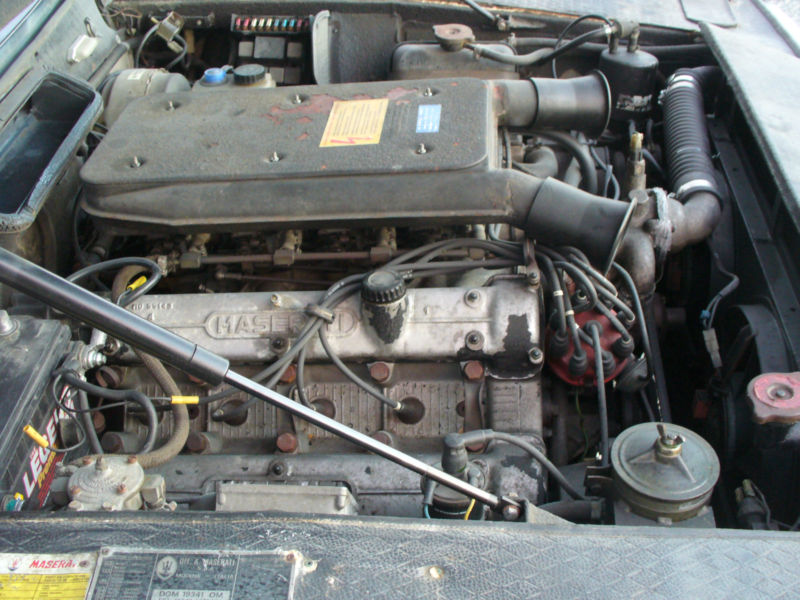
1985 Maserati Quattroporte Euro


The Quattroporte was Maserati's attempt to steal the ultimate luxury car crown from Mercedes-Benz in the eighties. It almost worked. The body was designed by none other than the legendary Giugiaro and the engine was an large and powerful V8. The car looked more modern and edgy than anything Mercedes was putting out, too, but was just as luxuriously appointed on the inside.

There were actually two previous generations of Quattroporte before this one debuted in 1979 and continued until 1990, resulting in a mere 2,155 units being produced, making this a rarity. It was conceived after the company's takeover by Alejandro de Tomaso (of the De Tomaso Pantera), and while not a success with that low volume number, did leave an impression in the minds of many, especially after it appeared in movies and on tv shows as the bad guy's ride.


Giugiaro's body is classic, and fits into his impressive portfolio of clean straight lines and hard edges. The thick and sloping c-pillar was no doubt influential and is especially seen on today's cars as they get more and more windswept back and over.

Underneath the hood was either a 4,136 cc V8 producing 238-255 horsepower, or a larger 4,930 unit that produced 280 hp, very healthy for the time and still respectable today.

Adding to this example's rare factor is that it's a Euro-spec version, with shorter and lighter bumpers, headlight washers and other small but good changes.


The seller says the bought it 4 years ago when it had only 32k miles and are now reporting it has 42k. They say it needs some time to warm up but always starts and the Chrysler transmission shifts well. The do mention the blower doesn't fully work, it needs new trunk shocks, and the a/c doesn't work any longer.

Cosmetically, they said it was repainted in the original color but needs weather striping on all the doors.


For the appreciative eye, this is a rare example of a rare car and seems to be overall well kept and enjoyed. With some tlc it could be ready to hit the Italian exotics circuit in no time.

Available here on ebay in Henrico, Virginia with no reserve bidding at $4,173.

In the US: 1988 BMW 325ix Wagon


Oh winter! How you punish me with your freezing temperatures, relentless snow and overly sanded and salted roads. But how you give me reason to buy cars that would make the winter so much more bearble - at least when driving.

The E30 station wagon was never officially offered in North America, and only a handful have made their way here since through private importation. While Mercedes-Benz wagons are legendary, BMW variants are less so. They were never offered in diesels, and weren't introduced until the late 80s, so they never developed a cult following. But that doesn't mean they aren't as cool.


The E30 wagon is particularly neat because the E30 chassis is arguably one of the best BMW cars of all time. It's about the size of a Honda Civic, but with superior design and engineering.

This particular example is the first year they starting making the wagon body style, and it's utterly brilliant. The roof is extended and the rear slopes perfectly into the same taillights as sedan, coupe and convertible had. It also has a rear wiper.

As a cherry on top, this one is also equipped with BMW's first all-wheel drive system, simply denoted by the "x" in 325ix. BMW did not advertise this system as much as Audi did with Quattro and Mercedes with 4Matic, so it disappeared after the E30 and did not return until nearly a decade later with the E46 "xi" (of which I am a very happy owner). As an additional bonus, this one has a stick shift for those rally enthusiasts.


The U.S. government prohibits the private importation of vehicles newer than 25 years old for road use, but this puppy just turned 25 this year, so it should be here legally. The seller says it is exempt from DOT and EPA exempt, and can be registered as a classic vehicle.

Cosmetically, it seems to be wearing ugly aftermarket rims, but otherwise looks fine. The front black plastic spoiler is missing, a common flaw on these as they are usually taken out by road debris or parking blocks, and should be easy to replace.

Mechanically, the seller says it's a 1-owner vehicle with full maintenance, everything working, and no needs.


If this thing checks out with no rust and a clear title, you've got one really cool car for a bargain price.

Available here on ebay in New York for $6,999.

1974 Mercedes-Benz 240D Manual


I spotted this vintage Benz yesterday at dusk and went back again today to 'check it out' in more detail. While I was taking some photos, the seller emerged from their house and kindly answered some questions about it for me. Basically, it's a U.S.-spec W115 '74 240 Diesel with a 5-speed manual transmission and over 250,000 miles on the clock. The seller is not the original owner, and didn't elaborate on how and when they acquired it, but said it runs fine.


The W114/W115 was produced from 1968-1976, resulting in over 1.9 million constructed. The W114 chassis signified the 6-cylinder models, while the W115 represented the four-cylinder models, including this 240D.


The body is credited to legendary auto designer Paul Bracq, and is a classic three-box shape, taught, conservative, squared-off and perfectly proportioned. Unfortunately, this being a 1974 U.S. model, it sports the heavy and unsightly 5-mph bumpers and lousy sealed beam headlights. Fortunately, it looks utterly charming in pale flat moss green, a relic of the 70s but still fresh looking today.


The '240D' signifies the 2.4-liter OM616 diesel-powered 4-cylinder engine that powered the rear wheels. These are not fast cars. I've actually read they are downright slow, even dangerously so, in modern traffic. Fortunately, this one is mated to a 5-speed manual transmission to bring both some liveliness to the engine and engagement to the driving experience. And what it lacks in overall performance it more than makes up in reliability. Mercedes-Benz diesels from the 60s, 70s, and 80s are some of the most durable engines ever released to consumers.

Cosmetically, the car is far from perfect, with obvious rusting and faded paint among other defects in the body. I didn't go inside, but the dark green interior sported what has to be that indestructible MB-Tex vinyl leatherette, as the seats looked really good.


The seller is asking just $2,500. This could easily be a great first car for someone, a temporary set of wheels for a college student until the end of the semester, or really just about anybody's beater car. It's good looking, diesel-powered, and has a stick-shift. What do my readers think? Thumbs up or down?

Early Bangle: 1996 Fiat Coupe Turbo


Utter the name of designer "Chris Bangle" among auto enthusiasts and a collective shudder will ensue. Bangle is an American who was hired as a stylist for BMW, and beginning with the 2002 E65 7-Series, radically altered the look, tone, and feel of all BMW vehicles, much to the public's disdain. During the late 20th century, BMW designs under Claus Luthe were always evolutionary, building carefully on each predecessor. These cars, like the E30, E32 and E34, were also built extremely well and when combined with the conservative styling, became seared in the minds of drivers all over the world as superior products. Bangle broke the evolutionary chain in favor of revolution. It backfired. The E65, with its bloated proportions, ridiculous trunk, overly complex electronics and unintelligible "iDrive", was a step in the wrong direction after the beloved E38 it replaced.

So what was Chris up to before he "bangled" up BMW? He worked for Opel and then Fiat, and this '96 Coupe bears his mark.


The Coupe was produced from 1993-2000. Bangle designed the body, and Pininfarina did the interior. Bangle's work here isn't half bad. It's quite in line with that Italian designers were striving for in the 90s, moving past the chiseled-from-steel edges and lines of the Eighties and into soft curves and minimalist panels. The unorthodox wheel arch shapes are interesting but give it an odd look from certain angles. The round taillights are nice. It's kinda futuristic, kinda pretentious. I also appreciate the rear wiper.

Inside, exterior color flows in and wraps around the dashboard to brighten things up.


Like Alfa Romeo at the time, which Fiat owned, the Coupe is front-wheel drive. Fortunately, under the hood of this example is the later 2.0-liter 20-valve 5-cylinder turbocharged engine. It pumped out around 217 horsepower and propelled the car from 0-60 mph in 6.5 seconds, not bad. This one is mated to a 5-speed manual transmission.

The car is located in Canada and the seller says it has only 69,999 kilometers on the clock, which is only about 42k miles. They say it's in "perfect" condition inside and out. The also say it's one of just a handful ever imported to North America. The US currently doesn't allow cars newer than 25 years old to be imported for road use, but there are exceptions. Perhaps this could be made into one of them? The seller warns however if you are a US bidder and you don't have a concrete plan on getting the car across the border, don't bother bidding.

Available here on ebay with no bids starting at $6,000 and a Buy-It-Now of $12k.