Rumble in Coventry: 1976 Jaguar XJC V8
This cool custom Jaguar build features a 1996 Chevy 350 V8 engine on top of numerous cosmetic upgrades.
The XJC was a two-door coupe version of their XJ Series II sedan. Only 9,378 were made between 1975 and 1978. Like a lot of British cars, it looked good but was made poorly. Aesthetically speaking, the Series II translated surprisingly well into a pillar-less coupe. However, when it came to construction, fit, and finish, Jaguar cut corners and made mistakes. They welded on door extensions. The loss of b-pillars flexed the roof, which in turn cracked the paint. Jaguar covered the roof in vinyl, but it looked ugly and trapped rust.
Fortunately, the seller of example has rectified nearly all of the car's original problems and enhanced its strong points tenfold.
Cosmetically, they stripped the paint to the bare metal, vinyl roof and all, and repainted the whole body in glossy black. Inside, they have new grey leather seats from BAS interiors of England. The dash is new and the wood was refinished.
The wheels are from a 1996 XJR and are pitch-perfect. The only change I would have made is swapping clunky U.S.-spec bumpers for slimmer units or ditching them altogether.
Mechanically, the American V8 swap provides a ton more muscle and power. The seller says the engine itself was blueprinted, balanced, rebuilt and upgraded with a small cam and roller rockers.
The seller notes this was not a restoration, but a rebuild, and they say the car originally had no rust. They say it currently runs well and produces a "beautiful sound". It's certainly not a cat anymore...probably more like a lion.
This could really satisfy someone's itch for a sleek and unique classic Jaguar, but without the quality headaches that usually come with them.
Find it here on ebay in California with bidding at $5,600 but reserve not met.
14k-Mile 1990 Mazda 323 Hatchback
Did you miss out on a chance to own a sixth generation Mazda 323 when new? This could be the closest you'll get again. The seller is reporting the odometer as reading just 14,264 miles.
These were known as the Familia in most other markets and were produced from 1989-1994. They were basic front-wheel drive cars, although four-wheel drive was available. Mazda's Familia/323 helped establish the brand as makers of frugal, reliable little economy cars in the eyes of many consumers. This car became the Protege in North America, but the hatchback retained the 323 name.
Styling is pleasing. This was when Japanese designers were still being influenced by the conservative forms from Europe, so even their entry-level cars wore what could be described as "staid" sheet-metal, at least in comparison to today's cars. But a funny thing happened when those very Japanese designers (and, eventually, German and Italian designers, too) threw away hard corners and simple lines in favor of swooshy potpourri shapes more befitting of the Target parking lot than the Autobahn: consumers yearned for the hard angles. Americans (and Europeans to an extent), like our cars to look like cars, not sculptures (as Chris Bangle would have it). As such, there is a growing movement of people nostalgic for the look of these cars, insignificant as they might have seen at one time.
The seller of this remarkable survivor is a dealer and the car is not without some drama, unfortunately. The bad news first: it does have an accident to the left rear fender reported, but it looks like it was repaired. However the title was branded as salvage. The dealer explains they bought it from the insurance company, so it was involved in an accident, the owner decided not to fix it, and then the insurance company auctioned the vehicle at wholesale to dealers. It happens everyday.
The good news is that the car does genuinely seem to be a 1-owner, 14k-mile car.
The seller has provided a bunch of high-resolution photos and also taken the time to detail the car, and it goes a long way in presentation. Cosmetically, car looks great in steel grey with unpainted bumpers, cross-spoke wheels and grey cloth interior.
Mechanically, the seller states they have test driven the vehicle and it is road-worthy, needing nothing. They also offer to help the next owner apply for a rebuilt title.
Getting salvage cars can be a way to acquire cars with for cheap. Other times I imagine it could be a nightmare, or just a waste of money when a better car could be had for not much more. This might be a case of the former.
Find it here on ebay in Redondo Beach, California with a $4,988 Buy-It-Now and the Make Offer option.
Beautiful Berlinette: 32k-Mile 1975 Renault Alpine
This is one of the cleanest examples of an Alpine A110 seen around, and it's also conveniently located in the United States, as opposed to several that have been found in Mexico lately (as there used to be a factory there).
The A110 was produced from 1961-1977. These featured rear-mounted engines that powered the rear wheels. The engine makers varied but they were all four-cylinders.
The lovely fiberglass body was styled by Giovanni Michellotti, who also penned the BMW 2002.
Renault eventually took complete control over Alpine, but it didn't hurt the cars. Engine displacement increased among various other modifications. These cars have extensive rally history that deepens their historical significance, winning the 1971 Monte Carlo Rally and becoming the first World Rally Champion in 1973, to name a few.
This late build example looks terrific in refrigerator white, showing off the excellent proportions and classic shape. The seller says the body is mostly original with no cracks, and that the interior has the original seats and floor mats. They state the mileage as being around 53,000 kilometers, which is about 32k miles.
They also say it has the Gordini engine, but give no indication as to whether it is running or not.
It's hard to find an Alpine in good shape, let alone one in the U.S. This could be a great opportunity for someone looking for one that doesn't require a major restoration.
Find it here on ebay in Staten Island, New York.
1979 BMW M1
Now here is something you just don't see everyday.
This thing easily ranks as one of the coolest cars of all time.
The M1 was originally intended to be a racecar, but in order to qualify for the World Championship, BMW made a limited production run of just 456 units between 1978 and 1981.
The body was styled by none other than Giorgetto Giugiaro and is absolutely awesome looking. Giugiaro was among the first to embrace the now-classic "wedge" shape for supercars, and the M1 stands as a fine example of that trend. The wedge is perhaps the ultimate expression of the dominating form over function design philosophy of the 20th century, as the rear-engine design requires large tail ends which taper to slim front noses that hold just spare tires or luggage. For the M1, Giugiaro followed this formula exactly, but used BMW design language. The results are stunning. I also like the apparent thrift with the reuse of E24 6-series taillights.
This example looks appropriately moody in dark blue over black. The BBS wheels look fine, but I prefer the stock alloys which mimic the louvers and air vents on the body and keep with the ultra-mod-deco vibe of the overall car. In one photo, they appear to be in the trunk, but the seller makes no mention of them.
Underneath the metal lay a rear-mid positioned twin-cam M88 3.5-liter inline 6-cylinder engine producing around 274 horsepower, with a top speed of 160 mph. Handling and performance must have been incredible.
The seller of this example says this was 11th chassis and 16th car built, making it an even more rare early example. They say it was completed in December of 1978 and was retained by BMW for promotional purposes, before it ended up in California by at least 1981. They state the odometer reads a mere 23,723 miles, but they say it runs great. They also say the car has factory air conditioning, a nice feature if you live in warmer climates.
Interestingly, one could consider the M1 a flash in the pan for BMW. As influential and iconic as it has become, it's so far their only mass-produced rear-engine car.
This is a special opportunity to buy an extremely rare, desirable, and beautiful automobile that performed as good as it looks. The seller is asking $195,000 but has the auction starting at around $50k with reserve. Hemmings CPI Value Guide estimates a 1979-1980 M1 Coupe to be worth $71,175 in fair shape, $115,000 in good shape and $191,500 in excellent shape.
Find it here on ebay in Astoria, New York.
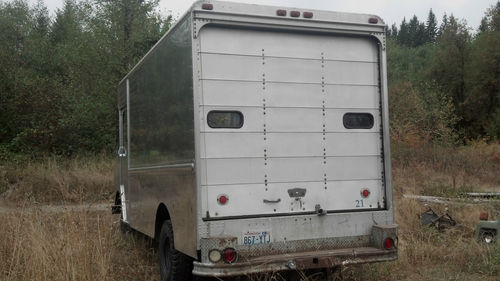
Mobile Lab: 1973 Grumman Olson Kurbmaster
I love almost anything stainless steel. It's such a interesting texture, and it looks good in many applications.
Take this delivery truck, for example. Ordinarily something not very interesting, (although old trucks are rarer). But in stainless steel, it sticks out like a sore thumb, gleaming from the rows of ebay listings like a diamond to my eyes. I'm suddenly plunged into a dark nighttime underworld of Deloreans, secret meetings in mall parking lots, black market chemicals, neon light in rain. I love how the ad says "want attention?", and yet I've just come up with the most illicit possible uses for it.
It also looks like one of the vehicles the Terminator would hijack, then smash through a wall and drive off a bridge or something.
The seller, thankfully, imagines it being used in just about every other nature: ice cream truck, motorhome, storage hauler. They say the previous owner told them the 3-speed automatic transmission was rebuilt. Under the hood is a 304 International 8-cylinder engine.
Mechanically, they say it runs and drives great. They list the mileage as 82,380.
Cosmetically, they say the seats have tears and it has normal wear expected for a work truck.
They do say the stainless steel exterior is factory-built, however, and have never been painted.
This could be really cool as a show van for a hi-tech company or as a transporter for a Delorean (if it can fit in the back). Or as a command center for the apocalypse.
Find this cool beast here on ebay in Battle Ground, Washington with a buy it now of $10,000.
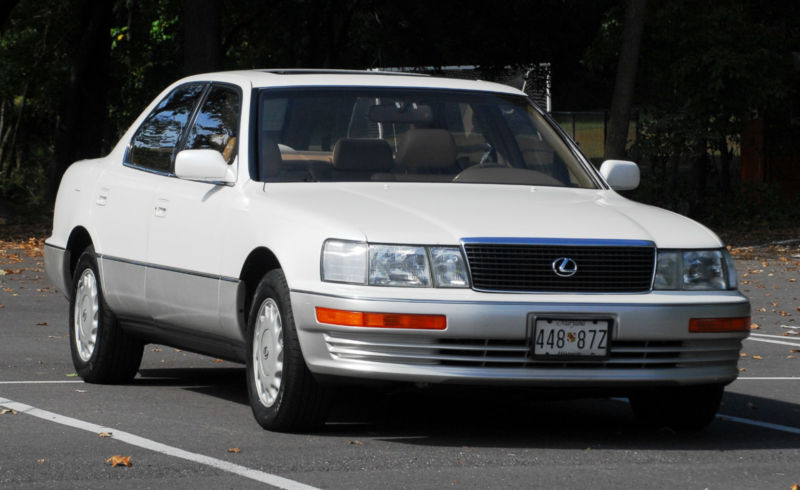
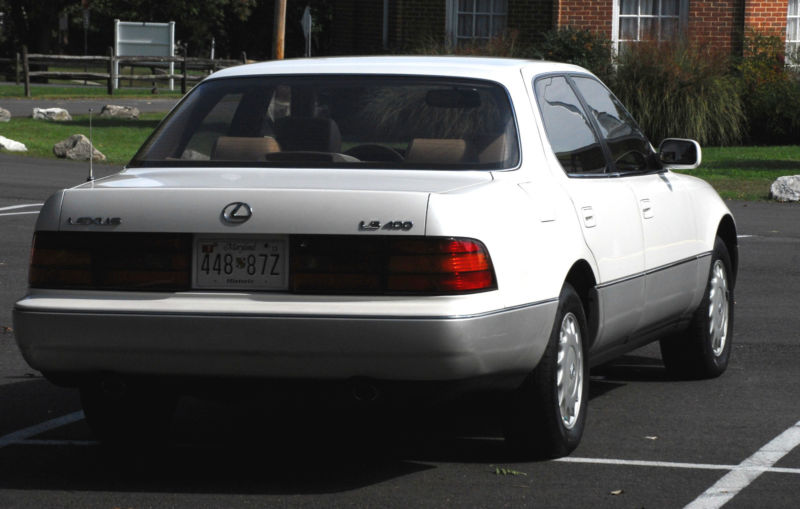
Clean 90k-mile 1991 Lexus LS400
The LS400 was the first Lexus ever made.
Japanese auto manufacturers were rising stars in the 1980s. They had already demonstrated a mastery of compact economy cars. By the middle of the decade, they decided to conquer the luxury car segment too.
Toyota created Lexus with that exact intention. Although Honda had them beat by launching similar-minded Acura in 1986, early Acura cars too closely resembled their Honda siblings and shared their front-wheel drive platforms and small engines. Lexus, on the other hand, was a clear departure from anything Toyota was offering at the time. Supposedly, Toyota sent an undercover research team to live in Laguna Beach, California and observe the lifestyles of wealthy Americans (one can imagine this also becoming rather comedic). The results indicated a whole new brand was needed to launch a high-end sedan that could compete with the world's best. It would feature an unparalleled blend of luxury and technology.
Lexus debuted the LS400 at the January 1989 North American International Auto Show in Detroit and it went on sale later that September as a 1990 model. It was an immediate success.
The "400" stood for an all-new 4.0 liter 32-valve V8 engine, capable of 250 horsepower and 260 ft·lbf of torque powering the rear wheels. This thing was a fast and silky smooth performer. In a December 1989 Car and Driver luxury sedan road test, the Lexus LS400 won, and was the second fastest coming off the line to 60 mph in 8.6 seconds, behind just the Infiniti Q45. Compared with the BMW E32 and Mercedes W126, the LS 400 had a higher top speed of 160 mph, a lower drag coefficient, lower curb weight, and a quieter cabin with 58 decibels at 62 mph, all the while remarkably avoiding the U.S. Gas Guzzler Tax.
The LS400 also featured a host of new technologies, like automatic tilt-and-telescoping steering wheel with SRS airbag, power adjustable shoulder seat belts, electrochromic rear-view mirror, fluid-damped cabin fixtures, vibration-insulating rubber mounts, airflow fairings, and sandwich steel body panels.
Styling is extremely derivative, but nonetheless successful. The key is simplicity, utilizing straight lines and gently sloping forms. No shape is odd or offensive. Everything pleases. Lexus took cues from all the existing luxury cars of the time and blended them together very well. Although their cars still have no core theme today (as many Asian automakers suffer from), the original LS is something of a design classic now because it smoothed out the harsh chiseled creases of the German and Italian sedans at the time. It was a "kinder, gentler" luxury sedan for the "kinder, gentler" 1990s (yeah, right).
Lexus did all of these amazing things while not forgetting two of the most important aspects of cars, particularly high-end vehicles: cost and quality. With an initial base price of around $35,000, the LS400 was also the least expensive offering in its segment at the time, costing an astonishing $23k less than the comparable Mercedes W126-chassis 420SEL at $61,210. Lexus were also built extremely well. In 2007 the LS400 made a Consumer Reports list of recommended vehicles that regularly last 200,000 miles or more with proper maintenance.
By 1990, the LS400 was outselling Mercedes, BMW and Jaguar. Over 165,000 first-generation units were made. Lexus had won, and, more importantly, the consumer won too. Free market competition drove quality up and prices down.
Since so many were made and they were so reliable, a lot of them are still on the road today, but in varying condition. The seller of this example says they acquired it with only 70,000 miles on it and have since put on an additional 20,000, using it as it was intended: a comfortable and dependable daily driver.
Cosmetically, they say the paint is clean but does have a few chips and a scratch. They say the interior is fine but the seats show some typical wear.
Mechanically, they say they added new front brakes and a new A/C hose. They say the antenna doesn't rise but it still relieves radio waves, and the overdrive light comes on and off, but the transmission and overdrive work fine. Overall, they say everything they know of works. They list the current mileage as 90,652.
This could be a chance to acquire a quality vehicle with relatively low miles at a decent price.
Find it here on ebay in Catonsville, Maryland with a Buy-It-Now of $5,999. The seller has 100% positive feedback.
What Is It: 1979 Aztec 7
Looking like a reptilian with embedded louvers comes this fantastic late 70s kit car called an "Aztec 7".
Kit cars run the gamut. Ugly, bizarre, beautiful, ingenious, you name it. I don't know when the kit fad started but it seems to have been popular in the 70s and 80s...perhaps with mainstream vehicles (at least American cars) looking so dreadful from that time period, there was a market for these things, people hungry for wild designs and looking for a project to get their hands dirty.
I think the best kit cars offers cool designs the public isn't normally allowed to consume, coupled with cheap parts and fast engines.
This thing might fit that bill.
The seller is, unfortunately, not the original builder, but they clearly have an appreciation for this vehicle. They state that their research has indicated only about 400 were built, and most were on VW chassis. The say the builder of this example went all out, with a custom boxed frame and rear-mounted Chevy 350 V8 and four-wheel disc brakes. With the huge rear engine powering the rear wheels, this thing is in Pantera territory, and has got to be entertaining to drive.
Styling is evocative of the performance the statistics suggest. A lot of kit cars played up the fantasy of the stereotypical exotic car of the 1970s, which was essentially inspired by Gandini's groundbreaking 1968 Alfa Romeo Bera. After that, for nearly two decades, the "wedge" was the definitive shape for supercars. I don't blame designers for replicating it so many times: it is perhaps the ultimate junction of form and function, as the rear-engine design allows for the severely tapered nose, which in turn lets air glide smoothly over the car. Although this Aztec also has bears some supercar cliches like gullwing doors, louvers, and hidden headlights, they all work well and are just charming by now.
Mechanically, the seller says the vehicle has been in storage since and is honest about it not being road ready. They did start it up, but recommend a thorough inspection.
Cosmetically, they say the paint and chrome are ok, but with a little attention could be presentable.
I for one would replace all gross fake wood in the interior with carbon fiber inserts. The car is too futuristic to have a dated interior.
Find it here on ebay in Elkhorn, Wisconsin with 16 bids at $3,050.
Post-Soviet: 2001 Lada 110 1.5 GLI
One of the things that happened after the fall of the Iron Curtain and collapse of the USSR was the opening of trade, technology and information between East and West. This included automobile culture. Of course, since the Russians have historically made pretty poor cars (by Western standards) it was basically a one way relationship. But without Gorbachev, we would probably never have access to this charming little Lada built exactly one decade after the USSR bit the dust. So how far they have come?
Lada have been making cars since 1970. They exported a lot of vehicles, though never officially to the United States (for obvious reasons - but can you imagine a Cold War comedy about a Russian car dealer in the U.S.? Bugged cars, suspicious neighbors, jokes about drinking vodka while driving).
They have had close relationships with Fiat, and more recently, Renault.
The 110 was produced from 1995 until 2010, quite a run for this little thing. It's a typical compact economy car, with 1.6-litre four banger pumping out just 90 horsepower that powers the front wheels. Weight came in at 2315 lbs. These are not innovative, special, or sophisticated in any manner, but rather standard transportation from point A to B.
Styling, however, isn't half bad. The tires are too small, but it looks decent in silver and is relatively simple and clean. I like the rear taillights. From what I've seen of Russian car designs, they range from hideous to passable. This moves beyond years of poor and anti-asthetic styling towards a global city-car-look, acceptable in any of Europe's capital cities as a frugal commuter machine.
What is most interesting is to find one right here in the good ol' USA. Unfortunately, the seller is one of those people who writes in all-caps, and says things like "it's in great shape for Russian standards" and "you get more noticed in this car than in a Ferrari". They also drop the worst bomb possible when considering with a foreign car not exempt from the U.S. gov.'s current 25 year or older vehicle importation rule: this Lada has no title and cannot be registered! Yikes. They say it can be used with dealer plates only and must be taken on a trailer to "shows". What kind of show would that be? Illegal cars currently here somehow? As frustrating as the ad is, it's somehow perfectly fitting of a Russian car made in 2001...a creaky country emerging awkwardly into a new world.
Find it here on ebay in Arlington, Massachusetts with 1 bid at $3,500.
Original Paint: 1971 Alfa Romeo GT 1300 Junior Zagato
The GT 1300 Junior was designed by Ercole Spada (later of BMW) then working under famed Italian design house Zagato. It features some of his trademark styling cues: a large rear with some overhang to force air down for increased control and a small, forward-leaning snout with quad round headlights. Spada is a genius and the 1300 Junior was another fine peice on his resume.
It debuted at the Turin Motor Show in 1969. Only 1,108 units were ever made, and they were never officially imported and sold here.
The floorplan, driveline and suspension were borrowed from the 1300 Spider.
A 1.3-litre four-cylinder engine powered the rear wheels.
In 1972, the 1600 Zagato came out with slightly different bodywork and a larger engine.
This survivor wears one California blue plate and what the seller says is the original coat of paint, although they mention it is cracking. However, they say the floors and jacking points are all solid and rust free.
They mention the center console has been swapped for a Berlina unit, but the original piece is included.
Mechanically, they say it has a 2.0-litre engine in place of the 1.3-litre, but the original engine is available and also numbers-matching.
Zagato cars are special and collectible because they are often limited production and wear finely designed and crafted bodies. This is an opportunity to acquire one such vehicle, with a larger engine already switched in to also make it a fun driver.
Find it here on ebay with no bids starting at $28,500.
Der Camino: 1978 Mercedes-Benz 450 SEL Custom
What if Mercedes decided to make a two-door pickup based on the body of the W116 chassis sedan? They didn't, but someone else thought they should have. So they created this wild custom car in the style of a Chevrolet El Camino.
The seller says $75,000 was spent making this dream come true. Based on the model name, I'm assuming they used a standard 450SEL long-wheelbase sedan, a good place to start. The extra length means more bed space, and the 4.5-litre V8 engine means plenty of power and torque to help haul or pull.
The body has undergone a radical transformation. The rear passenger seats and doors have been completely obliterated in favor of a small two-seat only cabin. The rear bed is enormous, but not too deep. It also features a sleek toneau cover that limits cargo height but looks really cool. The slim Euro bumpers and single-unit headlights combined with the black exterior and interior give this a no-nonsense, utilitarian look. The Germans love frugality, practicality, and functionality, so the concept of this Benz is actually quite fitting of the brand, at least where they were in the 1970s. I could see it being sold alongside the Geländewagen for use on farms in the European countryside. It would also be cool with a turbo diesel engine.
In keeping with superior build quality of Mercedes vehicles at the time of the original build date, the seller says the custom bodywork was professionally done and features "impeccable workmanship" with no visible seams.
The vehicle also has a moonroof, custom wheels (that look to be genuine OEM G-Class alloys), new tires, dual exhaust, and a carpeted bed.
Personally, I think this thing is awesome. The seller claims it is one of a kind, and it probably is. There can't be many people with the talent or skill to pull this off, but the idea was good and the execution seems mostly pretty successful. Job well done.
Find it here on ebay in Volo, Illinois with 1 bid at $14,500 and reserve not met.
Subscribe to:
Posts (Atom)