Happy Anniversary, 007: 1988 Aston Martin V8 Zagato
James Bond is celebrating 50 years of cinematic existence since his 1962 debut in Dr. No and COTC is marking the occasion by spotlighting this unusual and rare Aston Martin Zagato.
Zagato has a long history with Aston Martin and Aston Martin has a long history with James Bond. But Aston was in trouble by the 1980s, as was Bond. Timothy Dalton did a great job in The Living Daylights, but by License to Kill and the fall of the U.S.S.R. the series was running out of steam. Aston Martin meanwhile, was struggling to provide a reliable and respectable supercar (or sedan for that matter, after the Lagonda debacle) to compete with the best.
So in 1986, they asked Zagato to re-body their aging V8 Vantage to reinvigorate the lineup and drum up some press coverage. The Italian coachbuilder had always been at the forefront of automotive design, celebrating and influencing trends of the moment throughout their decades of design experience.
Zagato delivered the goods, erasing the existing sheet metal in favor of a radical redesign that seems to be auditioning for the set of Blade Runner. Zagato immerses themselves in themes of the 1980s while still retaining a core Aston Martin identity. Especially brilliant is the 8-bit Tetris front end arrangement, where the rectangular headlights, turn indicators and fog lamps neatly abutt a reduced, simpliflied and modern interpretation of the Aston grille. The glass-to-glass canopy and side windows-within-a-window doubtless inspired Giugiaro's Subaru SVX.
This particular example looks perfect in Javelin Grey metallic over black leather interior. The seller says it has low miles and all service records. Although it made a splash at the 1986 Geneva motor show, with a flood of orders immediately taken, only 52 were built, and so they remain highly collectible and desirable today.
James Bond might never have driven this particular model, but it would have suited him just fine.
Available here on Car and Classic UK.
1977 Pinzgauer 712K 6x6
This Pinzgauer was a former Radio Communications Vehicle for the Austrian military and is now available in California after a rare factory rebuild to make it even more formidable.
Pinzgauer is one of the few off-road trucks that can rival the Unimog by Mercedes. These are every bit as imposing, capable and stylish in a very rugged way.
Steyr Puch laucnhed the Pinzgauer in 1971 as the standard issue military mobile for armies all over Europe, and production by them lasted remarkably until 2000. These were extremely capable on and off-road, towing up to 11,000 lbs and drivable for 249 miles on one fuel tank. The central tube chassis has a transaxle to keep the weight distribution even and center of gravity low. Portal axles provide extra clearance over ground obstacles.
We usually see these in 4x4 only, so the six wheel version is incredible, and this one looks especially awe-inspiring. The flat military green is perfect, as are the the black centered wheels. The lack of any military text or decals hint at civilian ownership. Nothing is out of place or overdone.
The closed top full back gives endless possibilities, but this one is so cool and clean it could just be kept as-is. The exterior color nicely flows inside with stacks of storage drawers and compartments.
Underneath the hood is a 2.5-liter air-cooled 4-cylinder engine. While not fast, it was simple, easy to fix and extremely durable.
As part of the 1998 restoration in Graz, the seller gives a huge list of important upgrades and imporvements and says that only about 9k mi have been driven since.
Honestly, if you're in the market for a Pinzgauer, I doubt anything else out there is quite like this one. The seller does mention it is not driveable by law in California, but should be transferable elsewhere.
Available here on ebay in Vallejo, California with bidding starting at $44k.
1968 Iso Rivolta IR 300 Project
Iso was a short-lived Italian automaker. They were kind of like DeTomaso, except on steroids. They do have one utterly timeless vehicle under the belts: the 1953 Isetta microcar. But in the 1960s, they turned to making cars that rivaled Fiat and Maserati more than anything else.
The IR 300 was produced from 1962-1970. The seller of this example says it was built in 1963, but titled in 1968, and is the 51st example built.
Styling is classic 1960s gran turismo, with a forward leaning front, round headlights, hood scoop, large greenhouse glass, and squared off rear with subtle taillights. The chrome, wheels and Michelin tires all look good.
The seller says this example has been in Dallas and owned by the same person for the last 30 years.
Cosmetically, there are quite a few flaws, most noticeably the edge of the front hood. Inside, the carpeting is stripped and the front floors seem to have some repair done. The seller says the rear floors are "a little weak".
Mechanically, they have swapped in a 350 Chevrolet engine in place of the 327, but say the original is included in the sale. They do say the new engine was rebuilt and is running and driving. They also added rack and pinion steering.
This IR 300 was intended to be a sleek, comfortable and powerful long-distance cruiser. It really only works if it's in showroom shape. The cosmetic flaws will need to be addressed, along with some mechanical sorting. But it seems like a lot of the work is done, and it's not too far from completion. The seller adds it has a clear Texas title ready to go.
Available here on ebay in Dallas, Texas with 5 bids at $14,300 but reserve not met.
Clean 1986 Honda Civic Wagon AWD 5-Speed
There was once a time when automakers thought nothing of offering all-wheel drive on even their compact vehicles. Today, if you want AWD they make it a big costly deal. It's only available on heavy mid-size and up cars, loaded with options. These cars are expensive, complicated, and gas guzzling. After all, someone that wants something as simple and safe as extra traction in inclement weather must also have a bunch of extra cash for all the bells and whistles, right? I'm being sarcastic of course. One of the few automakers that still "gets" this is Subaru, whose Impreza is still a relatively small and affordable entry-level car with AWD. But in the late 80s and early 90s, other automakers like Toyota and Honda were doing this too.
Honda decided to offer AWD on their compact third generation 1984-1987 Civic Wagon. These puppies are just too good to be true. Notice how Honda - or any other automaker for that matter - no longer offers this versatile body, with minimal sheet metal to keep costs down for the manufacturer and consumer, large and high greenhouse region for maximum interior comfort and visibility in and out.
The AWD system was introduced on the Civic in 1985 and was part-time, any-speed and activated by pushing a button on the dashboard. Giving the driver discretion was extremely practical, as bad weather is not a constant variable. It also allowed for better fuel economy because when the system was off the engine only had to work the front wheels.
Japanese designers are used to crafting cars for small spaces in Tokyo, and their gift for compact dimensions glows in this Civic. Every angle is hard, with no organic shapes. It's the textbook definition of form over function. Note the unpainted plastic bumpers that give it an ultra-utilitarian look that is also quite practical as it deflects chips, dirt, scrapes and grime in spots that encounter it most. This one looks especially crisp and attractive in light blue. I also love the mudflaps.
Under the hood is a four cylinder engine. This one is mated to a rare 5-speed manual transmission for a more involved driving experience.
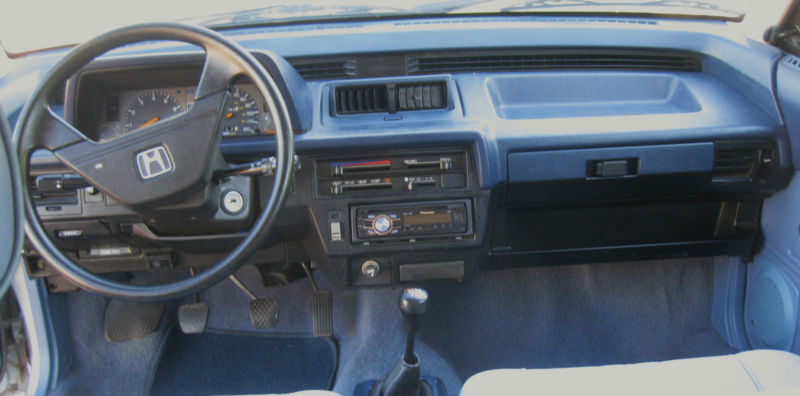
Inside the skeletel interior is even more functional.
This example is claimed as being in California since new, proudly wearing its blue plates. The seller says it has been well maintained and mostly garaged, with original paint, no accidents, no major dings and a clear title. They do say it has some small surface rust spots however.
Mechanically, it has a new clutch, tires, brakes, belt and water pump. The seller says it's running well, although there is some axle noise.
These were often bought in regions with bad climates so most have all bust rusted into the ground. It's refreshing to find a clean and mostly spotless survivor of this great little vehicle. There really isn't anything like it being offered today.
Available here on ebay in Fremont, California with 14 bids at $1,225.
1959 Goliath Express 1100
This is one of those rare car classifieds where the seller offers some context to flesh out the full story of the vehicle. The seller of this Goliath says it made the car blog rounds before they bought it this summer. They say it was advertised as a "museum quality" and in running condition, but it was actually much different.
Fortunately the seller had enough admiration for the vehicle that they devoted themselves to getting it running again. They say it now runs well and is up for grabs again.
Goliath was part of the larger Borgward German automaker group before both folded in 1961. They specialized in small three-wheel trucks, but also made passenger cars and larger trucks. The 1100 was intended to distinguish them from their smaller trucks, and was later sold under the name Hansa.
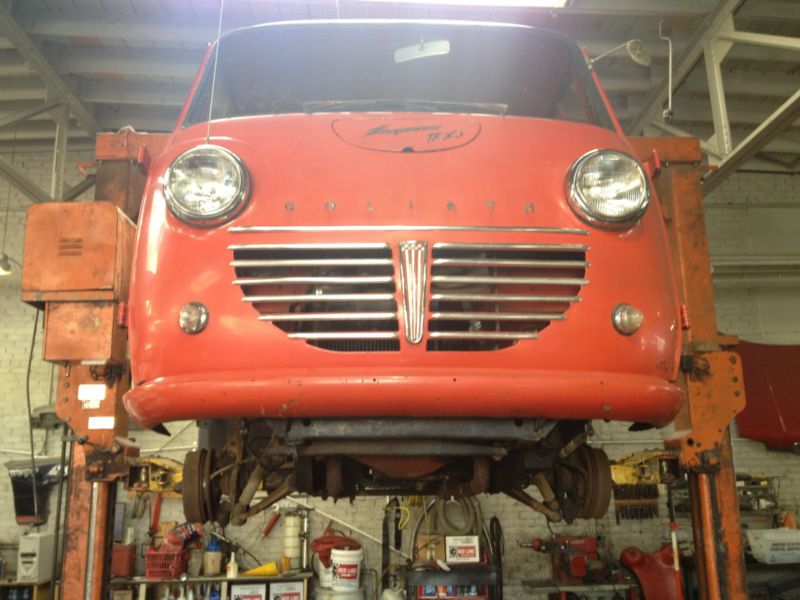
Underneath the charming red paint and wood bed is a flat four-cylinder four-stroke water-cooled engine powering the front-wheels. The rear-axle is solid drop-forged 1-ton steel, and it features low gears for hauling heavy freight.
Cosmetically, the seller does say it needs TLC, although with no major visible flaws the existing patina could pass. Mechanically, they cleaned the carburetors, added brake fluid, reseated valve covers, gaskets and seals and rebuilt the fuel tank. They say they got help and support from Goliath fans along the way.
The seller estimates this is just 1 of 3 Goliath trucks in North America.
If you saw this before and wanted it, here's another chance to have it better sorted.
Available here on ebay in Salt Lake City, Utah with a Buy-It-Now of $15,000 and the Make Offer option.
12 Cylinders for Under $10k: 1991 BMW 850i
I love the E31 8-series.
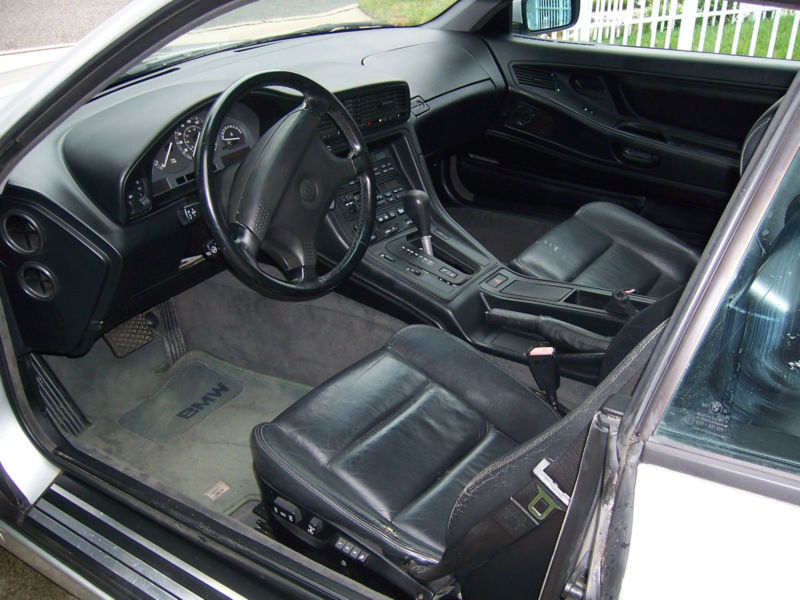
It debuted at the Frankfurt Motor Show in 1989. The E31 did not replace the E24 6-series but heralded a whole new class of grand tourer for BMW. Over 1.5 billion Deutschmark was spent developing the car, and as a result a host of new technology debuted on it. It was the first road car to have a V12 engine mated to a 6-speed manual transmission, among the first cars to have an electronic "fly-by-wire" electronic throttle, and one of the first BMW (along with the Z1) to use a multi-link suspension. The low beams, high beams and foglamps were all integrated together in the pop-up headlights. Inside was a seat-integrated retaining system.
Covering all the mechanical wizardry was a totally new CAD-drafted body with a remarkably low drag coefficient of 0.29. Working closely under legendary chief Claus Luthe, the design is credited to newcomer Klaus Kapitza and is the only production BMW to bear his mark. He helped develop and patent some alloy wheels and a rollbar but that was it before moving to Porsche.
But what a mark it is! The E31 manages to take all the best elements of several BMW cars leading up to it. The slim nose, hidden headlights and slim horizontal turn indicator recall the M1. The chiseled rear and broad taillights are directly inspired by the E32 and E34 of the same era. The whole thing is sleek and cool the way nothing else is. It was also very influential. The rectangular side mirrors were used on every BMW after until the early 2000s. Inside, the a/c vents housed close to the instrument cluster probably inspired the E36 dashboard.
Initial cars were offered with just the 5.0-liter 498cc V12 engine that produced 295 horsepower to the rear-wheels. Along with the E32 750i/iL, BMW beat Mercedes-Benz in the race to a V12 in German sedans and coupes. In 1994, the same 8-cylinder used in the E32 740i/iL and E34 540i was offered. It had a similar power band as the V12, but was affected by the Nikiasil fiasco.
At the time, BMW was still more synonymous with "luxury" than "sport" in the US, and combined with our preferences and skill level, meant that Most E31 that came to the U.S. were equipped with automatic transmissions. This critically hurt their collector and resale value. And as groundbreaking as the V12 engine seemed, it was eventually proven too good to be true; as in over-engineered, and extremely expensive to maintain and fix. Values on them plummeted and as far as I can tell are still falling, despite only 7,232 being sold here over seven years. Still, it's a modern classic in the making.
These run the gamut in condition now. Maintenance records are a must, and as few owners as possible. Check for rust and accidents (usually speed related). Other than that, get in and zip off. The seller of this example say it has 126k miles.
Available here on ebay in Trenton, New Jersey with 13 bids at $3,177.51 and a Buy-It-Now of $7,500.
Winter Proof: 1987 Mercedes-Benz Unimog Snow Blower
I can't resist. Here is another Unimog within the span of a week. This one will make sure you never, ever get stuck in snow, or any inclement weather for that matter.
The Unimog is perhaps the ultimate 4x4 vehicle. As far as I can tell, there has never been a purely civilian version offered. They were initially military vehicles. The ones that pop up for resale are usually decommissioned civil service vehicles. They were never officially sold here until 2002, when Daimler Chrysler attempted sales of the U500 variant for only 5 years, resulting in just 184 units sold.
This is a 1987 U-1500, based off the 1976-88 424 series. These featured more angular styling than the beloved 406 series. The "classic" 406-style was categorized as a "light" truck, while the new 424 became "middle" and "heavy".
The seller of this example says it is a Class 6 vehicle, weighing between 19,000-26,000 lbs. The seller says is is powered by twin diesel engines. It's mated to no less than 8 forward and reverse gears. Attached to the truck is a Sicard Snow Blower that is powered by a twin-turbocharged 12-cylinder OA424A engine.
Cosmetically, this thing is a beacon of hope in the desolate winter landscape with bright orange paint and black accents. When the Unimog is used for military and civil work for the German government, they are aesthetically pleasing in a level of detail only the Germans can master. This one comes close, but could use some more details. I'd paint the rear bumper guard in yellow and red diagonal hazard stripes.
It is not clear whether this example was used for a public or private entity.
If you own large commercial space or a farm in areas that get dense snowfall, this could be a nifty tool all winter long.
Available here on ebay in Stanley, South Dakota with bidding and a Buy-It-Now of $33.9k.
RHD Conversion 1995 Subaru Impreza STI Turbo
This is the first generation Impreza, launched in 1992. It set the bar for compact economy cars, but with typical Subaru twists. These were definitely a step above the Honda Civic and Ford Escort.
The Impreza was offered in either front-wheel or all-wheel drive layouts. The AWD version was the one you wanted, though.
Styling is classic 1990s Japanese. Gone are the hard edges and layers of detail on their 1980s designs, and in are smooth edges, bubbly corners, flat planes and round lines. In basic trim they were very generic looking, but in higher trim with some larger wheels and bottom skirts, they started to look a little more edgy.
North America never received the coveted high-performance WRX version of the first-generation Impreza. In 1994, the STI (Subaru Tecnica International) version was launched in Japan only, improving on the WRX. The turbocharged engines, transmissions and suspensions were specially tuned. These were very successful as rally cars and street racers.
This is not an authentic STI from Japan as a decode reveals (VIN# JF1GC2359SG516379). The seller has instead done an incredible conversion to right-hand drive and STI specifications. Although at first counter-intuitive, the effort involved and apparent success is impressive. The seller says they did a complete conversion with all JDM wiring and computer work. No cost is mentioned, but it couldn't have been cheap.
Under the hood is an engine swap to an STI-correct Version 4 2.0-liter turbocharged 4-cylinder engine powering all four wheels and mated to a close-ratio 5-speed manual transmission. The seller says the odometer reads 63k, but the swap equipment have 61k on it.
Cosmetically, the car is missing side molding and has a bunch of scrapes.
But if you want something fast, grippy and unique, few other cars will fit the bill as this does.
Available here on ebay in Chandler, Arizona for a Buy-It-Now of $9,800 and the Make Offer option.
No Reserve Pre-War 1923 Renault KJ Roadster
This boat tail Renault was made before WWII. Renault was founded in 1899 and is one of France's major automakers.
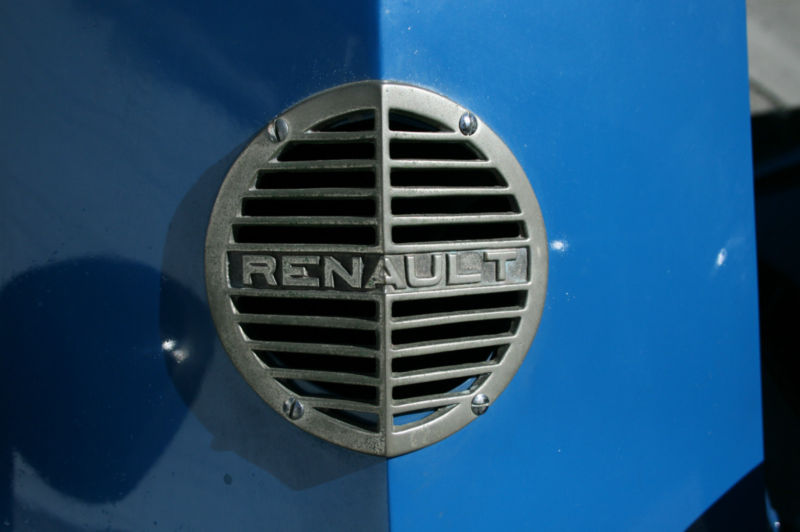
Pre-war cars featured the radiator behind the engine, hence the sloped nose and side vents. It was not until 1930 that radiators were moved to the front.
The 1920s were a time of economic prosperity and Renault produced a bunch of vehicles at the time. While closed cars were the most luxurious and costly, roadsters like this were the cheapest.
The seller says this example is motivated by a 4-cylinder engine mated to a 3-speed manual transmission. Mechanically, they say it has a rebuilt motor and carburator.
Cosmetically, it looks stunning in flat true blue which black wheel arches and running boards. I especially love the aerodynamic full-faced wheels.
The seller says it had no rust or rot, 1000 original miles (impossible to verify but ok), and a clear CA title.
This is a lovely car. If you're into pre-war, check it out.
Available here on ebay in Mission Hills, California with bidding at $7,600 and no reserve.
Threatened Species: 1976 Volkswagen Scirocco
Hagerty Classic Car Insurance released this fascinating but alarming list of cars once built in great numbers that they now insure very few of.
One of them is the first generation or Mark I Scirocco produced from 1974-1982. Hagerty says they insure fewer than 25 of them.
Well, I found one. This gives new meaning to the term 'survivor'.
The Scirocco was a front-engine, front-wheel drive two-door hatchback with four-cylinder engines.
Perhaps the most notable feature was the lovely styling by Giugiaro from his heyday. It's typically well done, perfect proportions and still cool and fresh looking now. I especially love the quad round headlights which contrast nicely with the angular shape.
The seller says this surviving example has a 1.6-litre 4-cylinder engine, 82k miles, and a 4-speed manual transmission. The later teardrop wheels look good and although the seller says they are keeping them, they say they have the original alloys. Mechanically, the seller says the radiator is missing and the car does not currently run.
Cosmetically, the seller says there is no serious structural rust but there is rot in a few places. Inside, they say the interior is complete and original, but the seats are torn. Still, it's great to see those rare Euro-style plaid seats still with the car.
Unfortunately, the seller says they don't have a title. They say the Pennsylvania DOT lost the title during the last transfer of ownership, but the seller says they have the last registered owner's info. Honestly, if the seller doesn't have a title in their name and never registered the vehicle, they have no authority to sell it unless I'm mistaken. They say they are unsure of what to do, but I can say you'll definitely need a title if you want to ever have this legally on the road again.
This car doesn't run, has rot and no paperwork, which are usually things to avoid, but for the right price (as in under $1k) it could be a good start for a restoration. They aren't many left, after all.
Available here on ebay in Emmaus, Pennsylvania with 7 bids at $256.
Subscribe to:
Posts (Atom)